There are numerous articles and many research papers which argue for the focus of schooling to shift from high stakes testing to a greater development of social skills and enterprise skills for a changing world. One such article written by Bill Lucas in 2016 stated,
“Too often we focus too narrowly on literacy and numeracy when these are only the beginning. We become obsessed with school subjects rather than thinking more broadly about the capabilities which will be valuable in the real world.”
The importance of social skills and enterprise skills are reflected through the General Capabilities of the Australian Curriculum.The Australian Curriculum, Assessment and Reporting Authority (ACARA) requires schools to develop a number of capabilities in young people in addition to literacy and numeracy. These include
information and communication technology (ICT) capability,
intercultural understanding,
ethical understanding,
personal and social capability, and
critical and creative thinking.
Those capabilities, as ACARA states, “play a significant role in the Australian Curriculum in equipping young Australians to live and work successfully in the twenty-first century.”
We know that the social skill development and the enterprise skill development are foundational to the work of educators across early learning, primary and secondary schools. We also know that students with well developed social skills and enterprise skills are increasingly hopeful, resilient and engaged participants in their local and global communities. Such dispositions are credible leading indicators for life success as compared to the lagging indicators such as HSC, VCE, ATAR and NAPLAN test scores.
As part of establishing any new school, foundation staff are presented with a blank canvas to deeply consider ‘what matters’. Social skills and enterprise skills matter! One of the challenges we have taken on at St Luke’s is to ‘bring to prominence’ the social skills and enterprise skills students need for a changing world.
As such, at St Luke’s Catholic College, staff have engaged with a process which aligns the ACARA General Capabilities with our ‘6 Pillars’ of learning. These pillars are:
WITNESS by living the Good News as revealed through the Gospel of St Luke
MANAGE self
RELATE with others
COMMUNICATE and COLLABORATE with peers and experts
THINK CREATIVELY and CRITICALLY through deep and rigorous reflection
Be DIGITALLY LITERATE.
Each pillar
has a rationale with reference to the Australian Curriculum and explains its importance in our context
contains a number of elements from various General Capabilities, and
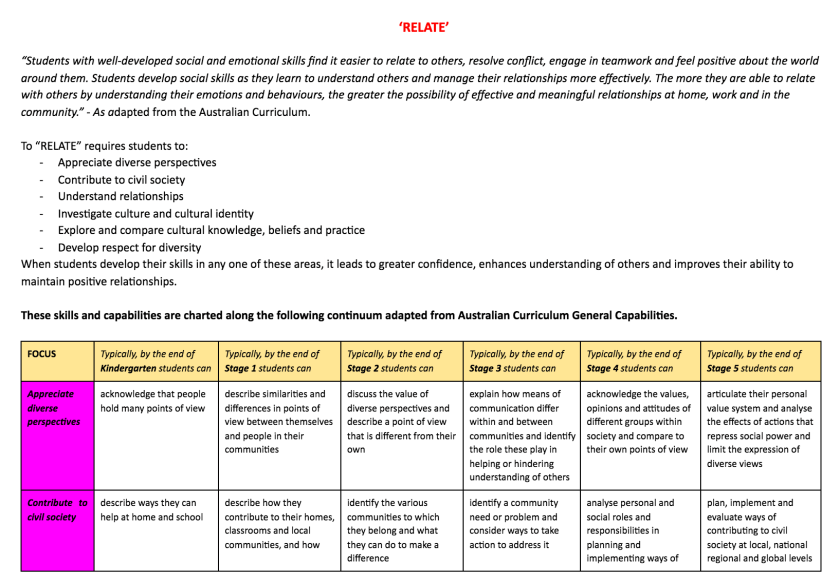
adopts the continuums from those elements to describe the relevant attitudes, behaviours, skills and dispositions relevant to each stage of learning.
Here is a sample…
Overall, the ‘6 Pillars’ assist teachers to plan for the development of social skills and enterprise skills as students engage with the curriculum. The ‘6 Pillars’ figure prominently when preparing and evaluating student learning and are priorities when we provide feedback to students. Furthermore, there is the commitment for students to increasingly self reflect and peer assess the ‘6 Pillars’, as well as provide real time feedback to parents about each child’s development along the ‘6 Pillar’ continua. This work will not be easy but it will be worthwhile!
As always, comments, feedback and questions are welcome.
As the principal of a new learning community establishing the new normal for pre to post schooling, I am obligated to collaboratively explore options for a flexible and differentiated curriculum which is authentically personalised through collaborative processes led, driven and developed by each student.
When in Melbourne last week, I visited three schools. Each school views students as as the drivers of their own learning, not having learning ‘done’ to them. One school in particular, Templestowe College, genuinely hands over ‘control’ to each student, and “everything is negotiable”. The automatic response to students when they negotiate their semester learning program is to say, “Yes, we can look at that.” This culture of trusting students to direct their own learning, along with an unwavering commitment to flexible timetables and diverse curriculum offerings, has resulted in students who, among other things:
serve as traditional staff employees including grounds personnel, teacher assistants and front office support staff, AND, they are paid!
train other students to deliver a reading preparation program for primary students
participate in the local community as professional musicians
market an online game to an overseas investor
tender for the provision of on site cafe services
engage in elite sporting programs
provide catering and hospitality services for local community events after a tendering process
organise business conferences using school facilities
establish business which sell products based on business proposals and marketing plans
establish animal breeding programs in liaison with relevant government authorities
use maker spaces, laser cutters and three D printers to design products that support emerging business ventures.
All these activities form part of a student’s ‘timetable’ and they are just the tip of the iceberg! The school offers an extremely varied curriculum with authentically rich individual learning pathways. Personalised learning is truly authentic! Individual learning pathways are developed by the student, inclusive of parents and signed off by the principal. This is done so in accordance with Clause 82 of the Victorian Curriculum Accreditation Authority. It reads as follows….
“If a school proposes for any student an individual learning program that departs from the provision model set out in the whole-school curriculum plan, that decision should be made in conjunction with the student and the student’s parents/carers, and must be approved by the school principal” –Victoria Curriculum December 2015
The principal has cleverly interpreted that each student is entitled to determine their own individual learning program. I am wondering if there is a similar clause in NSW. For example, although it applies for students with disabilities, is thecollaborative curriculum planning process for students a ‘way in’ for each and every student to develop their own personalised learning pathway? One part that jumps out at me is……..
“The decision should be made through the collaborative curriculum planning process involving the student, parent/carer and other significant individuals. School systems and individual schools are responsible for the manner in which the collaborative process is managed.”
In accepting that no two learners are the same, is the collaborative curriculum planning process a ‘way in’ for personalised learning to become a reality for each and every student in New South Wales?
As a part of my recent work I have visited a number of schools. Among many things, I have enjoyed listening to students confidently articulate “where I am with my learning” and “where to next”. With regards to reading, written expression and other core skills of listening and speaking, students know precisely their capabilities. They are also acutely aware of their ability to use other core skills, for example, graphing in Mathematics, mapping in Geography and, of course, their ability to use apps to demonstrate their learning. However, as good as they can articulate their strengths and areas for further development, they are less sure of “where they are at” and “where to next” as a collaborator, creator, thinker, team player or problem solver.
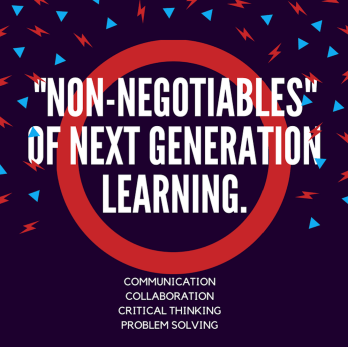
A key indicator of when next generation learning has arrived will be when students can self-assess, peer assess, record and report about the ‘non-negotiables’; those ’21st century skills’, often called ‘soft skills’, that are now undeniably required for students to be happy people and successful workers enjoying their vocation based around their passion. On a side note, I don’t think there is anything “soft” about the perseverance and effort required, for example, to be a critical thinker and problem solver as part of a group of individuals all of whom possess different abilities and interests.
Don’t get me wrong, as I have already stated, I am impressed with how students articulate their learning. I am also encouraged by leaders in schools who ensure there are references to skills such as creativity, collaboration, communication and team work as a part of their formal assessment and reporting. However, it is not yet mainstream for schools to assess and report (I would rather the words “observe and feedback”) to parents about the ‘non-negotiables’.
Next generation learning leaders will engage with parents (some are already) about the importance of the ‘non-negotiables’. The better leaders will do this so convincingly that parents will no longer ask, “Where is my child placed?”, “What mark did they get?” or “How many grades did they jump?” In fact, a success indicator of next generation learning is the day when parents more often ask….
Last week I attended a professional learning day where I was introduced to Code Club Australia, a network of coding clubs for Aussie Kids aged 9 – 11 which uses Scratch. Ian Wedlock facilitated the day and I was impressed with his calm but assured belief in the learning benefits associated with coding. As part of his presentation he:
Asked participants to “think origami – follow sequential instructions and be precise.”
Introduced us to Rube Goldberg machines which “require all the coding skills without the technology”.
Whilst sharing these and other resources, Ian confirmed that coding, in particular Scratch, allows students to program interactive stories, games and animations which requires them to think creatively, reason systematically and work collaboratively; all important 21st century skills.
The discourse around coding in schools is, in part, prompted by predictions that 40 to 55% of current jobs will be made redundant by technology within the next 10 years. In a world where robots could be performing one third of U.S. surgeries by 2021 and where a robot arm builds a house in just two days, future jobs will increasingly require employees to create and program those robots. Coding is a good starting point for that to be a possibility for a significant number of our young people.
Matt Resnick articulates the benefits of coding for young people in Let’s Teach Kids to Code (16 mins). With reference to Scratch he outlines the benefits of coding for young people code so they can do more than just use new tech toys; they can also create them. However, what resonates with me the most are the analogies Resnick makes with reading and writing.
Firstly, he points out that it is useful for everyone to read and write, and whilst these skills will be useful in almost everything not everyone will become a professional writer or resident book reviewer. And so it is with coding. When people learn to code they simplify complex ideas, collaborate, fix things and persevere in the face of frustration, that’s called resilience! Such skills and dispositions will be transferrable to almost all aspects of future work.
And secondly, Resnick reminds the viewer that the actions of browsing, chatting, texting and gaming do not make young people digitally fluent. For those who can use technology applications to ‘create’, they are digitally fluent. However, for those who cannot, “It is almost as if they can read but not write with new technologies.”
As I tweeted during the day with Ian,
Maybe I got that a little wrong. So before publishing this blog, I tweeted….
Just last week the next iteration of a modernised HSC was released by the New South Wales government. Unfortunately, it appears to be ‘dressing up the old’. I wonder if those who managed the process…
(via @HealthyLDN as reposted by @nickya73 on Twitter, 26 July, 2016)
As part of the media promotions that come with such government announcements, it was promised the new HSC would be setting students up for success. New pathways for post school are required because the HSC is a lagging indicator of school success rather than a leading indicator for life success.
Executive Director of Catholic Education Diocese of Parramatta, Greg Whitby reflected that the new HSC was simply modernising educational relics and stated,
“The HSC reforms really are a missed opportunity to bring some coherence to educational policy and radically rethink how we assess the spectrum of students’ learning and skills.”
Greg also asked, “Where is the New Thinking?” Well, here are some thoughts….
Pre-school becomes part of the K-12 learning continuum by allowing resources, funding and structures to ‘cross the divide’ of those very definitive and separated entities. This may mean breaking with current regulations and, for example, actually paying early learning teachers the same as primary school teachers. It may also see ‘Junior Kindy’ and ‘Senior Kindy’ exist over two years so that Kindergarten is a stage rather than a year.
Observe and report on social and emotional outcomes for Kindergarten and Stage 1 students as often as literacy, numeracy and other KLA outcomes are assessed and reported. Oh heck, why not do this until students conclude Year 4?
Have leading indicators for life success, as discussed in data and questions, shape a data informed, strengths based coaching program for students in stages 3 to 6. Using various data sources, each student would identify their interests, abilities and passions and link them to vocations and jobs of the future. Maybe the 75 minutes per week of pastoral care time which exists in most secondary schools could be redirected towards this?
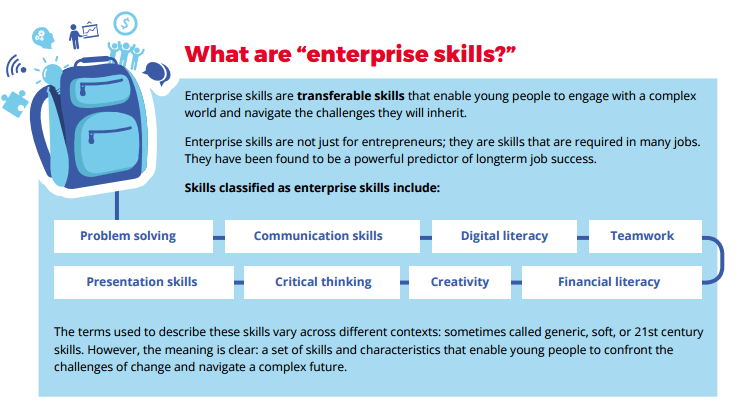
Develop an enterprise skills continuum, by delivering the ‘The New Basics‘ and embedding ‘enterprise rubrics’ into mainstream schooling. Those 8 skills as determined by fya.org.au (see picture below) could be observed and assessed through self assessment, peer feedback and teacher conversation rather than through the judgement of a test mark or grade. Wouldn’t it be great if assessing and reporting on these skills were as mainstream as outcomes based KLA assessment and reporting?
Lastly, have multiple school exit points of which the HSC is but just one exit. However, that’s a whole other conversation!
Of course, for each of the above suggestions (or others like them) something has to go. In an already packed curriculum serving the needs of a government economic agenda, there is not one more ‘priority’ which can be squeezed into the school day. Something, or some things have to go. I suggest the modernised HSC is one of them.
I welcome your feedback, comments and/or constructive criticism.
With more than 380,000 students aged 5 to 12 attending our of hours school care, and unmet demand for another 80 000 children as estimated by the the Australian Bureau of Statistics, the call for schools to offer services ‘above and beyond’ the normal school day continue to grow. For quite some time now, the rise of single parenting and working families has challenged the 1950s’ construct of the 9 to 3 school day. A few months back, Federal Minister for Education, Simon Bermingham, was quoted in The Australian as saying he was “open to longer school day”. In that same article, there are references to schools providing services beyond the traditional school day.
Across Australia, there are already a number of ‘services’ both ‘within’ and ‘outside’ the school day. These services are offered in the form of early learning centres, primary schools, secondary schools and K-12 learning communities.(I am uneasy with the term ‘services’, especially when linked to primary and secondary school; however, I use it for the purposes of this blog). Furthermore, and to complement these educational offerings there are out of school hour care centres.
As part of recent conversations with my work, I have become aware of the different regulations and requirements for school settings as distinct from early learning centres, as distinct from long day care providers, as distinct from out of school hour care centres. In recent times there has been great effort and noted success in raising the standard of early learning, reflective of its importance, as there has been with out of school hours care. Despite these successes, the various educational offerings act as separate entities and ‘bolt-ons’ rather than integrated services. There is great work being done within each educational entity; however, the reality is they are not integrated.
The idea of an extended school day responds to the needs of families to have children cared for in a way which supersedes the 1950’s school construct. We can challenge the idea of ‘what the school day looks like’ by providing an experience focused on learning which looks different and better for each student and family. However, how do we do this without providing more work for teachers and staff across all sectors? Another question might be, “How much more is the education sector expected to do?”
The conversation about an extended school day poses many questions. A third question, but with a more positive spin…..”Is there an opportunity to provide quality pre to post school learning with services connected in a way which acknowledges learning as a continuum and transcends the traditional boundaries of time and space?”
If we are to extend the school day, the answer is not more of the same with longer learning blocks as part longer days with more face to face for teachers. We need to be more creative than that! I suppose, my inquiry really is…..
…. In what ways can extending the school day provide integrated services which offer an all inclusive, learning focused approach to the school day?
There may be learning communities already doing this. If so, please let me know.
I look forward to feedback, questions and comments.
I recently spoke with Colin Klupiec from Learn Fast in my capacity as the newly appointed Principal Leader at St Luke’s, Marsden Park. Colin’s professionalism, deep knowledge of Australian education and strong desire for a ‘new paradigm for learning’, meant that I enjoyed our time discussing the future of education in Australia within the one local context of St Luke’s.
St Luke’s is a (soon to be established) ‘next generation’ learning community. As part of the conversation Colin and I discussed ways to blur the finish line of schooling. Currently, that finish line is when the vast majority of young people conclude their formal education at the end of Year 12, around mid-December each year. InNSW, the checkered flag waves frantically for 24 hours with the release of HSC results followed by the release of the ATAR* the next day.
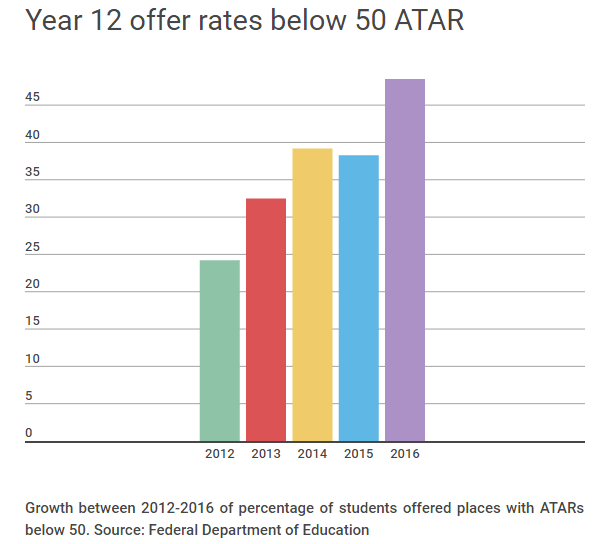
ATARs have increasingly become less meaningful as expressed in a recent article ‘Not in our national interest’: Universities slammed over ATAR leniency’ by Eryk Bagshaw. Universities have compromised tertiary entry standards in pursuit of growing enrolments. Increasing ATAR offer rates below 50 has been one of many approaches.
Whilst the number of university degrees is increasing, the value of a university degree is in decline. According to the Australian Institute of Health and Welfare, of bachelor degree graduates who were available for full-time employment in 2000, 83.6 per cent were in full-time employment within four months of completing their degrees in 1999. Since then, the trend has been….
in 2005, 80.9 per cent were in full-time employment within four months of completing their degrees.
in 2010, 76.2 per cent were in full-time employment within four months of completing their degrees.
In 2015, 68.8 per cent were in full-time employment within four months of completing their degrees.
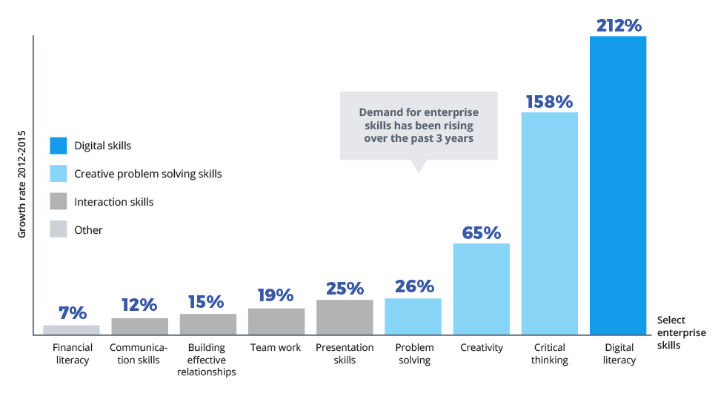
It may well be that there are now more university degrees for less jobs or it may be that employers are looking further afield than the traditional degrees as evidenced by FYA’s most recent report. Employers in Australia are increasingly advertising for people who exhibit the ‘New Basics’ of Digital Literacy, Critical Thinking, Creativity and Problem Solving.
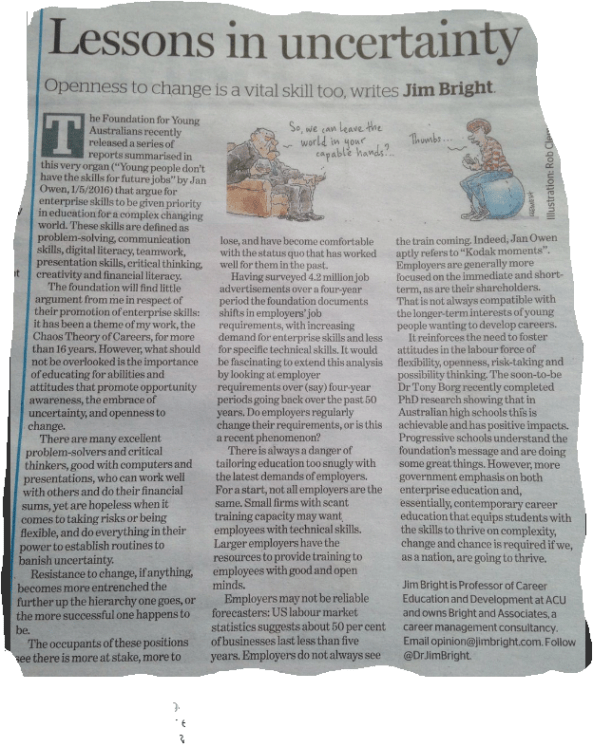
Reading between the lines of the report, and with reference to Jim Bright’s article below, it appears employers may be unsure of how HSC results or an ATAR number assists an employer to ascertain a prospective employee’s capability in these areas.
In the interests of best preparing our students for the future which awaits them, it is now time to look at more flexible post school pathways other than just the HSC and ATARs. These pathways would see students:
make links with industry by showing their work through their online presence, one which connects with experts across the world; OR,
create their own start up business in Year 8, 9 or 10 (possibly after many failed attempts) by asking them the question, “What problem do you want to solve?”; OR,
assisted by their wider learning community (not just school) to develop the skills for the surprising jobs of today.
I welcome your thoughts.
Greg
* The ATAR is The Australian Tertiary Admission Rank (ATAR) is the primary criterion for entry into most undergraduate-entry university programs in Australia. It was gradually introduced during 2009 and 2010 to replace the Universities Admission Index, Equivalent National Tertiary Entrance Rank and Tertiary Entrance Rank.
I am honoured to be asked to host @EduTweetOz for the week commencing Sunday 3 April. @EduTweetOz is a social media space on both Twitter and Facebook that sees a different Australian Educator hosting the account each week where they share their views and perspective on education. Hosting the account requires me to be quite active throughout the week with the aim of generating discussion.
The areas of focus for the week may centre around:
Ed. leadership for a digital age.
The best use of time.
Contemporary pedagogies.
Using technology to accelerate learning.
With regards technology and learning, there has been recent debate about the value of otherwise of technology for learning. Some schools have taken the step to ban or reduce days with laptops. I am a little unsure as to why when the devices themselves are not the technology, they are indeed a tool which offers the user to engage with applications which are relevant in this day and age.
It seems we are assessing the value of technology based on test scores from end of school exit examinations or NAPLAN learning growth. I cannot recall any educator making the claim that introducing laptops will result in better NAPLAN or HSC results. Until outcomes such as critical thinking, creativity, collaboration and global connection are valued as much as test scores, it is unfair to judge the value of devices and technology when addressing its impact for students.
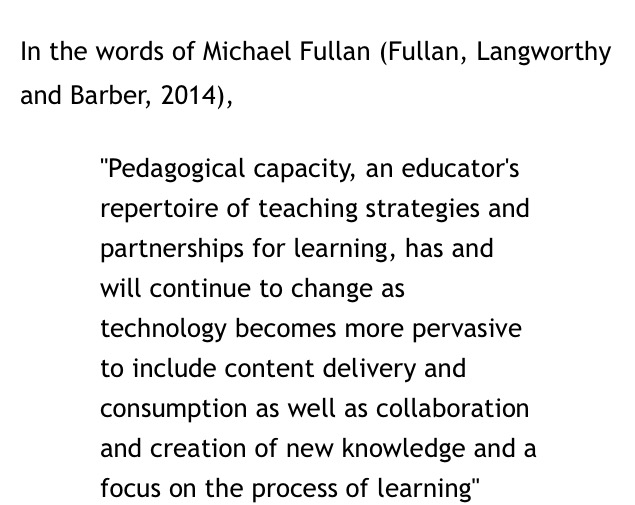
Generally, we are spending too much time focusing on the technology and not enough of the pedagogy. we need to clearly focus on what Fullan calls “Pedagogical Capacity” and the need for it to address the reality which comes with emerging technologies.
While there may be a focus on the areas mentioned above, I will also post ‘just in time’ items of interest as well as post a few posters collected from Twitter over the last twelve months or so. Furthermore, I may tend to ask questions than pretend I have the all the answers.
The WordPress.com stats helper monkeys prepared a 2015 annual report for this blog.
Here’s an excerpt:
A New York City subway train holds 1,200 people. This blog was viewed about 4,400 times in 2015. If it were a NYC subway train, it would take about 4 trips to carry that many people.
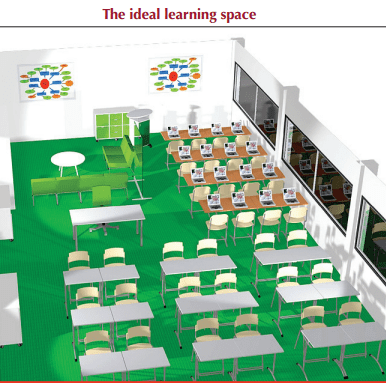
In this contemporary age, what is the ideal learning space? As part of A New Learning Space in 2014, I referred to ‘The ideal learning space’ – OECD, 2011.
The Ideal Learning Space – OECD 2011
More recently, on December 11, 2015 I published, Designing Learning Spaces – Part 1. In that post I highlighted some of the research which strongly argues that learning spaces can accelerate learning initiatives grounded in student-centred pedagogy.
There is little doubt that learning space design has a significant role to play in facilitating and reflecting new pedagogical approaches. The teacher-student relationship is changing, with a shift to student-centred teaching in multi-purpose spaces that allow for individuals and groups, specialist areas, indoor and outdoor learning, and flexible community oriented spaces. With that in mind, I make the following recommendations. They are offered:
with the research in mind;
literature encountered as part of my recent Master of Education – Knowledge Networks and Digital Innovation at Charles Sturt University;
recent experience as a principal in a contemporary learning setting; and,
engagement with new and refurbishment building processes as part of my current system based role.
So……. , when designing learning spaces:
RECOMMENDATION ONE
Involve the users, especially the students.
Real change cannot occur without involvement and input from teachers and students; the main users of space (Sanders and Stappers 2008; Kuuskorpi and Cabellos 2011). The planning and design of school spaces should be adapted to daily practices and school organisation, which means taking users’ views into consideration (Veloso, Marques et al. 2014). Involving students in the design process may result in a more shared sense of purpose (Hunter 2006). Furthermore, involving teachers in the design process may result in them becoming more confident and able to reorganise their classrooms according to their pedagogical intentions (Martin 2006).
Therefore, schools are obligated to engage users in the design process when designing learning spaces.
RECOMMENDATION TWO
Introduce key stakeholders to Learning Space dialogue.
If students and teachers are to become co-designers of learning spaces we may need to provide alternative learning experiences and curricular to assist with the development of the creative mindset for those who are designing (Sanders and Stappers 2008). Such learning experiences could be as follows:
Develop, establish and introduce design thinking courses for students and embed such courses into mainstream curriculum. One example is “Teaching Design for Change” (Pilloton 2010)
Therefore, schools are obligated to engage with research and learning space design thought leaders.
RECOMMENDATION THREE:
Remember Pedagogy and Technology.
The emerging area of learning space design integrates the pedagogy of learning with the technology that is used within spaces, both physical and virtual (Wilson and Randall 2012). The convergence of pedagogy, space and technology, provides a framework with which to address a host of issues associated with the design of learning spaces (Oblinger 2005). The link between learning theory and physical space can be sees as…. ‘chicken and egg- what comes first’? However, ongoing and extensive dialogue about both contemporary learning (pedagogy and technology) and building design (space) will bring substance to new buildings and spaces.
Therefore, schools are obligated to demonstrate evidence of how the learning space supports pedagogy and technology use to accelerate learning.
RECOMMENDATION FOUR:
Design for students’ needs.
Communities and cultures are now more connected and more informed than ever before (Friedman 2006; Sanders and Stappers 2008). Therefore, there is a need to design for people’s purpose more so than designing products (Sanders and Stappers 2008). This currently translates to designing and creating learning spaces which:
support the development of skills as compared to concentration on content;
focus more on formative assessment and the process of learning, rather than just the summative assessment and end product of learning; and,
take into account the student-centred approaches as much, if not more than teacher directed delivery.
Therefore, are obligated to demonstrate an understanding of how any new space will support the development of skills and student-centred approaches to learning.
RECOMMENDATION FIVE
Adopt a ‘prototype mindset’
By adopting a ‘prototype mindset’, the user increases their understanding of the space and its capabilities which can then inform the type of learning activities possible within the space (Wilson and Randall 2012); after all, educational spaces embody the pedagogical philosophies of their designers (Monahan 2002). The communication and collaboration that comes with iterative nature of prototyping is one characteristic that is lacking in most classroom and building design processes.
Therefore, schools are obligated to engage with an extensive process of iteration among and between staff, parents and students which lead to the final building design.
In conclusion, these above five recommendations offer a way forward for schools to better lead and manage the design and building of new and refurbished learning spaces.
I welcome your thoughts and comments.
Regards and Thanks,
Greg.
REFERENCES
Friedman, T. (2006). The World is Flat: The globalised world in the twenty-first century., Farrer, Straus and Giroux.
Hunter, B. (2006). “The eSpaces Study: Designing, Developing and managing Learning Spaces for Effective Learning.” New Review of Academic Libriananship12(2): 61-81.
Kuuskorpi, M. and G. Cabellos (2011). The Future of the Physical Learning Environment: School facilities that support the user. O. Publishing.
Martin, S. H. (2006). “The classroom environment and children’s performance-is there a relationship.” Children and their environments: learning, using and designing spaces: 91-107.
McIntosh, E. (2010). “Seven Spaces of Learning.” Retrieved 24 September, 2014, from http://vimeo.com/15945912.
Monahan, T. (2002). “Flexible space and built pedagogy: Emerging IT embodiments.” Inventio—Creative Thinking about Learning and Teaching4(1).
Oblinger, D. (2005). “Leading the transition from classrooms to learning spaces.” Educause Quarterly1(7-12).
Sanders, E. B.-N. and P. J. Stappers (2008). “Co-creation and the new landscapes of design.” Co-design4(1): 5-18.
Thornburg, D. (2007) Campfires in cyberspace: Primordial metaphors for learning in the 21st century. . Thornburg Center for Professional Development. Retrieved from: http://tcpd.org/Thornburg/Handouts/Campfires.pdf
Veloso, L., J. S. Marques, et al. (2014). “Changing education through learning spaces: impacts of the Portuguese school buildings’ renovation programme.” Cambridge Journal of Education44(3): 401-423.
Wilson, G. and M. Randall (2012). “The implementation and evaluation of a new learning space: a pilot study.” Research in Learning Technology20.




 LEARN AND LEAD