My Dream School

Recently, I have engaged with colleagues at my place of work to respond to the question, “What will school look like in 5 years?” We were encouraged to dream about the possibilities of what might be….

Therefore, in the spirit of messiness and complexity, and with the understanding that relational trust is all important, I put together this piece of “My Dream School”.

My dream school is one which strives to develop literate and numerate students who harness the power of digital technology to become ‘self-regulated learners’. Students would do this through learning opportunities which provide them with greater choice of subject matter, learning methods and pace of study. Furthermore, I dream of a school where students are granted the autonomy to challenge themselves and take risks to collaborate, co-create and think critically through learning experiences which are relevant to the real world.

As such, my Dream School acknowledges every student with the dignity and respect they deserve through the provision of student voice and student agency. The school supports of parents as the primary educators, enables children to become young adults who can recognise, have access to, and take up opportunities that will grow them as compassionate people with integrity and moral strength to make right and just decisions.

I dream with the end in mind and use the following questions to provoke thought

  • What will be required of students when they leave school?
  • What will be required of students who started Year 7 this year and leave school in 2020?
  • What will be required of Kindergarten students who leave school in 2027?

Furthermore, this Dream School prepares students for post school life in a world which is increasingly a different one to when their parents left school. In saying that, we must remember, the world will be different for our students in their early years of primary school as compared to our students due to graduate at the end of this year. Principles for Future Employees guides my thinking…..

7_principles_of_the_future_employeehttp://www.forbes.com/sites/jacobmorgan/2014/11/11/the-7-principles-of-the-future-employee/

I dream of a school where we dare attempt to measure ‘hard to measure skills’ of communication, collaboration, critical thinking creativity, innovation and leadership.  Why? because those skills, rather than test scores, will be more important for students in the world that awaits them…..

I dream of a school where we value teamwork as much as individual brilliance. Let me explain…..

American University, Professor Stephen Courtwright argues that organisations, especially in technology, are more than likely to be team based. He cites longitudinal survey of Fortune 1,000 companies which found in 1980 that less than 20 percent of companies had team-based structures; in 1990 that became 50 percent, and by the year 2000, 80. Now, almost all have 100% team-based. He then concludes, “It is more important for children to be taught how to gain the trust of teams, rather than the adoring approval of their manager.”

Martin Luther King said, “I have a Dream!” He did not say, “I have a Strategic Plan”. It is in that spirit, but very much without the charisma and courage, I offer (and in no particular order) …..

I DREAM OF A SCHOOL….

  • Where big, open-ended questions are valued more than answers for closed, state based, mandated tests.

I DREAM OF A SCHOOL….

  • Where Teach Meets and Dream Meets occur more regularly than Staff Meetings.

I DREAM OF A SCHOOL….

  • Where Vision and Trust inform School Annual Plans as much, if not more than data.

I DREAM OF A SCHOOL….

  • Where Digital Literacy and Network Literacy are valued as much, and measured as often, as English Literacy.

I DREAM OF A SCHOOL….

  • Where Maker Spaces are seen as Learning Spaces;
  • Where Coding sits as a subject along-side English and Maths; and,
  • Where students do not ask, “Miss, does this count towards my report?”

I DREAM OF A SCHOOL….

  • Where digital technologies are used for real time reporting and even replace summative semester reports that can be up to five months old.

I DREAM OF A SCHOOL….

  • Where classrooms look like playgrounds and playgrounds are seen as classrooms.

I DREAM OF A SCHOOL….

  • Where BOSTES mandated hours are delivered to their minimum, therefore freeing up time students to engage in self-regulated interest projects where they set the marking criteria and then have peers provide feedback without marks or grades.

I DREAM OF A SCHOOL….

  • Where a teacher is judged as much as the ‘colour’ of their classroom as they are on the ‘content’ they deliver.

I DREAM OF A SCHOOL….

  • Where the timetable serves the needs of learning rather than the delivery of subjects.

I DREAM OF A SCHOOL….

  • Where risk is valued more than compliance!
  • Where questions are followed by more questions rather than the quickest answer we can find; and,
  • Where the process of learning is valued, measured and assessed as much as the end product.

I DREAM OF A SCHOOL….

  • Where teachers work with other teachers and teams of students by planning, preparing and co-creating real world learning experiences .

Finally, I DREAM OF A SCHOOL….where student voice and student agency inform more than strategic plans and annual goals.After all, schools look radically different when we see it through the eyes of children. This requires teachers to unlearn and relearn their role.

WHAT DOES YOUR DREAM SCHOOL LOOK LIKE?

 

When will schools know they have changed?

Last week I heard Valerie Hannon talk about change (quoting someone I cannot recall) saying, in comparison to the Industrial Revolution, it is happening at 10 times the pace and 300 times the impact. Therefore the scale of change is 3000 times more profound. Wow!

I was also made aware university degrees are becoming increasingly irrelevant for Google. Google now take 14% of non university graduates, think test scores are worthless and rely on predictive internal interviews. With the number of future careers for our current students increasing from two to something like fourteen, and for jobs that have not even been invented yet, are university degrees a thing of the past? If so, the ATAR score required to get into university will be come increasingly less regarded and so too will the exams that are converted to an ATAR.

Anyhow…… places such as Hi Tech High in San Diego are engaging with “new thinking and new action on education” by focusing on i) Primacy of the quality of student work, ii) Integration of heart, head and hand, iii) Integration of students and disciplines, and, iv) Teachers a designers – team teaching is the Norm. Do not see themselves as studying for a test.

Schools such as Hi Tech High and Australian Schools Rethinking Education are moving from “School Engagement” to “Learning Engagement”. “School Engagement” is a focus on attendance, attentiveness, exam results and behaviour. “Learning Engagement” is energy, enthusiasm, all the time everywhere, taking responsibility and achieving a wide sense of learning outcomes rather than commanding short term memory for the next test.

There are some schools who value learning more so than schooling, but when the majority of schools develop data sources which value energy, enthusiasm and others such as communication, connectivity, critical thinking, creativity, then we will know we have transformed schools to become contemporary places of learning. At the moment, schools are governed by state based tests which dictate schools as places which prepare students for a test at the end of 13 years of schooling. This needs to change because, as the bank HSBC have acknowledged, “In the future, age will be no barrier to ambition”.

Regards
Greg

The Need for Vision in Schools

Just yesterday, I read this……

“If you don’t have a common, agreed-on destination, then everyone is left to his or her own devices to imagine one—a scenario that results in unharnessed and unfocused efforts, with everyone believing that what he or she is doing is right. A common understanding of the destination allows all stakeholders to align their improvement efforts. And the best part of planning for this journey is that it doesn’t cost anything to decide where you want to go.” http://www.ascd.org/publications/books/107042/chapters/developing-a-vision-and-a-mission.aspx

I strongly believe that the most important responsibility of any effective educational leader is to share, implement and lead a vision which articulates best thinking about teaching and learning, which then inspires students and teachers to reach for ambitious goals.

Through experience and learning, I understand that a well articulated vision results in a common language which informs teachers, parents and students of the WHY about WHAT you do and HOW you do it. I have also found that authentically pursuing the Vision affirms, supports, questions and challenges the school directions regarding many areas, including the following:

  • professional learning for teachers: pedagogy discussions, use of technology and learning spaces;
  • assessment practices: valuing the process of learning, not just the product of learning;
  • the value of skills as compared to the value of content;
  • leadership roles and leadership structures;
  • teacher and support staff appointments;
  • subject offerings and timetable construction; and,
  • data sources. Measure what you value rather than value what you measure!

I know this may sound simplistic and may even appear to ignore the complexities of schools and the diversity of leadership requirements of school principals; however, without Vision, you have a rudderless ship, or, “unharnessed and unfocused efforts, with everyone believing that what he or she is doing is right.”

Lastly, we all need to remember the words of the great Nelson Mandela……

Vision and Mandela

Hence the need for each school to have a Vision for Learning and then ACTION it!

SOME QUESTIONS….

  1. Do you have a Vision? If so, what is it?
  2. Is it widely shared? If so, is it widely understood and how do you know?
  3. Do you use your Vision to make decisions about learning?

I would appreciate your thoughts.

Regards

Greg

“Flip the thinking” about mandated hours?

As part of my recent university reading, I have been reminded of the unprecedented and immediate accessibility to information through the rise of the internet. Readings have also confirmed that information is socially situated and knowledge is increasingly constructed socially. I have also been reminded that school has shifted from the provider of content to just one context of information for students.

That being said, the biggest takeaway of recent readings has been the understanding that there may be a reticence of some to use information in a collaborative way to build knowledge through open source sharing. The video, Collaboration – On the Edge of a New Paradigm, retrieved from: http://vimeo.com/77240879 made a definite impression on me. In that video, Michael Wienburg points out that the internet is a giant force as a multiplier and sharer of information. This multiplier effect brings many different perspectives and, as Wienburg points out, you are almost inevitably going to make more advancements in responding to problems. However, people can lose control and ‘ownership’ of the process. As Elizabeth Start, founder of Harvard Free Culture Group points out, people that are engaged in traditional structures are often threatened by newer paradigms around ownership and control of information shared via the world wide web

This is where the challenge is. In school learning environments we may promote the multiplier effect of collaboration and connectivity; however, students may leave to become adults working for a company who is not OK with someone taking their information and do something else with it. Nevertheless, connected learning where students collaborate with others in new ways outside of ‘normal school hours’, “where learning was fluid (not governed by set hours and days)” (Lindsay, 2014), is an idea I hope to one day explore and challenge the status quo. Come to think of it……

….. here’s an idea. Why don’t we ‘flip the thinking’ about mandated hours in New South Wales? For example, in Years 7 to 10 English, Maths, Science and HSIE, there is a minimum of 400 hours per subject. Why don’t we limit these subjects to the bare minimum 400 hours? Yes, LIMIT them!

Let’s take the example of School “A”. At that school, they deliver 520 Hours of English, Maths, Science and HSIE across Years 7 to 10.  That is a surplus of 480 hours across the four subjects over four years; 120 hours per year! Just to give you an idea of what can be done with that time, Music/Visual Arts is allocated 240 hours over Year 7 & 8. LOTE is allocated 120 hours in Year 8. As per its timetable, that is 3 x 1 hours lessons per week for four years. WOW! What if the 120 hours could be better used to address our era of rapid change where using information to co-create knowledge and (hopefully) solve real world problems to improve the world? Maybe those hours could be used to explicitly teach and develop the five information literacies articulated by Howard Rheingold. Now there’s an idea that would challenge more than just a few of us.

Regards

Greg


REFERENCES

Collaboration – On the Edge of a New Paradigm, retrieved 7 March from: http://vimeo.com/77240879

Rheingold, H. (2010). Attention, and Other 21st-Century Social Media LiteraciesEducause Review, 45(5), 14. https://net.educause.edu/ir/library/pdf/ERM1050.pdf

Lindsey, J. (2014). Discussion Forum Thread 1.2. Retrieved March 8, 2015, from INF532 Knowledge Networking for Educators: https://interact2.csu.edu.au/webapps/discussionboard/do/message?action=list_messages&forum_id=_14229_1&nav=discussion_board_entry&conf_id=_7274_1&course_id=_6636_1&message_id=_7155_1#msg__7155_1Id


Schooling, Learning and Teaching

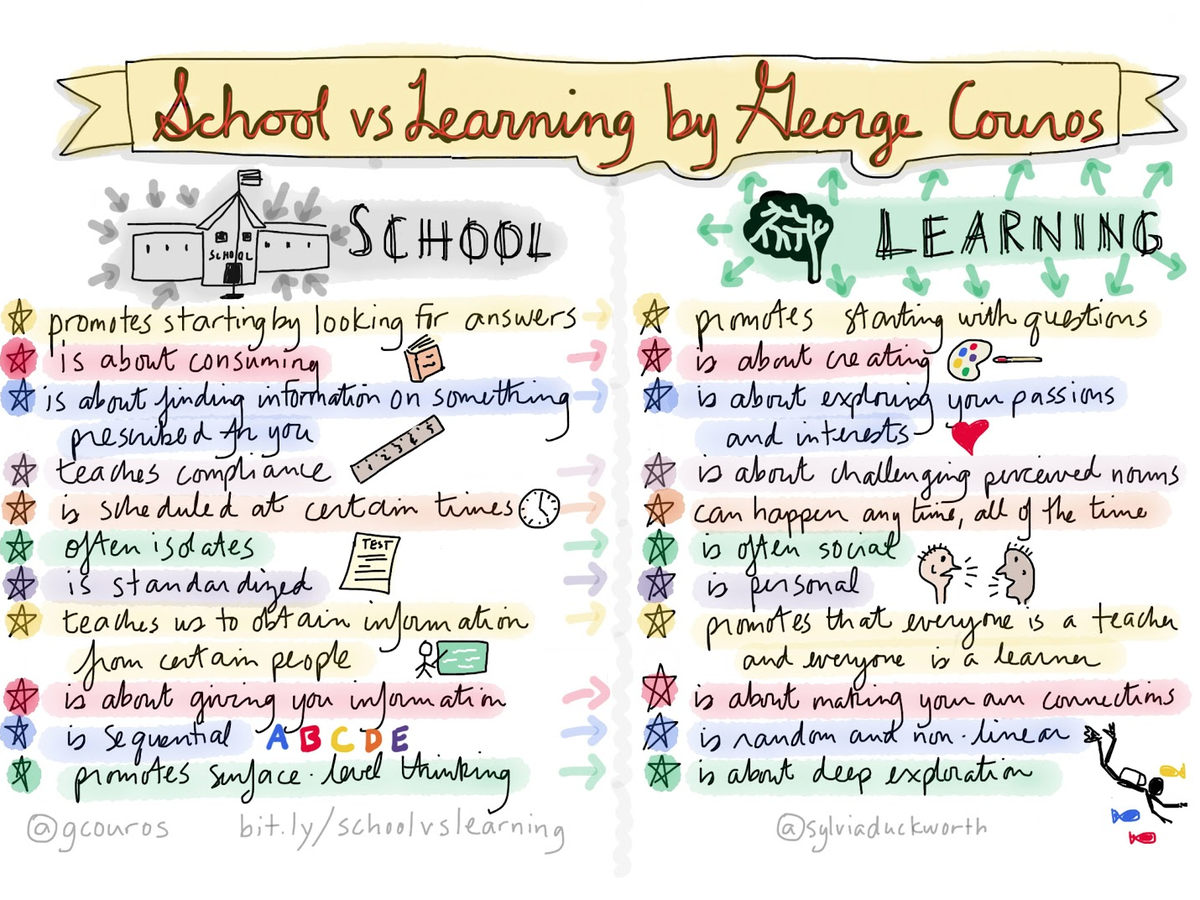
For quite some time now I have contemplated what school could look like if we weren’t so ‘programmed’ as to what school is. Let’s face it, school start and finish times are generally dictated by bus timetables, especially in rural and regional settings. A majority of classrooms appear similar to what they were 30 years ago, and governments regulate the focus of ‘learning’ through mandated curriculum and mandated hours. The public indicators of success for schools are NAPLAN, end of school examinations and ATARs. Hhhhmmmm. In contemplating what school could look like, one must consider what learning IS. On Sunday 25 January, 2015, via Twitter @ijukes posted a George Couros’ graphic. Embedded image permalinkSource: School vs. Learning by George Couros.

Ian Jukes also posted a link via Matt Armstrong. The link led me to an article called “The Future is Learning, But What About Schooling?” by  Richard F Elmore dated 5 January, 2015. The article clearly contexualises learning in 2015 and is also critical of current day schooling. Elmore writes,

Schools, as we currently know them, will continue to exist, if only because the byzantine collection of political interests that underlie them will keep them afloat regardless of their contribution to learning. AND….. learning has largely escaped the boundaries of institutionalized schooling.

And, the institutionalisation starts early as per  posted 25/1/2015 via 

https://pbs.twimg.com/media/B8KUmcQIUAASMmb.jpg:large

Such images support Elmore’s arguments that…….

Standards and expectations have become more and more literal and highly prescriptive in an age where human beings will be exercising more and more choice over what and how they will learn. Testing and assessment practices have become more and more conventional and narrow as the range of competencies  required to negotiate digital culture has become more complex and highly variegated. The type of knowledge and skill required to negotiate this increasingly complex world is completely different from what schools have conventionally done, and schools are institutionally disadvantaged as players in this new world, in large part because of the well-intentioned efforts of school reformers.

Elmore’s comments about schooling contrasts with what he sees learning to be……

an individual and social activity, has never been so alive as the present, and it will continue to grow in scope and breadth indefinitely. 

Of course, the contrasts between ‘schooling’ and ‘learning’ provide great challenges for principals and teachers. Elmore talks of teachers and writes, “Teacher preparation, hiring, induction, and evaluation practices have become more and more rigid and hierarchical in an age where the teaching function is migrating out into a more individualized and tailored set of learning environments.” We need to empower teachers to provide the conditions for ‘learning’ and not just adhere to the constraints of ‘schooling’ as dictated by other influences.

Embedded image permalink

In summary, I will continue to contemplate what school could look like knowing that if we pursue the ideals of learning within schools we do so knowing we need to support principals and teachers so our schools become centres of relevant learning and growth for those we serve, the students. This will enable students to be equipped with the skills required of them when they leave school and enter a whole new world of learning.
I welcome your thoughts.
Greg

Schools Rethinking Education

As part of some reading for my current study, in late 2014 I was challenged with the question, “Can we simply ‘update’ things as we go, or is it time to complete rethink what schooling is?” I reflected that each school has its own context and some asked this question ten years ago whilst others are yet to ask the question.

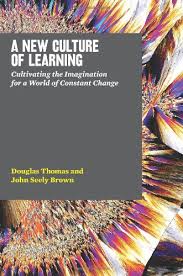
As we know, the digital age has changed society and, very obviously, schools are a part of that society. The learning landscape for schools has changed with the onset of the digital world in which we live and this new earning landscape is brilliantly and articulately explained in A New Culture of Learning by Thomas and Brown (2011).

A new culture of learning

The authors argue learning environments must take into consideration the great changes that have occurred with digital technology. Thomas and Brown argue that we are obligated to do this because the world is changing faster than ever and our skill sets have a shorter life. This presents great challenges to schools and education systems working with students to develop skills that will prepare them for post school life. Thomas and Brown remind us the world is getting more connected than ever before and that the need for mentors is a priority. They regularly remind the reader that schools need to be innovative, a need which is sustained with a commitment to cultivate imagination which can be supported with creative use of social media and digital technologies. John Seely Brown’s Youtube clip The Global One School House continues the message. In this clip Seely Brown contests there is a need to completely rethink the learning landscape because working as individuals will not sustain learning. This prompts many questions for education leaders of today. To ask the right questions is necessary in providing schooling which is relevant and supportive of student learning growth; learning growth that must address the skills of communication, collaboration, connectivity and critical thinking through formative assessment and not just (or should I write “rather than”) scores and grades for a summative report. The longer a school, system, state or country takes to ask those disturbing questions, the longer it will be before schooling provides an education which is relevant and pertinent for students who enter an ever changing world.

There have been ‘lead schools’ who have bravely asked questions and boldly taken on the exciting challenge of looking at new and better ways for schooling. Northern Beaches Christian School with its Sydney Centre for Innovation and Learning is the pacesetter when it comes to innovative approaches to learning characterised with greater relevance, interest and engagement for students. Northern Beaches is led by Stephen Harris who is ably supported with great communicators such as Anne Knock and innovators such as Steve Collis. First and foremost Stephen, Anne and Steve all see themselves as learners who ask curious “what if” questions which then prompts and ignites the imagination, creativity and innovation that flourishes at NBCS. Secondly, they share their insights, learning and questions through their blogs and Twitter. Thirdly, they generously open NBCS for others to visit, look and learn. Thirdly they ‘walk the talk’ by seeking, offering and encouraging communication, collaboration and critical thinking with other thoughts leaders within schools and outside education.

Other schools have developed innovative learning cultures which have improved and even transformed the learning landscape for students within their schools. Marrylands East Public School led by the innovative John Goh have early start and finish times. Parramatta Marist High School has adopted project based learning so successfully, it regularly receives much media attentionMater Dei Catholic College, Wagga Wagga * implements TED in Year 7, teacher team based planning and team teaching in Religion, English and HSIE in Year 8, a compressed SOR 1 course in Year 11 (where students sit the SOR 1 HSC exam at the end of Year 11) and a 9-day timetable for Year 12 students. Also, as recently as Setepmber, 2014 Delaney College launched its new model of learning and has developed connections with Telstra to promote meaningful, real-life learning for their students. All schools were bold enough to ask critical questions and have achieved much progress in their aim to provide schooling which is relevant, engaging and challenging whilst also supporting students to develop skills for when they leave school. Their climate for learning allows students to exercise choice and pursue interests whilst still adhering to mandated curriculum requirements but moves away from the ‘one-size-fits-most’ approach to traditional curriculum delivery. Furthermore, there is a greater emphasis on, and explicit reference to, the skills of creativity, communication, collaboration and critical thinking.

All this has come from schools with leaders who adopted, and continue to adopt, a ‘complete rethink’ mindset rather than an ‘update’ approach. What other schools approach learning with a ‘complete rethink’ mindset and what can we learn from them? I would be interested in your thoughts and comments. Regards Greg Declaration of Interest – I declare that I was Principal of Mater Dei Catholic College, Wagga Wagga from 2008 to 2014 inclusive.

A New Learning Space

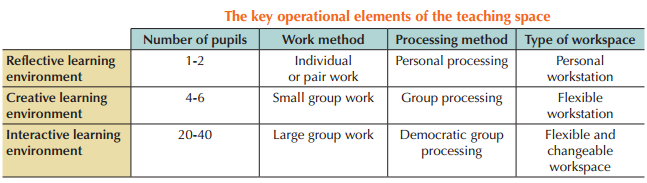
Back in September I had an enjoyable Creative Conversation with students and adults who could add to the thinking about that problem space, Rooms 11-14 @materdeiwagga. In mid October, I shared the feedback from the creative conversation with teachers who were interested in addressing the challenges of ‘that problem space’. One conclusion from those conversations was that any new furniture had to have chairs with ‘backs’ and there must be more “desk real estate”, as compared to another transformed space within the school, The Glasshouse. However, the furniture must still maintain the necessary agility and flexibility to move “between spaces” which accommodate individual work, work in pairs, small group work and large group / whole class work as outlined in a 2011 OECD Report

Key Operational Domains - OECD 2011
Key Operational Domains – OECD 2011

This furniture could be placed within the “Ideal Learning Space” (OECD 2011) as seen below,

 The Ideal Learning Space - OECD 2011

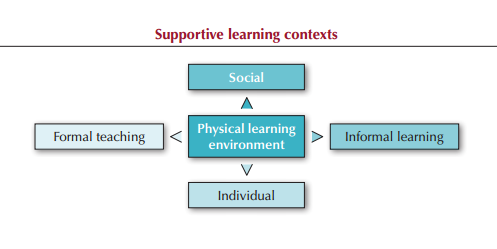
which supports various learning contexts (OECD, 2011).

Supportive Learning Contexts - OECD 2011
Supportive Learning Contexts – OECD 2011

The conversation with teachers focused on furniture within the problem space; however, it soon steered towards the space outside Rooms 11-14. Another creative conversation quickly visualised a combination of learning spaces which accounts for both informal social group learning and formal individual learning. Some examples of what I am talking about….

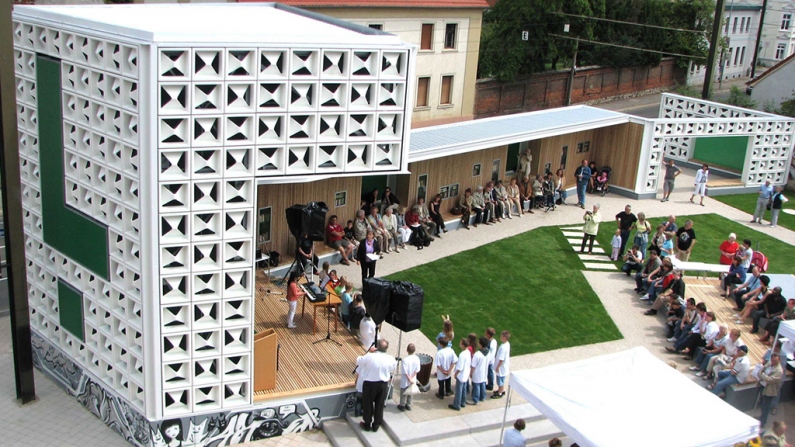
Madgeburg Library, Germany
Merida Youth Factory, Spain.

More thinking by the principal post meeting confirmed that a mix of indoor/outdoor learning spaces supports and promotes the College’s increasing commitment to collaborative learning. It resulted in an interesting sketch which included ‘waterholes’ and ‘camp-fires’ as discussed in Ewan McIntosh’s The Seven Spaces of Technology. These spaces, within a Large Group Learning Area which flows into Outdoor Learning Common, can creatively add to innovative learning initiatives already in place at the College. Initiatives such as Year 7 TED, Year 8 Religion, Year 8 English, Year 8 HSIE, Year 10 Australian Studies and Tear 11 Studies of Religion 1 Unit could benefit from an agile space which values community and promotes engaged learning enhanced through mobile technologies. Furthermore, such a space supports the overall learning vision of the College which is for students to become ‘self-directed learners’ through the provision of learning opportunities which provide students with greater choice of subject matter, learning methods and pace of study. It also strives for students become more involved in decision‐making processes, extensively use digital technologies and increasingly ‘learn by doing’ with relevance to the real world. It also acknowledges that our teachers are no longer a part of 20th century ‘push’ for change, rather they a 21st facilitators of learning who are creating a new learning paradigm. Any new indoor/outdoor space needs to address the extremes of Wagga heat. For hotter days, there needs to be fans, shade and access to cold (filtered?) water. In the cold, overhead heaters with clear plastic blinds which ‘trap’ the heat and act as a wind break are very necessary. It would be good to see flexible tables and chairs to allow for sitting and standing, and an experimental space like a market garden for “From the Paddock to the Plate”. Inside, there could be a small stage for one person or small group presentations. Wow! This is exciting. Now, for the architects! I welcome your comments. Greg

New Ways for New Courses

As part of the ongoing quest to make learning relevant for the students we serve, @materdeiwagga will introduce an Interest Elective for Year 9 students in 2015. The idea has been on our agenda since halfway through 2013 and it is great to see the idea now close to reality. Part of that reality involved a Planning Day (boring title) held with the courageous 10 teachers who are prepared to engage in iterative rather than linear planning. The purpose of the day was three fold:

  1. CLARIFY that is, to….. “Make clear or plain” the intent of the Year 9 Interest  Elective Initiative.
  2. DISTINGUISH that is, to…..“Recognise or note/indicate as being distinct or different from; to note differences between” current BOS approved/mandated courses and the  new courses.
  3. INVESTIGATE that is, to….. “Plan, inquire into and draw conclusions about” the best way to deliver Year 9 Interest Electives in 2015.

As part of achieving these Learning Intentions, teachers were reminded of the intent of this initiative. Furthermore, teachers were encouraged to see their participation as an opportunity for you to relieve ourselves of mandatory requirements whilst not losing focus on the rigor required for deep learning. It is an opportunity to explore new and different ways of learning delivery which authentically pursues our commitment for students to become ‘self-directed learners’ through the provision of learning opportunities which provides them with greater choice, where they are more involved in decision‐making processes and increasingly where they can ‘learn by doing’ with relevance to the real world.

The new courses are

  • Art Making – with the emphasis on ‘making’.
  • Challenge Plus – a practical course where students undertake Duke of Edinburgh principles.
  • Hunger Games – a new look at ways of engaging with food.
  • Interior Design – research, design and create spaces of interior design as a community service for the poor.
  • Outdoor Education – involves students choosing outdoor activities which challenge them.
  • Put it in Print – students will engage in texts, genres and mediums which worldwide publication reach.
  • Song Writing, Recording and Performance – say it all, really.
  • Video Gaming – students will anaylse the industry as well as use software to develop their own games.

These courses, as part of the 2015 Year 9 Interest Electives, are also linked to our 2015 Annual Plan With this in mind, teachers were asked….. “Have you thought about……

  • ways data can assist with your ongoing, iterative (not linear) approach to this course?”
  • formative assessment?”
  • opportunities for ‘real time reporting’?”

As part of our Planning Day there was acknowledgement of the constraints of budget, paperwork, personnel and timetable; however, there was a commitment for these not to restrict us in our thinking but to be more seen as signs that we can look for new ways of delivery. Our exploration of New Ways, included looking at The Global One Room Schoolhouse by John Seely Brown and also looking at snippets of the book A New Culture of Learning by Douglas Thomas and John Seely Brown. These snippets were combined with the following questions…..

In the interests of INQUIRY, have you….

In the interests of SELF-DIRECTED LEARNING, have you….

In the interests of COLLABORATION, have you….

  • spoken with others in THIS team? Yes, you are a TEAM!
  • consulted students in your course?

In the interests of CONNECTIVITY, have you….

  • made contact with anyone in other schools delivering similar courses across the state, nation, world?
  • reached out to ‘experts’ who may assist?

These questions immersed these brave souls in deep reflection and prompted professional dialogue about the implications for them as teachers and the very different role of acting as a coach and becoming a facilitator of learning. At one point, there was a provocative suggestion that the courses should ban two words; ‘Assessment’ and ‘Reporting’. The words Assessment could be replaced by “Goals, Aims, Achievements”, and the measuring of such. The word Reporting could be replaced by “Record and Inform”. For example, we could explore ways of using sound and film to ‘Record’ learning and then use these to ‘Inform’ parents about student (individual and collective) learning and learning gain. As time was coming to an end, the question was also asked, “What about the word Program?” It will be interesting to see where this discussion about Assessment, Reporting and Programming ends up.

Over the next few weeks, teachers are committed to do one or some of the following…..

  • Seek out other collectives through online Social Media including Twitter, Facebook, Pinterest et al
  • Explore how the GROWTH Model could assist with goal setting.
  • Complete an audit of resources Collating resources.
  • Reach out to other schools/teachers who may be doing something similar.
  • Explore the idea of a combined Project/Excursion Week in the second half of 2015.
  • Consider Local Facilities, Local Experts. Local causes where the work of these course could connect with ‘the real world.

The next steps are….

  1. For us to meet as a team for the last 30 minutes of the Professional Learning Meeting on Monday Week 9. This would be to prepare for the ……
  2. Meeting with students in Week 10. The prime prupose of this time would be to consult students about their interests, passions, goals they have for themselves in the Interest Elective. This will inform teachers how to…..
  3. On Monday or Tuesday of Week 11 (best) plan, prepare and resource the first 4 to 5 weeks of term 1, 2015.

I admire these teachers who understand these New Interest Elective Courses courses, without mandated requirements, simply cannot be ‘more of the same’! They have been encouraged to see themselves as ‘trailblazers’, as ‘innovators’, by engaging engaging in ‘new ways of learning’ with ‘a new culture of learning’. In time, the Year 9 Interest Elective will be another learning initiative which will inform  the rest of the school in years to come as the global educational landscape continues to change.

My only disappointment is that, with my impending move to Sydney, I cannot be around to see first hand the failures and success of this exciting learning initiative. Knowing these teachers as I do, and within the healthy risk-taking climate of @materdeiwagga, I know there will be far more success, than failures.

I would appreciate your comments.

Greg.