TEDx Burleigh Heads – An Education Worth Having saw an engaging group of educators, leaders and thinkers share ideas with courage and conviction. While each voice was distinct, a shared message echoed across the day: our current education system is misaligned with what it means to be human in the 21st century.
Post Blog Note: Within 8 days of the event, all TEDx Burleigh Heads 2026 Talks can be found here.
Again and again, presenters challenged the industrial model of schooling, one built on compliance, conformity, and high‑stakes testing, and called us instead toward an education that puts people first, purpose first, and humanity at the centre.
What follows is a weaving of their thinking, credited and celebrated.
Awe Before Outcomes
Jen Buchanan invited us to reconsider the very starting point of learning. What if education didn’t begin with content, compliance, or outcomes but with presence?
Jen is principal of Think Globabl School (TGS). Each year, TGS students and staff travel to four countries together, one term at a time, to learn from the wisdom of local communities, through the power of their local context. Jen asked the audience to imagine students arriving in class and spending just one minute noticing what it means to be human: feet on the ground, breath steady, sounds drifting in from outside. To feel what she described as the human hum and the awe which surrounds it.
In a system obsessed with coverage and pace, awe slows us down. It reconnects learning to meaning. Awe reminds us that education is not simply about knowing more, but about becoming more. If awe were the curriculum, wonder would no longer be a by‑product of learning, it would be the entry point.
Think Set Go
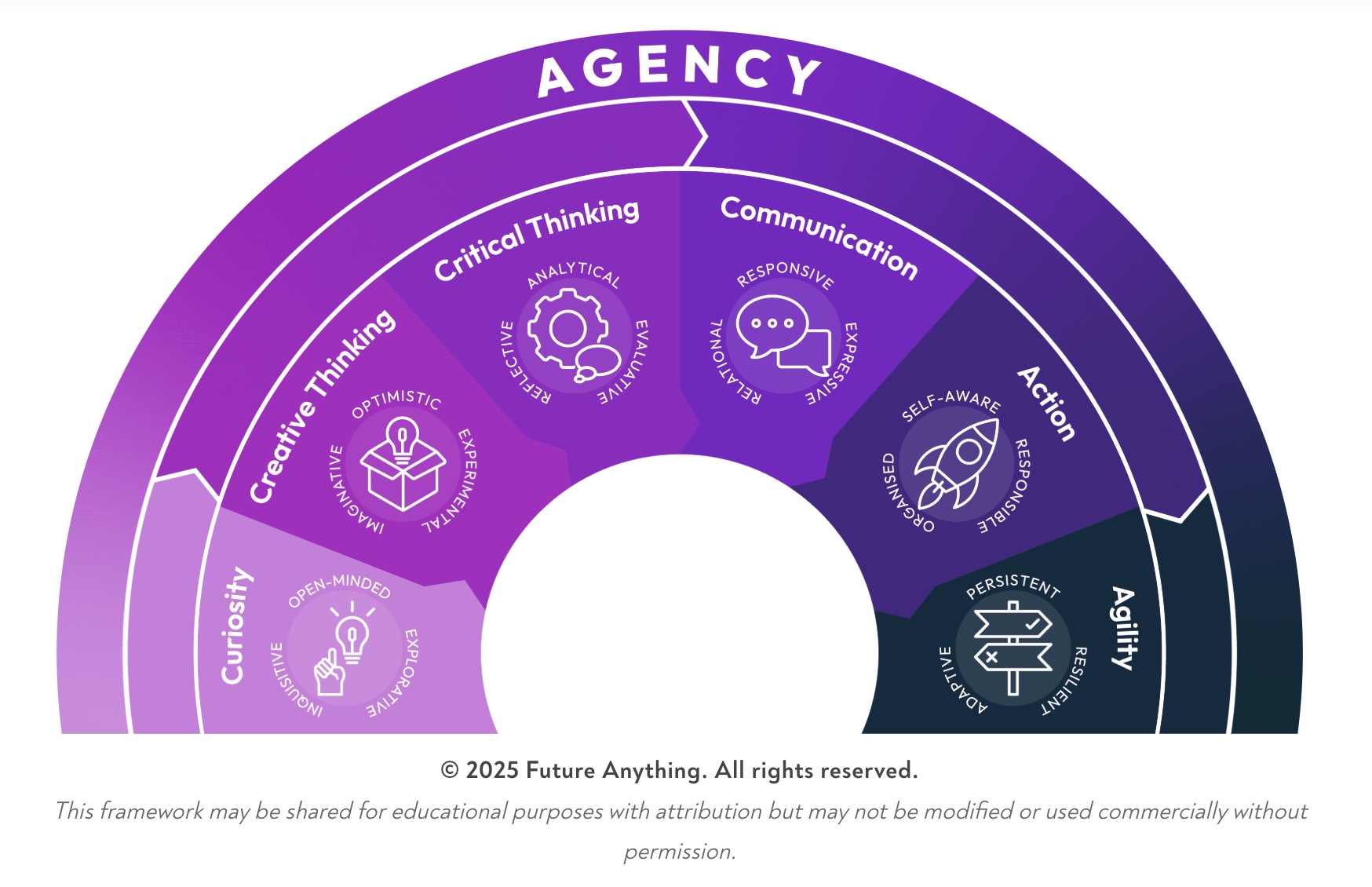
Lauren Munday offered a practical and empowering framework for navigating uncertainty: Think. Set. Go. Rather than preparing students to simply follow instructions, she spoke about developing the mindset skills needed to adapt, to pause and think critically, to set intention and direction, and then to move into action.
In an industrial model of education, compliance is often rewarded over agency. Lauren’s framework reframes learning as an active, human process, one that equips young people not just to succeed in known contexts, but to respond confidently to the unknown.
An education worth having doesn’t remove complexity; it gives students the tools to face it.
AI as a Mirror to Our Humanity
Pip Cleaves brought a clear and grounded perspective to the conversation around artificial intelligence. AI, she reminded us, is not the enemy, it is a mirror. If AI can take on many of the tasks we currently do, the question becomes: what parts of our humanity are we willing to protect, prioritise, and develop?
Her work with custom-made AI bots, bots that don’t get tired, forces education to confront a deeper truth. The value of human beings is not efficiency alone. It is empathy, creativity, ethical judgment, relationships, and meaning. AI doesn’t make education irrelevant. It makes humanity non-negotiable.
Imagination Over Obedience
Adriano DiPrato offered one of the day’s most arresting provocations: “Obedience builds replicas. Imagination builds worlds.” He challenged the outdated binaries that still shape much of schooling and work, blue collar versus white collar, and named what is emerging instead: a no‑collar future. In this future, purpose, values, and accountability matter deeply. Creativity is no longer decorative. It is infrastructure.
Adriano reminded us that the 20th‑century promise of education was security. The 21st‑century call is courage.
People Before Policy
Sally Lasslett asked a confronting question: Why didn’t we truly learn from COVID? During the pandemic, we discovered that flexibility was possible. Systems adapted. Learning shifted. And yet, we have gone back to a model of education where students are still expected to reshape themselves to fit rigid structures. Her message was clear: know the person and their story before compliance.
Compliance, she argued, is not the starting point. Wellbeing is not an optional extra, nor is it in opposition to learning. Wellbeing is the starting point and when wellbeing and learning work together, they don’t dilute outcomes, they transform people, classrooms, and communities.
An education worth having is one where students are known before they are measured.
Choice, Becoming, Humanity
Colleen O’Rourke cautioned against confusing technological advancement with human growth. Colleen is clear that when we offer learners choice, when they are invited to think, to question, and to become, education shifts from something done to students into something they actively shape.
An education worth having, she reminded us, does not simply prepare students for work. It prepares them for life as humans in relationship with others, alongside technology, not beneath it, and certainly not replaced by it.
Strengths, Purpose, and Service
Paul Miles grounded the conversation in purpose and practical wisdom. Drawing on Aristotle’s model, he spoke about the power of education that helps young people to identify their strengths, develop skills from those strengths, and use those skills in service of others. Rather than asking only What are you good at?, this approach asks, Who does the world need you to be?
An education worth having doesn’t end with personal success. It leads naturally toward contribution towards the common good.
Courage Is Not Optional
Bianca Nuss posed a question that lingered long after it was spoken:
We don’t leave literacy to chance.
We don’t leave numeracy to chance.
So why do we leave courage to chance?
She challenged the tendency to remove all discomfort from learning. Bianca acknowledged students must feel safe, yes, but learning also requires discomfort. Growth demands risk.
Bianca offered a simple and powerful sequence: Courage is the decision. Bravery is the action. Resilience is the outcome. She also offered a great line, “let kids be uncomfortable and get out of their way.”
An education worth having doesn’t eliminate challenge. It teaches students how to meet it.
Time to Think
Aimee Presnall named a reality many educators feel but rarely articulate:
Leaders are not running out of passion. They are running out of time to think. When leaders are denied protected time to reflect on learning, why it matters and how it evolves, education becomes reactive rather than intentional.
She reminded us that the most powerful leadership questions are not What’s the direction? but What do you need to get there?
An education worth having requires systems that value thinking as much as doing.
So, An Education Worth Having Is…
… human before it is systemic.
It is grounded in awe, courage, and imagination.
It sees wellbeing as foundational, not optional.
It treats creativity as essential infrastructure.
It honours strength, purpose, and service.
It allows leaders the time and space to think, not just manage…
And it prepares young people not just to succeed, but to become and a future worth stepping into.
As always, reflections and comments are welcome. Any thoughts about what an education worth having is, would also be welcome.
Onwards and Upwards
Greg
Acknowledgement: We are fortunate that another forward thinking educator, Michael Ha, got this off the ground. Those who attended this sold out event are appreciative that Michael took the time to organise the inaugural TEDx Burleigh Heads. Same date, April 9, next year. Lock it in!
 LEARN AND LEAD