Book Review – Digital Leadership: Changing Paradigms for Changing Times by Eric Sheninger

The subject of this book review is Digital Leadership: Changing Paradigms for Changing Times by Eric Sheninger, a joint publication between Corwin, a Sage Company and the Ontario Principals’ Council, Ontario. The paperback publication date was 18 March 2014; however, I downloaded the eBook version through online bookstore Kobo on 28 February, 2014.

Eric Sheninger has risen to world-wide prominence in schooling and education within the last four to five years. As a regular blogger at http://esheninger.blogspot.com.au/, host of his website http://ericsheninger.com/esheninger and prolific tweeter to more than 60 000 followers at https://twitter.com/NMHS_Principal, I was looking forward to reading and reviewing this book. As a principal for six years, and with the saturation of digital technology in that time, being a digital leader has figured prominently in both my formal and informal learning.

Integration of digital technology into the learning and teaching process is the most significant change that many teachers will undertake in their careers (Hargreaves 2005; Treadwell 2010). To lead this process of change is challenging, and the problem is there are few principals who understand what is required to lead a digital school (Moyle 2006; Gaffney and Lee 2008). Digital Leadership: Changing Paradigms for Changing Times encapsulates the work of Eric Sheninger and the work of other leaders who have achieved sustainable change through the use of social media and web 2.0 technology. In doing so, Sheninger produces a book which is a credible reference point for principals and system leaders looking for ways to maximise the opportunities for learning in a digital age.

This is a book about digital leadership which records the actions of Sheninger and those of other leaders who have addressed the changed educational landscape in their local context. Whilst Sheninger does not offer a clear or succinct definition of digital leadership, there are numerous statements and stories which indicate exemplary ‘Digital Leadership’. This book is clearly written for principals, system leaders and teacher leaders with the understanding that we are all learners, most especially those leading schools in this digital age. And whilst the focus is on digital leadership there are references to research and literature which convinces the reader we live in changing times and therefore, we are obligated to change the paradigm of education.

The Forward is written by the internationally renowned Yong Zhao who reminds the reader that there are many disruptive influences already reshaping the workforces and workplaces of today (Davies, Fidler et al. 2011). Zhao argues that Sheninger’s book pushes educators and education leaders to begin the work of transforming schools to produce students with the necessary skills to work in a rapidly changing world, one where students will require skills which use information to collaborate and solve real world problems (Berners-Lee 2009; Davies, Fidler et al. 2011). Sheninger (2014, Ch4, p7 of 34) acknowledges this when he writes, “As technology’s role continues to become more prevalent, it makes sense to integrate it effectively in schools so that out students are not short changed upon graduation.”

The current and emerging changes to the workforce as a result of technology, and its implications for schools, form Sheninger’s strong case for school change. With credible references to research and literature including Education Week, EduTopia and the Pew Internet and America Life Project of 2010, Sheninger argues for a complete rethink of the learning landscape for schools if they are to be relevant for students and develop necessary skills students need when they leave school (Seely Brown 2012; Siemens 2013). However, the unfortunate reality is “Despite these major changes over the years, one thing remains unchanged: the structure of schools” Sheninger (2014, Ch2, p4 of 60).

The pleasing aspect of this book is that Sheninger’s call for change recounts the stories of pathway schools, led by creative leaders, who have commenced the process. This gives hope to schools, principals and system leaders struggling with the complexities of digital leadership. In the case of NMHS, connectedness was the catalyst for change but only after Sheninger himself had become connected with social media which provides him with the knowledge, tools and ideas to initiate change. Sheninger initially faced his fears head on and then began to model effective use of technology from which many school initiatives began to flourish.

Central to Sheninger’s book is his Seven Pillars of Digital Leadership. They are 1 Communication, 2 Public Relations, 3 Branding, 4 Professional Growth and Development, 5 Student Engagement and Learning, 6 Opportunity, and 7 Learning Environment and Spaces. Each pillar of leadership “provides a context for leaders to lead in different ways that are aligned with the societal shifts that place an increased demand on technological fluency and integration” Sheninger (2014, Ch4, p23 of 34).

These pillars are aligned to the 2009 International Society of Technology in Education’s (ISTE) National Educational Standard for Administrators and provide a framework which responds to information flow created by the social and technological changes of the digital age. In offering these pillars of digital leadership, Sheninger articulates the digital leadership requirements needed to respond to the increased connectivity which comes with web 2.0 technologies.

Cloud computing and mobile learning are increasingly becoming part of the educational landscape (Johnson, Adams et al. 2013). Many social media sites, including Facebook and Twitter, live in the cloud are accessible by mobiles devices and therefore act as interactive platforms where individuals and groups generate, share and update content. Sheninger strongly pushes the use of social media for the purposes of community engagement and provision of information to school stakeholders through a variety of media to foster two way communication. At one stage, Sheninger lists a number of web 2.0, social media platforms that various schools are using as a means to increase engagement for students and members of the relevant local community. This is most helpful.

A strong theme which is weaved throughout the book is that of ‘connectivity’. With the premise that ‘connectedness matters’, and with the conviction that the educational landscape is changing, there are dynamic examples of digital leadership. Firstly, there is the story of the Van Meter district whose system leaders committed to being connected with each other, and with their community stakeholders, through the use of blogs, wikis, YouTube and Twitter to transform education within the district and withstand competition from other districts. Other stories see Sheninger recalling the trailblazing work of Dr Spike Cook, the sound leadership of David Britten and the innovative professional development programs implemented by Lyn Hilt. Each story is an excellent example of a leader who uses digital technology to collaborate and create content to benefit their individual learning whilst contributing to the learning of their online community. These educators engage in both consumption and publication where knowledge is shared, exchanged and co-created. As professional learners within a global digital commons, they learn from leaders and become thought leaders themselves whilst also demonstrating a sound understanding using social media for meaningful professional learning.

In the case of NMHS, Sheninger instigated the use of school Twitter and Facebook pages to increase community access to school events and strongly encouraged teachers, students and parents to follow his blog. It was, and still is his way of ensuring that as principal of the school he leads, that community members remain connected. He talks of the need for teachers and schools to use social media to create more transparency with parents and also promote innovative and creative learning activities that take place in school. Furthermore, he cites examples from various schools where students are adapting social media tools to extend and enrich the learning process to assist with learning goals; however, these examples are limited.

There is only one chapter of the book which focuses on student learning, after all, the book is about digital leadership. Sheninger refers to a pedagogical framework for digital tools and reflects on twenty-first century learning at NMHS which fosters the skills of creativity, critical thinking, collaboration and problem solving. Critics could argue that he provides no clear evidence linking new methods with student learning gain. This is probably correct when comparing learning growth solely on results from state based mandated tests. However, that same testing does not acknowledge nor measure the 21st century skills required of students when they leave school.

One clear message of the book is that students can only maximise the learning potential of digital technology when the school leader models it. It is through this modelling that teachers will begin to understand the benefits of social media and web 2.0 technologies for the purposes of learning. Eric Sheninger’s clear intent is for students to fully utilize the interactivity and availability of information to be globally connected, and it appears his message is this can only happen after leaders understand the potential of learning digitally through their own experiences.

In conclusion, Eric Sheniger’s book certainly addresses the paradigm shift taking place in education as a result of increased connectivity and access to information. The internet has irreversibly changed education forever and there is an urgent need for education systems and individual schools to respond appropriately. Sheninger’s own story, and the stories of other innovative educators, certainly records the intelligent and brave leadership of those who are responding to the challenges presented by the current paradigm shift in education. Although we may not know exactly how technology will continue to drive the changes that will impact on the learning experiences of school communities, schools must be prepared to accommodate those needs by utisling the opportunities that come with the emerging technology trends. Sheninger’s book offers current and future educational leaders a framework to do this and I am far more informed for having read Digital Leadership: Changing Paradigms for Changing Times.

References

Berners-Lee, T. (2009). “Tim Berner-Lee on the next Web, TED Talks, TED Conferences, LLC.”. from http://www.ted.com/talks/tim_berners_lee_on_the_next_web.html.

Davies, A., D. Fidler, et al. (2011). “Future work skills 2020.”

Gaffney, M. and M. Lee (2008). Leading a Digital School. Melbourne, ACER Press.

Hargreaves, A. (2005). “Teaching in the knowledge society.” Professional Voice 4(1): 11-25.

Johnson, L., S. Adams, et al. (2013). “The NMC horizon report: 2013 higher education edition.”

Moyle, K. (2006). “Leadership and learning with ICT : voices from the profession.”

Seely Brown, J. (2012). “The Global One Room Schoolhouse “. Retrieved March 12, 2014, from http://youtu.be/SoRV0BEwvEU.

Siemens, G. (2013). “Changing Schools, Changing Knowledge.” The Agenda with Steve Paiken. Retrieved 30/03/2014, from http://youtu.be/JR_ziHA_8LY.

Treadwell, M. (2010). “http://www.i-learnt.com/Paradigm_Mark.html.” Retrieved 19/02, 2010, from http://www.i-learnt.com/Paradigm_Mark.html.

Travelling Abroad

The Catholic Schools Office of the Diocese of Wagga Wagga provides Renewal Leave for principals after six full years of active service in the position. In August of 2013, I made application to access Principal Renewal Leave in 2014. The focus of my Renewal Leave was a two-fold experience which focused on ‘Faith’ and ‘Learning’.

The primary focus of my professional development between 2010 to 2013 was participation in Doctoral Study. The focus of this study was the leadership required for school transformation through the use of digital pedagogy. This Renewal Leave was a continuation of my interest in, and commitment to being a leader of contemporary learning in a secondary school setting within a Catholic context.

I was supported by the Diocese to ‘self-direct’ my Renewal Leave rather than attend an ‘organised tour’. My itinerary was organised primarily through contacts and introductions on Twitter – Ahhhhh, the power of Twitter! The educational focus of my Renewal Leave resulted in visits to 6 schools and meetings with 3 people/organisations who support learning in schools. These all took place in England; mainly London and Manchester. The religious focus of my trip saw me engaged in a six day pilgrimage visiting religious sites of significance for the Presentation Sisters and Christian Brothers in Ireland. My reflections are as follows….

1. Pilgrimage develops meaning.
I am humbled to work in a school which honours the work of Nano Nagle, founder of the Presentation Sisters, and Edmund Rice, founder of the Christian Brothers. For six straight days I engaged with each of their stories; stories which told of their call to serve the people of their districts through offering education to the poor. The poverty experienced by the Irish in the 18th and 19th centuries is well known. The persistence and bravery of Edmund and Nano to overcome the obstacles placed before them to educate the illiterate and the poor, is to be admired and never to be forgotten. To visit the resting places of both Edmund and Nano was a real privilege; something I will never forget. To sit with, and beside each of them, within a few days of each other, knowing that I work at at school which is directly linked to their commitment to educate the poor, was both humbling and moving.

2. We are “ahead of the curve” in Australia (as compared to England).
Maybe it was the fact that some schools “talked themselves up” when it came to their use of digital technology to support student-centred pedagogy, but the inquiry/PBL approach to learning in our Diocese and other schools around the state and nation, is only on the agenda on two of the six schools I visited. It is a small sample I know, but the classrooms that I saw were clean, tidy but traditional. In saying that, there were some very modern and attractive learning spaces; however, when I asked about how the spaces promote learning, I was met with little explanation as how this new (sometimes expensive space) supported learning. When talking with teachers, whose passion and dedication were as obvious as those in Australia, their methods of learning appeared to be still grounded in a pedagogy which required the teacher to direct rather then facilitate learning. Again, six schools is a small sample, but my email correspondence leading up to the visits were more promising than what I witnessed.

The most innovative school I visited was Cornwallis Academy http://www.futureschoolstrust.com/Cornwallis/We-are-Cornwallis
Under the leadership of David Simmons and with the strong support of his deputy, Claire Thompson, Cornwallis Academy has evolved into a school where students are engaged in learning within spaces which are modern, attractive and agile. There has been great thought and planning gone into developing learning spaces which ensure collaboration and team-based learning. Also, what was obvious was the “buy in” by teachers. David encourages teachers to develop their own action-research projects which align with learning philosophy of the College. I learnt much from my visit to Cornwallis.

It was also an amazing experience visiting Eton College in England. This world renowned school has the services of James Stanforth who understands the concepts of learning in a digital age. James has the support of the leadership team at Eton to engage in action research projects with like-minded teachers to use digital technology to support innovative learning. Although it is early stages, I look forward to watching from afar the developments which will eventuate.

One anecdote: I was informed one of the best schools in central London, according to “A level results” and “Ofsted Inspection”, is a campus where each faculty exists in their own, separate silos of three story buildings with windows only on one side. Whilst I am sure the community of this school are proud of their results I wonder whether students are being properly prepared for the world which awaits them.

3. The Accountability/Testing Agenda is all too prominent in England.
There is no other way of saying this other than to say that the “top down” thinking by government to impose their agenda on teachers and schools is a great worry. Education in England is focused on responding to the strong Ofsted agenda, which, due to recent changes, has become even tougher to “pass”. Creativity, critical thinking and collaboration are put aside by schools so that they properly prepare for, and then respond to, the outcomes of Ofsted reports. Without going into to detail, the preparation for an Ofsted inspection is all-consuming, with head teachers and leadership teams under extreme pressure to prove their worth based on learning outcomes which are ‘test driven’. Overall, I admire the commitment and willingness of teachers in England who maintain their passion and enthusiasm for teaching despite this crippling agenda which stifles imagination, creativity and innovation. Despite our own local challenges, I am very glad I work in Australia and not England when it comes to education!

4.Take a colleague next time.
Whilst I enjoyed seeing other schools in action, and was fortunate for different teachers giving up their time to show me their educational context, it would have been rich to ‘debrief’ each day with a colleague. Being on my own meant notes each evening, reflecting on photos taken during the day and comparing ‘my lot with their lot’. However, discussing these with a colleague or two would have been taken my thoughts and reflections to a new depth.

All up, this very generous Renewal Leave assisted my ongoing development in the principal leadership requirements of:
• Vision and Values of Catholic Leadership;
• Knowledge and Understanding of contemporary learning; and,
• personal qualities and social and interpersonal skills.

The experience deepened my understanding and empathy for the two pillars of Catholic Education in the Diocese of Wagga Wagga; they being, Faith and Learning. The experience resulted in:
• A deeper understanding of the charisms of both Nano Nagle and Edmund Rice as expressions of the Mission of Jesus Christ;
• An improved understanding of the capabilities required to lead faith development and learning at Mater Dei Catholic College;
• Increased knowledge of the creative and adaptive leadership required to respond to the demands that come with digital technology; and,
• Established links with two English schools who are sound exponents of collaborative learning and agile learning spaces.

“Thank you” Diocese of Wagga Wagga for the opportunity.

Greg Miller

Teacher Professional Learning in a Digital World

Recently, regarding schooling and education, I was asked, “Can we simply ‘update’ things as we go, or is it time for rethinking of our collective practice?” A similar question has to be asked about Teacher Professional Learning; that is, “Can we simply update things or is time for a complete rethink?” There has been no doubt that teachers, principals and schools continue to adopt new forms of professional development in response to the demands of the digital age. In this essay I provide a framework for teacher professional learning which refers to research and the arguments of learned colleagues across the world. In essence, I argue that Teacher Professional Learning for a digital world requires a professional learning culture where teachers see themselves as facilitators of learning and have a sound understanding of 21st century learning.

21st Century Learning is an emerging landscape for schools. This landscape is articulately explained in A New Culture of Learning (Thomas and Brown 2011). The authors propose for learning environments to take into consideration the great changes that have occurred with new digital technology. Thomas and Brown argue that we are obligated to do this based on the fact the world is changing faster than ever and our skill sets have a shorter life. This presents great challenges to schools and education systems working with students to develop skills that will prepare them for post school life. Thomas and Brown remind us the world is becoming more connected than ever before and that the need for mentors is a priority. They regularly remind the reader that schools need to be innovative, a need which is sustained with a commitment to cultivate imagination and the creative use of social media and digital technologies. In a nutshell, this is cleverly summarised John Seely Brown’s YouTube clip The Global One School House where he contests there is a need to completely rethink the learning landscape because working as individuals will not sustain learning.

Mimi Ito focuses on digital learning in the Video – Connected Learning: Everyone, Everywhere, Anytime. Mimi Ito informs us that expertise is widely distributed and “anybody can help somebody else get better at something.” This significant shift away from the teacher being ‘the font of all knowledge’ requires a new approach for teacher professional learning.

Antero Garcia’s paper (2014) reminds us that learning is centered around youth interests in many out-of-school contexts and whilst this may not be new, what is new, are the ways youth expertise can be networked, accessed and even published globally with new digital media tools. Therefore, as part of our rethinking about learning for students we need to explore how teacher professional learning can assist students with this increasing propensity to use digital media tools to network and publish in ways which will support their learning growth.

The argument of Douglas Thomas and John Seely Brown for a new culture of learning is strongly supported by highly respected people including Mimi Ito, Antonio Garcia and others. I contest that, if this new culture of learning is to become a reality in our schools, we need to reshape teacher professional learning. Not only is there a need to shift our thinking about learning in schools, there is also a need to rethink teacher professional development.

There is an extensive amount of research which indicates the important role professional development plays in assisting teachers use digital technology in ways that will improve learning for students. There is a need to conceptualise professional development not just for the reason of increasing teacher use of technology. Whitby (2006) argues that professional development programs require principals, leadership teams and systems lead teachers to a full understanding of what it means to be a learner and a teacher in the twenty-first century. The Australian Institute for Teaching and School Leadership has produced 21st Century Learning (AITSL 2012).

Aitsl links 21st century learning with the needs for Teacher Professional Learning with a Professional Learning Animation (AITSL 2012).

It makes sense then that teacher professional learning, any professional development programme for teachers, will have at its core, a deep understanding of what it means to be a learner in a contemporary school setting. It also makes sense for teachers and leaders of schools to understand what learning environments best promote sound learning.

Teacher Professional Learning needs to take place within a professional learning community of learners in which teachers and school leaders work together to improve the learning conditions and results of students in schools (Fullan 2006). Such a community promotes: – a focus on learning; – a collaborative culture stressing learning for all; – collective inquiry into best practice; – an action orientation (learning by doing); – a commitment to continuous improvement; and, – a focus on results (Dufour, Dufour et al. 2006). With a specific focus on the use of technology by teachers, Digital education – making change happen (MCEETYA 2008) articulates that a ‘leading school’, “has a professional learning culture that reflects and contributes to the school and system strategic policies and is predicated on ongoing innovative and reflective practice” (MCEETYA 2008). Furthermore, it argues that a professional learning community “actively fosters a culture of informed, responsible inquiry and communication with ICT” (MCEETYA 2008).

Thomas and Brown (2011) would argue a professional learning should explore a second sense of culture, one that responds to its surroundings on an ongoing basis. In this new culture of learning, the explosion of digital technology has seen information used a participatory medium through cloud based social media platforms (Johnson, Adams et al. 2013) and teachers need to immerse themselves in how that can be done in the context of their school setting.

That being the case, teachers can no longer deliver teacher centred lessons and must work on ways to better access external expertise to assist students with their learning. What is required is a substantial shift for all teachers to adopt the role of a ‘facilitator of learning’ which assists with the development of contemporary skills such as collaboration, critical thinking, problem solving; all skills required for the 21st century learning (Fullan and Smith 2000; BECTA 2004; Lyons 2007). To do this, the teacher

“supports the students in their search and supply of relevant material, coordinates the students’                   presentations of individual milestones of their projects, moderates discussions, consults in all kinds of       problem-solving and seeking for solutions, lectures on topics that are selected in plenary discussions         with the students and conforms to the curriculum” (Motschnig-Pitrik @ Holzinger, 2002, p.4).

Teacher professional learning for a digital age is underpinned by a professional learning culture where teachers see themselves as facilitators of learning. However, this is not enough. Teacher professional learning in a digital age requires teachers to develop a sound understanding of the principles of best practice contemporary learning. All teachers have been introduced to, and some may say bombarded with images of 21st Century Learning.

2

Taken from flick.com/photos/75807119@N07/14123450319/

Digital-learning-Matrix-1rrbsgl

However, Teacher Professional Learning must be more than just references to images of 21st Century Learning. (By the way, I like to call it contemporary learning because, due to the rate of change. What was once 21st century in 2010, may not be 21st century in 2014). Foundations of professional learning culture where teachers see themselves as coaches and facilitators of learning must then focus on developing teacher awareness and understanding of the following principles of contemporary learning:

i) Connectivism

ii) Networked Learning

iii) Creativity

Connectivism acknowledges the informal networked manner one can learn through the increasing capability of digital technology. Essentially, learning is a process of connecting information sources and maintaining those connections to facilitate continual learning and the ability to see connections between fields, ideas, and concepts is a core skill and the intent of all connectivist learning activities (Downes 2012). In an Interview with George Siemens (Siemens 2013) he elaborates on this theory when he discusses how access to the World Wide Web has greatly increased the opportunities for students adopt multiple learning pathways when engaging with the curriculum.

Learning is now an iterative process moving back and forth, to and from numerous knowledge networks including engagement with Google Groups, following a person on Twitter, viewing YouTube videos, accessing information via Flipboard and Zite, discovering forums on Pinterest and discussions via online forums. CONNECTIVISM is one key principle of contemporary learning required to be known and understood by teachers and therefore an essential element of and Teacher Professional Learning.

The case for creativity in schools has been led by world renowned Sir Ken Robinson. In this video Why is Creativity Important in Education? (Robison 2012) Sir Ken argues the case for creativity in schools.

So why don’t we pursue this in Professional Learning? For teachers to be able to foster creativity in classrooms, they need to be able to understand what it is, how it can support learning and why it is important to the future of each and every student they teach. Therefore, Teacher Professional Learning must immerse teachers in an understanding of creativity. Whether it be through the viewing of videos such or increasing creativity through the use of Socratic questioning and inquiry learning, teachers are obligated to understand creative learning, a process which starts with student ideas and imagination which then leads to students ‘creating’, ‘making’ and ‘designing’ for their real world with the possibly of innovation being the end product. For more about this read my blog The What of Imagination Creativity and Innovation (Miller 2013). https://gregmiller68.com/2013/06/08/the-what-of-imagination-creativity-and-innovation/ CREATIVITY is another key principle of contemporary learning required to be known and understood by teachers and therefore an essential element of and Teacher Professional Learning.

Understanding Networked Learning is an essential part of contemporary pedagogy. Connecting through networks in a digital world is when a learner accesses information through a number of connections and uses that information to construct knowledge, often through those same networks. Whether it is Big Data or Linked Data as Tim Berness-Lee refers to it in The next Web of open, linked data teachers need to be clear about how data, information and digital technology knowledge are interrelated and the opportunities that come with knowledge building.

The willingness of teachers to engage with the connectivism of digital technology assists students to create knowledge and understand concepts through their participation of the digitally enhanced globally connected learning environment they access each and every day. NETWORKED LEARNING is another key principle of contemporary learning required to be known and understood by teachers and therefore an essential element of and Teacher Professional Learning.

In conclusion, the principles of Connectivism, Creativity and Networked Learning is essential for any Teacher Professional Learning. When these principles are explored and promoted within a professional learning culture and where teachers see themselves as coaches, the best chance will exist for students to engage in learning which uitlises networks and promotes engaged, participatory learning. A visual of this can be found here https://docs.google.com/a/ww.catholic.edu.au/document/d/1EsKxbCvSyODGyJFw6iRENRSQY_LOp2TFWcfIu7wSPoA/edit

If teachers, principals and schools have adopted different approaches to professional learning, then so be it. I applaud the attempts of teachers and schools who gallantly and dare i say on some occasions, successfully respond to the challenges of a digital age. I offer this framework as one which references research, relates to our leading professional body and also refers to the thoughts of educational leaders across the world. I would appreciate your responses and thoughts.


REFERENCES

AITSL (2012). 21st Century Education Retrieved 31 March 2014, 2014, from http://www.youtube.com/watch?v=nA1Aqp0sPQo&feature=youtu.be.

AITSL (2012). Professional Learning Animation, 12 April 2014, from http://www.youtube.com/watch? v=nRnstWGJwPU. Downes, S. (2012).

Connectivism – A Learning Theory For Today’s Learner. Retrieved 15 May 2014, from http://www.connectivism.ca/about.html.

Dufour, R., R. Dufour, et al. (2006). Learning by Doing: A Handbook for Professional Learning Communities at Work.

Fullan, M. (2006). Change theory: a force for school improvement. Jolimont Vic, Jolimont Vic: Centre for Strategic Education, 2006.

Garcia, Antero, ed., 2014. Teaching in the Connected Learning Classroom. Irvine, CA: Digital Media and Learning Research Hub.

Ito, M. (2012). “Connected Learning: Everyone, Everywhere, Anytime.” Retrieved 12 March 2014, 2014, from http://www.youtube.com/watch?v=viHbdTC8a90.

Johnson, L., S. Adams, et al. (2013). The NMC horizon report: 2013 higher education edition. MCEETYA (2008).

Learning in an online world: Making change happen. Learning in an Online World Series. C. Corporation: 1-22.

Miller, G. (2013). The What of Imagination, Creativity and Innovation. gregmiller68, WordPress. 2014.

Motschnig-Pitrik, R. and A. Holzinger (2002). “Student-centered teaching meets new media: Concept and case study.” Educational Technology & Society 5(4): 160-172. .

Robinson, K. (2012). Why is Creativity Important in Education? Adobe Education Series.

Siemens, G. (2013). “Changing Schools, Changing Knowledge.” The Agenda with Steve Paiken. Retrieved 30/03/2014, from http://youtu.be/JR_ziHA_8LY.

Thomas, D. and J. S. Brown (2011). A new culture of learning: Cultivating the imagination for a world of constant change.

Whitby, G. (2006). A Time to be Bold: New challenges in learning and teaching.

“Student Voice” Informs Again!

In recent times I have been reminded of the powerful feedback students can provide for teachers and for me in my role as principal. One such example started a few weeks ago when I presented Year 9 2015 Interest Elective Information to all current Year 8 students.

In a nutshell, the New South Wales Board of Studies has clear expectations about what subjects can be taught and the mandated (minimum) hours for those subjects to be properly delivered. Across Years 7 to 10, our school delivers significantly more than the required number of hours for each and every subject. When a school does this they can then deliver options which are not mandated, like we do with Careers once a week in Year 10 and Sport once a week in Year 7 & 9.

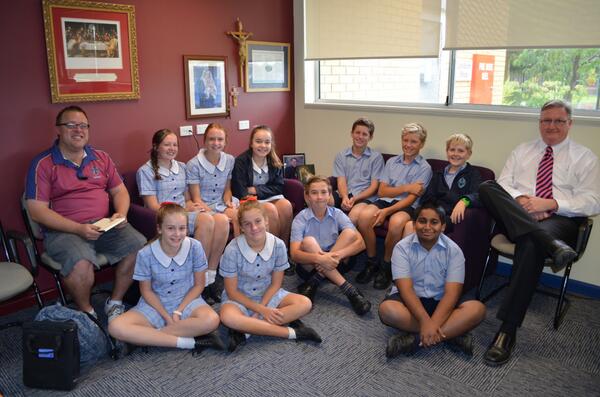
A week later, I invited students to offer a comment via the Year 9 2015 Interest Elective Survey. The responses of that survey were distributed to a representative group of 10 Year 8 students (pictured below with me and Pedagogy Leader @Carl Heise) at a meeting on Wednesday of this week. They see the interest elective as an opportunity to inform them about their future employment. Also, they stated that if they have the choice to work in an area of interest they will be motivated to work harder because they will be more focused. The group informed me that we should continue to explore the idea.

Image

As a result of that feedback, more work will be done with teachers over the next few months with the idea that teachers will work with students about actual subjects that might will offered. With regards to Year 9, 2015 we are asking these questions:

 “Do we do more of the same?” 
– “Can we use the surplus hours any better?” 
– “What would you learn if you could learn about anything you want?”

When exploring those questions, there is real excitement about the possibilities for students in Year 9, 2015. When more ‘concrete’ information is available, we will invite Year 8 parents to offer feedback before a final decision is made about subject offerings to Year 9, 2015. However, it has been the “Student Voice” that has convinced me to keep exploring this exciting initiative.
 
Any suggestions?
 
Greg.

The #learningfrontiers Forum on Twitter

Yesterday, I received an invite from Jon Andrews @jca_1975 to participate in the #learningfrontiers forum on Twitter. Through @aitsl , Jon arranged an ‘active forum’ for one hour between 8 & 9 pm on Wednesday 19 March 2014. At around 8 pm educators from around Australia jumped onto Twitter, entered #learningfrontiers in the search tool and PRESTO, we were instantly connected in a virtual discussion room for the next hour.

Jon was invited by @aitsl to lead the forum by posing questions. As host, host Jon types in thw question starting with “Q1″ and concluded his 140 character tweet with the hashtag #learningfrontiers.  When responding, people led with “A1″ and also included #learningfrontiers in the response.

Jon’s first question was…. “Engagement is a community priority. Give E.G’s of HOW Sch L’drs & community partners create conditions for engagement?” The next 3 questions can be seen in the picture below.

Questions for #learningfrontiers 19 March 2014

The hour long forum was frenetic, inspiring, affirming, enriching, challenging and engaging – all in one! In that time I offered responses to questions, had some of my tweets retweeted, retweeted the tweets of others, answered one tro one questions put to me by forum participants, and also had my tweets favourited.

As part of this forum, I also engaged in ‘side conversations’. At one point I was offering colleagues a copy of our Pedagogy Leader Role Description. At another point, I shared a link to a video clip with @danhaesler & @stringer_andrea about teachers as coaches. From that conversation I was introduced to a blog which, in turn, saw me send the following email to @materdeiwagga teachers…..

Hello All,

Following on from our metaphor for this year ‘TEACHER AS COACH”, I found this when participating in the most recent #learningfrontiers forum on Twitter.
 
 
In the spirit of Professional Learning, it would be great if you responded to this blog. However, just reading the blog for 30 seconds or less would be great.
 
Regards,
Greg.

As part of the Forum, I was introduced to some excellent initiatives occurring in schools across the country. One of them included a school where teachers invited students to the Department Meetings. So, with a title of “Random Idea”, I sent this email to teachers…..

Hello All,

What about inviting students to the KLA Meetings next week?
 
Leave it with you.
 
Greg.

No doubt I will get some interesting looks from teachers when I get up to speak at briefing in the morning.

In conclusion, #learningfrontiers reaffirmed my strong belief that Twitter offers an excellent professional learning network for anyone who wishes to participate in this virtual learning community. People are encouraging and supportive but also ask questions which challenge and occasional disturb me, in a good way!

Regards

Greg.

HSC and Inquiry Learning – What is the link?

 
Just last week, I received an email which started with, “When you get a moment I am looking for some advice, a magic wand, or silver bullet.” The author was expressing an emerging concern about how to respond to teachers when they say, “Guided Inquiry is all good and well, but if we are not EXPLICITLY preparing them for the HSC we are not doing our Job.”

 
Over the last few years our school has continued to pursue Inquiry learning as the scaffold to support student-centred pedagogy. Like any new approach, there were trail blazers, followers over time and obvious nay-sayers who are determined to remain loyal to what has ‘worked’ over the last so many years.
 
The author of the email is a trail-blazer who works with teams of teachers to engage in learning initiatives which strive for student-centred pedagogy. The Guided Inquiry Framework used at the College, modelled on Ross Todd’s work, challenges teachers to forgo their dominant instructional approach to one of facilitator and coach. Guided Inquiry acknowledges that the teacher is just one context for student learning with other contexts being online platforms including social media.
 
And sooooo, the HSC/Inquiry Learning conundrum. The author of the email wrote…. “Guided Inquiry creates conditions of learning/growth and that the description of a successful HSC student = a student able to undertake Inquiry independently.” However, over the first six weeks of school when this teacher/leader has engaged in professional dialogue with colleagues, the (I must say) diminishing ‘nay-sayers’ still argue, “Guided Inquiry is all good and well, but if we are not EXPLICITLY preparing them for the HSC we are not doing our Job.” HHHHmmmmmm……
 
Towards the end of the email I was asked two questions….
 
1) Does Guided Inquiry facilitate a ‘better’ HSC student? If so, what does this better student look like?
2) What compelling evidence/tools/videos/hallucinogenic drugs are there available to be persuasive in building bridges between GI skills in Stage 4 = HSC skills in HSC?
 
Here is an edited version of my response…..
 
Interesting email. What you are  asking in a sense is, “What is the purpose of schooling? To an extreme, some parents would see school as child minding until their child is adult enough to get a job – random! With that being said, a few points……
 
I do not see it as an “either / or”. I see inquiry as supporting and scaffolding student learning, especially in those ‘higher domains’ of learning such as evaluation, synthesis and creativity. Rote learning for a HSC may not always develop those ‘higher domains’ as well as inquiry learning.
 
When done well, an Inquiry approach to learning supports rigorous learning, promotes formative assessment and builds student capacity to ‘know themselves as learners’. These are all great attributes to have for the HSC, are they not?
 
Year 12 is not all about the HSC. No doubt, the HSC forms a very strong focus, but Inquiring students ask discerning questions which not only value adds to the content driven nature of HSC, but life after the HSC.
 
Also, teachers are no longer the font of all knowledge. Teachers have now become one (still very important) context for student learning. If so, are we trying to encourage students to source information from more than just the teacher? An Inquiry approach supports that.
 
The skills of inquiry will benefit students for University as much if not more than the rote learning aspects of HSC examinations. Also, the skills of inquiry will benefit students who produce major works such as Visual Arts Major Works, Music Composition, Drama major performance, Society and Culture PIPs, CAFS IRPs, Textiles Major Works, Design and Technology Major Design Project, etc, etc,

 
Overall, you can see the benefits, some others may not. Not just yet anyway. 
 
What are your thoughts? Please let me know
Greg

The Future of Learning – A response to David Price on LinkedIn

David Price OBE, recently started a discussion on Linked In. It can be found at  http://www.linkedin.com/groupAnswers?viewQuestionAndAnswers=&discussionID=5821013489681969152&gid=3795424&trk=eml-anet_dig-b_pd-ttl-cn&fromEmail=&ut=0-yzWIj-172S41 

The predominant part of his discussion refers to an excerpt from his book, Open: How We’ll Live, Work, and Learn in the FutureHere is my reflection after reading the excerpt.

With “customization and personalization” (of student learning) comes the need to both challenge and support students to become self-directed learners. If students can self-direct, that is ‘know’ themselves as learners, it will best allow for what the Singaporean Minister calls for…. a “new concept of educational success focuses on the nurturing of key skills and competencies such as the ability to seek, to curate and to synthesize information; to create and innovate; to work in diverse cross-cultural teams; as well as to appreciate global issues within the local context.”

Developing ‘self-directed learners’ can be done, and indeed is being done, through the provision of learning opportunities which provide students with increased decision making about content and pace of learning. The ‘content’ could come from “the arrival of MOOCS, social media and informal learning” as schools will need get better at “putting together units of study that appeal to their passions,”

Also, through extensive use of collaborative digital technologies and by making learning relevant to ‘their’ real world, students can direct their learning based on their interests, abilities and motivations. This requires teachers to unlearn the old ‘stand and deliver’ paradigm and relearn the new ways of coaching students and facilitating their “self-directed learning.”

What are your thoughts?

Greg.

From Year 7, 2013 to Year 8, 2014. Time is ticking!

Anyone who follows @materdeiwagga knows about TED.

The TED program for Year 7 students in 2013, an integrated approach to learning for Religious Education (R.E), English and History, Society & Its Environment (HSIE), has prompted us to think carefully about the transition of Year 7 students into Year 8. The TED team argue that, as a cohort, Year 7 students will arrive in Year 8 with an increased ability to:

  • Independently select resources and technologies to achieve outcomes;

  • Make reasoned choices about working collaboratively on part or all of a task;

  • Reflect on and evaluate their learning process and product;

  • Make effective use of conferencing with teachers, experts and peers to achieve all or part of a task;

  • Plan their own learning based on lesson objectives; and,

  • Follow inquiry cycle which includes: Open, Immerse, Explore, Identify, Gather, Create, Share & Evaluate.

They base these statements on data derived from surveys and observations conducted over the course of the year. Their ongoing reflections indicate that the collective capability of Year 7 to ‘self-direct’, is greater than those students of older classes in 2013.

Students in Year 7, more so than any previous year, are used to directing their learning and exercising choice around that. Just recently there have been times when (non-TED) teachers have passed comment that they too have observed a greater capacity of students in Year 7 to direct their learning as compared to students in older classes. Added to this, an isolated individual example of increased capability, was recently observed when a Year 7 student ‘in-serviced’ a Year 10 class about the use of an ‘app’. When is the last time a Year 7 students has ‘taught’ a class full of students who are three years older? It might only be a ‘one-off’, but a powerful one at that.

Throughout the delivery of TED this year, there has been a very strong focus to pursue the stated learning priority of the College; that is, for students to become ‘self-directed learners’ through the provision of learning opportunities which are ‘student-centred’. Being ‘student-centred’ has meant deliberately providing students with greater choice of subject matter, learning methods and pace of study in TED. This has resulted in students being more involved in decision‐making processes, extensively using digital technologies to ‘create’ (not just ‘consume’) and increasingly ‘learn by doing’ with relevance to the real world. The data extracted from a survey in May of this year, and interviews with a selection of students in September led to these conclusions.  

The ‘unpacking’ of student-centred pedagogy by the TED team has been constant, regular, persistent and on-going. It has required much time of the team, which was supported by one hour a week being built into their load. This time only partly contributed towards the substantial time they spent collaborating, consulting, reflecting and evaluating as a TEAM.

TED has not been without its struggles, challenges and flaws, one of which has been programming. I will be the first to acknowledge that TED might not have ‘hit the same high mark’ as other programs across the College, and they will need to be improved for next year, but I am not disappointed. As I stated to those (few) who have criticised the quality of our TED programs, “If programming was the priority we would never have had the development of TED this year.” I then ask aquestion, “What is more important, programming or learning?” Both! Of course, they are strongly linked, but where does the balance lie? Good programming is one element which assists good teaching, but the best teachers, the most innovative teachers can adopt ordinary programs (not that TED is an ordinary program) and make learning come alive for students. As stated earlier, if programming was the learning priority for TED, then we would not have witnessed the valuable developments which have unfolded. I am pleased programming was not the ‘driver’ of TED.

It is those developments which we need to keep at the forefront when planning for Year 8, 2014. In that planning we need to understand the aims of the program. They are:

i)                   Developing ‘self-directed learners’ through student-centred pedagogy; and,

ii)                  Improving teacher practice by maintaining a team-based approach to planning, reflection and evaluation. Capturing                        data, meaningful data, will assist with this process.

The challenges are substantial, but not insurmountable. Options and avenues need to explored to assist teachers to pursue those stated aims above. To strive for those two aims, it is planned that  all lessons will be “blocked” for RE., all lessons “blocked” for English and all lessons “blocked” for HSIE. All lessons will take place in the Glasshouse; however, unlike TED, lessons will be delivered as part of individually programmed courses, not with an integrated approach to learning as is the case with TED. This allows for numerous OPPORTUNITIES and POSSIBILITIES. Further to this, the greatest resource teachers will need is time.  

To assist with the provision of time, one possible idea may be to allocate six teachers for five classes. This will allow for various possibilities. For example, to assist with the “reflect and evaluate” aspect of a team based approach will require team teaching and peer observation. All TED teachers, and SOR I teachers for that matter, have spoken about how much they have learnt (both good and not so good) from observation and team teaching with others. Research through the Bill Gates Foundation, Measuring Teacher Effectiveness (MET) program, identifies team teaching and peer observation as two of the most important factors required to improve teacher practice. Having six teachers for five classes during lesson time, could be one way of exploring how this could be done.

The idea of six teachers for five classes raises questions. If this is to go ahead, we need to think (and quickly) about how using six teachers for five classes could work well. Some questions…..

  • How can we maximise the opportunities that come with six teachers for five classes?

  • How can we best use the time to promote a ‘team-based approach to learning’?

  • Do we allocate 5 teachers to 5 classes and have a 6th teacher ‘float’? What would the ‘floater’ do/be responsible for? all Programming, Assessment, Peer Observation and ‘rostering’ of Team Teaching? Is this equitable?

  • If we have a “programmer”, are we shifting the focus from learning to compliance?

  • What role does the 2013 TED teacher play? Every good team needs a good leader? Are they the ‘leader’ of the team?

  • Who makes decisions about ‘when to pull the walls back’?

In the end, many of these questions need to be answered by members of the team.

Our Staff Charter reminds us of the need for effective communication which assists the development of professional learning communities. For this initiative to be successful it needs to be supported by allowing time for the team to meet regularly, either by way of timetabled meetings, meetings after school which are acknowledged elsewhere with each individual’s overall load, and/or ‘blocked days or ½ days for the team to meet. It will be difficult to ‘timetable’ a meeting for all three teams during school time. Another important question, “When does the team meet?”

I would suggest while looking at answering the many questions, we need to consider an ‘orientation’ for Year 8 teachers of R.E., English and HSIE. This orientation would, among other things, need to:

  • Understand what it means to be part of a “teaching team”;

  • Develop norms as to how to operate as a team;

  • Explore ways to utilise the Glasshouse;

  • Immerse teachers in the use of Google Apps to support student collaboration; and,

  • Acknowledge student willingness and desire to collaborate.

The 2013 TED teacher would be of assistance here.

No doubt, you have many more ideas and questions and I look forward to hearing them. 

Regards,

Greg.

P.S. It is November. Tick, tock. Tick, tock. Tick, tock!!!

Digital Technology and Student-Centred Pedagogy – The TED Team’s comment.

Our system and system leaders, are reminding us that as professionals we are required to do more than teach. We are obligated to continually engage in a cycle where we constantly ‘Plan’, ‘Act’, ‘Review’ and ‘Respond’. We are required to be action researchers!

One of the opportunities that came the way of @materdeiwagga at the beginning of 2013 was to be involved in an action research project. The project was supported by researcher, academic and realist, Professional Tony Shaddock. His mix of appreciating the life of a busy teacher, yet affirming the need to maintain reliable and valid approaches to action research, was enlightening for all those involved in the project.

The focus of our project was one aspect of the TED project @materdeiwagga – for more on that go to http://web.mdccww.catholic.edu.au/content/year-7-ted The lead question for our action research was….

  • How is student-centred pedagogy best supported by digital technology for all students? 

 The supporting questions were….

  • What is the relationship between student-centred learning and digital technology?
  • How can digital technology be used for students to demonstrate their learning?

Surveys, teacher reflection, student interviews and teacher interviews were some of the tools used to extract data and measure progress. Another tool was to directly ask teachers those questions outlined above. Here are their answers….

Teacher One

Digital technology has allowed for more student centred learning.  Students have the power to go access instructions, information and source material whenever they need to and as often as they need to.  This means that all students can work at their own pace and level. Shared docs mean that students teach each other giving them more power.  For a student with a hearing impairment both the access to this written information and the digital sound system have enhanced their ability to be a fully included.  Differentiated material is less obvious when it is on a laptop rather than paper.

Students have the ability to chose how they demonstrate their learning through use of digital technology.  This means they can use both the most appropriate method for the content and ideas they are presenting and in keeping with their skills and capabilities.

Teacher Two

Initially through the teaching of a core set of collaborative and information sharing tools. Students need to be able to understand the value of: 1) Pulling information from somewhere 2) Pushing it to someone else 3) Sharing it dynamically in a collaborative and live form 4) Publishing it at as completed solution and 5) Reflecting on and giving/receiving feedback to others. A platform, suite, set, ‘solution’ of tools that facilitates this 5 steps allows students to then seek creative solutions as to the shape of that information, no matter which of the 5 steps they are doing. “What is the best way to get/give/share/show/evaluate this information is a behavioral value. The Web 2.0 tools we have available to do this grows almost daily. Students who understand their relationship to connecting to information and using it are suggesting Web 2.0 tools that we haven’t found as teachers.

Teacher Three

Digital technology underpins student centred pedagogy by allowing students to be independent learners. As the facilitator of the learning I don’t need to know everything.  

Student centred pedagogy, when employed with technology, allows students access to the world of information and allows them choice:

  • In the pace of their learning

  • In finding, choosing and selecting information that is the MOST appropriate, relevant and pertinent to their work

  • In exploring, trialling and selecting a range of digital resources

  • In who they can collaborate with and how

All learners in TED are constantly using technology to choose activities that they want to work on, who they want to work with, who they want to share with and as a way to peer and self evaluate their learning.

All learners in TED have a sense of confidence when it comes to technology.  Even if they don’t have a lot of skill with a particular program or tool, they know there are peers and teachers around them who can help.  There is more “I can figure this out” instead of “I can’t do this”. There’s less “I don’t know” and more “I can find out”. Having technology at your fingertips is important for that confidence.   

Teacher Four

Student-centred pedagogy using a guided inquiry model provides all students with access to learning particular to their needs. The focus shifts from researching and remembering content (a style of learning where only the intellectually advanced consistently succeed) to developing a process that allows students to immerse themselves in a new topic, explore their own thoughts, ask their own questions and focus on areas of interest that arise as a result of this. Students are then able to create a product that addresses their interest area and share their work with peers. Increasing access to a range of valid, current information through reliable technology increases the validity of this style of learning and reflects real-life problem solving strategies. Seeking and reflecting on peer and teacher feedback allows students to consider the strengths and weaknesses of both their process and product. This style of pedagogy provides entry and engagement points at each stage for students with a range needs and abilities. Access to and manipulation of technology both throughout the process and to create the end product empowers students to work independently and collaboratively without the traditional constraints of space and time. It gives them 24/7 access to the resources they need which means greater flexibility to work outside the classroom. Consequently, students can use the face-to-face time with their teacher more effectively to focus their conferencing time on problems they can’t solve by themselves or with their peers.

Overall, technology transforms the process and product of learning, it assists students with a range of learning needs and empowers students to develop their problem-solving skills. Whilst it is a highly useful aid, it does not replace the role of the teacher.   

Teacher Five

Student centred learning can be supported by digital technologies through:

o    Students are able to access course materials anytime anywhere through Moodle and Google drive.

o    They are able to work at their own pace on discretely differentiated tasks.

o    Instructions and course materials may be revisited as many times as necessary to achieve understanding.

o    Students can choose from a range of web 2.0 tools and available software and digital equipment to demonstrate both the process and end product of their learning.

o    Students are able to work collaboratively regardless of their geographical relationship to each other.

Teacher Six

Students are increasingly choosing to use technology to add to the quality of their work. Students in TED will vary the type of technology they use and to what extent they use it according to their desired outcome and what they are working on at any given time. Quite often this is done not consciously. Students are seeing how their peers are using technology and are then trying different applications as a result of this.

Technology is allowing students to work at their own pace and to access the task at hand continually. This means that students of differing abilities are all able to progress and learn within the one space. Students, working with teachers, and peers, are increasingly making decisions around how they can use and/or apply technology to give them the best possible outcome.  

Technology allows students to be independent learners. It means that teachers no longer have to be the source of all knowledge or the centre of gravity in the classroom. Technology supports both the process and the product of student -centred pedagogy.

I trust the above adds a little to the world wide dialogue taking place about the relationship between pedagogy and digital technology. Our experience is that quality teaching, combined with a willingness to strategically focus on the capability of digital technology, greatly assists with our goal to ensure student-centred pedagogy best serves the learning needs of our students.

I would appreciate any comments.

Regards

Greg.


CHOICE AT A STAFF MEETING – Teacher Feedback

On Monday 12 August forty three (43) @materdeiwagga teachers participated in a Professional Learning Meeting where they were provided with an extensive amount of choice by “setting their own agenda”. That “agenda” can be found at http://bit.ly/1acSj1t

The focus of the meeting was on “Non-Commissioned Work” such as research or project work. There was a clear understanding that the time afforded to the “open agenda” meeting was not meant for “commissioned work” of marking, programming, preparation and/or summative assessment. At the end of the meeting, 43 teachers participated in a survey. That survey can be found at  http://bit.ly/1acSj1t

The findings from the survey included…..

Teachers were asked to respond to the statement, “I appreciated the opportunity to make choices about my professional learning.” On a scale of 1 to 5, 1 being “not at all” to 5 being “totally”,

35 teachers responded “5”

5 teachers responded “4”

3 teachers responded “3”

Reflection: Teachers overwhelmingly appreciated the opportunity to make choices about their professional learning.

Teachers were asked to nominate the focus of their work.

·       16 teachers nominated “research”. This may not be the academic understanding of research but more like teachers doing their own research of digital Apps, digital programs or web 2.0 tools that may support student learning. However, teachers were supplied with scholarly articles and I noticed a few teachers accessing those articles. Also, two teachers mentioned they explored scholarly articles about their own area of interest.

·         16 teachers nominated “A new project for outside of my classroom work”. Examples of this included new bus bay ‘operations’, a suggestion for a new Visual Arts display area and a weekly ‘visiting artist’ to work with students after school. I have had follow up conversations with some teachers and some of these ideas will be explored for possible implementation at a later date.

·         11 teachers nominated “a new project for one/some of my classes”.

There was a need to ask teachers to nominate how much ‘Non-Commissioned Work’ they actually did for the 75 minutes of ‘meeting time’. According to the responses:

·         30 teachers focused on ‘Non-Commissioned Work’ for 100% of ‘meeting time’.

·         8 teachers focused on ‘Non-Commissioned Work’ for 75% of ‘meeting time’.

·         5 teachers focused on ‘Non-Commissioned Work’ for 50% of ‘meeting time’.

Teachers were given the choice to work on their own, in pairs or in groups.

·         22 worked on their own

·         12 worked “with a mix of people within my KLA and outside my KLA”

·         5 worked “with people all outside my KLA”

·         3 worked “with people all within my KLA”.

·         1 ‘no response’

Teachers were asked, “Would you like to see this format continue for Professional Learning Meetings?” 39 of the 43 respondents replied “Yes”. The 4 other responses indicated, “a balance of workshops”, “input from others”, “occasionally” and “sometimes”.

Teachers were asked, “What did you like about the PL Meeting today?” The responses were overwhelmingly positive with the ‘opportunity to choose’ and ‘time to play’ being two themes which came through strongly. Some responses were as follows….

–          Designated time to pursue opportunities I don’t normally have time to explore.

–          I had a chance to ‘play’ with some ideas that others had used.

–          Tossed around ideas and acted on the research behind the idea.

–          Having regular days like this will allow us to really build knowledge/resources for new projects.

–          Discussing and coming up with ideas with a staff member I don’t usually work closely with. I was pleasantly surprised at the creative ideas that resulted.

–          The chance to actually think and learn about my job, not just doing it. As teachers it is vitally important that we are also learners.

–          The time to investigate an idea which has been playing on my mind. A start has been made and so further investigation will be more likely to follow.

–          The opportunity to explore apps, websites, tools and blogs that we never get the ‘free time’ to review in any one school day. A great opportunity – thank you!

–          Can we do this again please!

Teachers were asked “As a result of the PL Meeting today, what suggestions do have?” There were the “more please” and “let’s do it again” responses. Furthermore, there was was a theme of wanting to share and hear more from others about what they were doing. Some responses were as follows….

–          Sharing the ideas that groups may be presenting with others.

–          If this was to continue, maybe also have an opportunity to discuss the directions individual research has taken us to find other like-minded people.

–          Perhaps a ‘report back’ to the group next staff meeting. Offer the opportunity for teachers to share the result of their time today with the rest of the staff.

–          Always have options at professional learning meetings/choice

–          It would be great to have another opportunity to research. It would also be good to hear from others about what was useful in their research.

–          Group or pair workers should have a nominated person to keep the pair or group on track. While I was researching as an individual I heard some discussions go way off track and turn into a bit of social chit chat.

What are your thoughts when you read the above?

Where do we go next?

Greg.