A self-directed learner looks similar to a ‘digital learner’ as described by Heather Wolpert-Garwon in an article titled Seven Digital Learning Tips for Students obtained from a blog at Edutopia
An abbreviated outline of those tips are as follows……
1. You have to have a sense of self. Successful learners online have an awareness of metacognition — self-motivation, self-starting, and ownership of one’s actions. In other words, they reflect on how they learn as well as what they learn.
2. You need to be able to manage your time wisely. They must be able to lay out their tasks with a critical eye, plan them accordingly, and follow them through to fruition — many times without someone looking over their shoulder.
3. You have GOT to know how to collaborate. This is a biggie. More than an understanding of technology, more than a perfection of writing skills, the ability to collaborate is one that must be used comfortably online.
4. You need to be able to set goals for yourself. Being able to see the target and backwards plan towards that target is vital.
5. You need to communicate well in writing. The entire online community is based on the language of words and how to communicate them effectively. One cannot use texting language and expect to be heard. A student needs to use their best level of writing.
6. You must follow the community norms. Just like a classroom has a set of rules, so does an online class. A student must function within the norms and rules of netiquette set up by the instructor (or, better yet, agreed upon by the class itself).
7. You must be your own advocate. As slam poet Taylor Mali once wrote when asked if they would be tested on the material, “If not you, then who?” So does it go with being one’s own advocate. If you won’t ask the questions, take control, and make sure your voice is heard in a positive way…then who will?
Therefore, a digital learner is a student who has a sense of self, is able to manage their time wisely, collaborates, set goals, communicates well in the written form, values their role in the community and is assertive enough to advocate for one’s self.
The conclusion to be drawn is that a student who is a digital learner is one who can manage and direct their own learning. Those schools who have the goal of developing students to become self-directed learners, need to capitalise upon the relative advantage of technology through student-centred pedagogies to achieve the end goal.
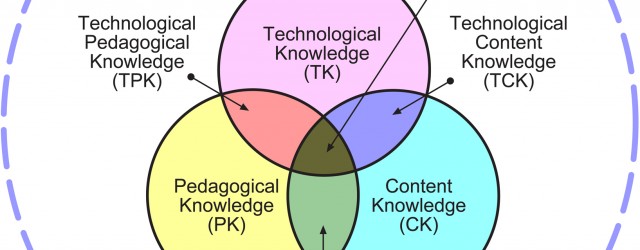
Content Knowledge (CK) is knowledge about the actual subject matter that is to be learned or taught (Mishra and Koehler 2008). Technological Content Knowledge (TCK) is an understanding of the manner in which technology and content influence and constrain one another. Teachers need to master more than the subject matter they teach, they must also have a deep understanding of the manner in which the subject matter can be changed by the application of technology. Teachers need to understand which specific technologies are best suited for addressing subject-matter learning in their domains and how the content dictates or perhaps even changes the technology, or vice versa.
There is debate about the importance of content; its usefulness or otherwise, with regards student learning in this contemporary age. There are those who argue it stills plays an important role in the education of students and should not be sacrificed for the 21st century skills movement (Rotherham and Willingham 2010) and there are others who argue that 21st century skills need to become the focus of curriculum if students are to be prepared for the world that awaits them after their schooling (Bellanca and Brandt ; Kozma 2009; Du Four and Du Four 2010). The Australian Curriculum Assessment and Research Authority (ACARA) argues both are important when it states,
“Young people will need a wide and adaptive set of knowledge, skills and understandings to meet the changing expectations of society and to contribute to the creation of a more productive, sustainable and just society” (ACARA 2010).
There is an argument that content knowledge (CK) is necessary in order to facilitate the interactive potential technology can offer in the teaching and learning process (McLoughlin and Lee 2009; Rotherham and Willingham 2010). Some authors (Hirshon 2005; Boettcher 2006) agree that there is a need to re-evaluate the role of content in courses, and have advocated, for example, a greater focus on process (as opposed to product) and personal skill development.
There are some who suggest that 21st century skills could be explicitly taught to students (Cisco Systems 2008; OECD 2008; Partnerships for 21st Century Skills 2010); in other words, the skills would become the content. In searching for the balance between content and skills we can investigate Partnerships for 21st Century Learning at http://www.p21.org/. This outlines how teachers can integrate skills into the teaching of core content and illustrates, “a blend of content knowledge, specific skills, expertise and literacies” (Patnerships for 21st Century Skills).
Partnerships for 21st Century Learning illustrates how content and skills can work together to assist teachers adopt technology in the classroom. It supports the argument that the implementation of 21st century skills into the curriculum requires the development of core academic subject content and understanding among all students. Accountability requirements have ensured this to be the case; however, they have also been an inhibiting factor in developing student capacity of essential 21st century skills (OECD 2006; Silva 2008). The educational landscape is characterised with increased technology; however, there are significant requirements for principals to remain publicly accountable in an atmosphere of NAPLAN and MySchool. Politicians and other policy leaders who express the need for students to be creative, self-directed learners, and be adept at using existing knowledge resources are also the same people calling for accountability measured by traditional testing. This provides a dilemma for principals, schools and systems when considering assessment for students in a contemporary educational environment.
Overall, there appears to be
the need to maintain a balance between content and skills as they are not separate, but intertwined. Both content and skills need to be interconnected with pedagogy and technology when striving for school transformation. What are your thoughts?
The link below is a document which I developed and used for a Staff Professional Learning Activity with a focus on student centred learning. The input and discussion that come from teachers indicated the activity was successfull in further developing their understanding of student centred learning.
The article refers to entrepreneurs being a unique type of people, ones who focus on their vision with a single-minded passion, so much so that anything diverts their attention from turning their visions and passions into reality, goes by the wayside. He quotes Gates and Zucherburg as such examples.
Stibel does give ground by acknowledging, “If family, friends, and hobbies are important to you, then by all means you should pursue those things. But the key is to make the most important things a priority and to get rid of the rest.”
At the time of my reading the article, I was enjoying “a week away from it all” after an unusually tough start to the year. I am very glad I took this week and had some “me time”. It enabled me, like no other time in my life, to ‘take stock’ and refuel the mind, body and spirit. It allowed me to realign my priorities for work life balance. I may not be an entrepreneur, they are special and unique people, but I am passionate about student learning and am very fortunate to be the principal of a great learning community!
Obviously passion drives people. If you are passionate about your work then you are not working. The fact is most of us are not entrepreneurs and therefore, when work gets too much for us, we need to address work/life balance. For some, family, children, spouses are the priority and passions; they are what sustain us. It is not our work and not our vision.
Some of us are not defined by the work we do but by the way we act as a mother or father, behave as a wife or husband, and support our parents. Ultimately, the way we go about these roles are what ultimately supports the growth and development of society. Sometime, we need to take time out to address the imbalance of too much work. I am glad I did.
This article confirms the need for schools to explore ways, and make time, to assist students REFLECT on their learning. Annie Paul reminds us “anytime a student learns, he or she has to bring in two kinds of prior knowledge: knowledge about the subject and knowledge about how learning works.” Teachers are very good at providing knowledge about the subject. Structurally, this is reflected by the way secondary schools ‘package’ education in ‘Key Learning Areas’.
On the second point, about “how learning works”, Annie Paul points out, “the guidance we offer on the act of learning itself—the “metacognitive” aspects of learning—is more hit-or-miss, and it shows.” An Australian Study involving 1388 Australian high school students found that their ability to engage with knowledge about learning was “less than optimal.” Annie Paul quotes Helen Askell-Williams of Flinders University in Adelaide, who states, “Teaching students good learning strategies would ensure that they know how to acquire new knowledge, which leads to improved learning outcomes.”
The article concludes positively by offering questions for parents and educators “to make sure that children know not just what is to be learned, but how.” These questions are:
·What is the topic for today’s lesson?
·What will be important ideas in today’s lesson?
·What do you already know about this topic?
·What can you relate this to?
·What will you do to remember the key ideas?
·Is there anything about this topic you don’t understand, or are not clear about?
In summary, each learning experience offers students the opportunity to reflect on their learning. By doing so they are enhancing their ability to learn about learning.
The above diagram accessed from http://www.tpck.org/ represents the interconnected importance of technology, pedagogy and content. Learning in our contemporary educational environment the requires systems, school leaders and teachers to take advantage of technology to enhance content and pedagogy(Jamieson-Proctor and Finger 2008).
With a focus on pedagogy and with reference to the TPACK framework, Pedagogical Knowledge (PK) is deep knowledge about the processes and practices or methods of teaching and learning and how it encompasses, among other things, overall educational purposes, values and aims. It includes knowledge about techniques or methods to be used in the classroom; the nature of the target audience; and strategies for evaluating student understanding. As such, PK requires an understanding of cognitive, social and developmental theories of learning and how they apply to students in their classroom (Mishra and Koehler 2008).
Appropriate pedagogy for the use of technology requires learner-centred approaches (Sutherland 2004; Chang and Wang 2009). Learner-centred pedagogy involves students being actively involved in knowledge construction. Dwyer et al, (1991) in Fullan and Smith (2000) outline the differences between knowledge instruction and knowledge construction. Essentially, knowledge instruction is viewed as the transfer of thoughts from one who is knowledgeable to one who is not and teacher work is perceived as direct instruction. Knowledge construction views learning as a personal, reflective, and transformative process where teacher work comprises facilitating students’ abilities to integrate ideas, experiences, and points of view into something new (Fullan and Smith 2000). According to them there are more possibilities with a classroom that enables knowledge construction.
In a knowledge construction setting, technology becomes a tool to help students access information, communicate information and collaborate with others. In today’s classrooms there is certainly the need for some knowledge instruction but a great deal of student activity might involve knowledge construction given the explosion of information (Fullan and Smith 2000).
These technology-based, learner-centred and knowledge constructivist pedagogical approaches are more readily appearing around the world due to increased access to technology. For example, Australian schools and teachers are integrating technology to support experiential, constructivist learning in schools and across learning sites; engage students in personalized, collaborative, connected and interactive learning; and broaden and use new pedagogies (MCEETYA 2006).
Student centred pedagogy has resulted in personalised learning environments for students. Personalised learning refers to the “school’s capacity to use ICT to extend and differentiate student learning opportunities, and to support students to manage and d
irect their learning” (MCEETYA 2008). Emerging technologies offer unique opportunities to personalise the learning environment for individual learners. A 2009 Horizon Report sponsored by the New Media Consortium identifies the ‘personal web’ as,
a collection of technologies that confer the ability to reorganise, configure, and manage online content rather than just view it; but part of the personal web is the underlying idea that web content can be sorted, displayed, and even built upon according to an individual’s personal needs and interests (Johnson, Levine et al. 2009).
The personal web enables students to experience school in a different way; a more ‘personalised’ way due to the advent of technology (Drexler 2010). The personalised learning environment, “promotes inquiry-based learning and digital literacy, empowers the learner, and offers flexibility as new technologies emerge” (Drexler 2010). The requirements of personalised learning place high demands on teachers and schools, and it is not surprising that personalised learning is entering schools only slowly (ICT Cluster European Commission 2010). However, the development of personalised learning as part of a school environment greatly assists teachers to adopt technology in their classrooms.
There is an implication that pedagogical change and greater personalisation of learning are both necessary for student centred, self-directed and independent learning (Sebba, Brown et al. 2007; McLoughlin and Lee 2009). Addressing the need to rethink and reposition pedagogy for the new learning landscape of the 21st century calls for the active involvement of students in defining their learning goals, and choosing both digital technology and strategies for learning. It also requires recognition that learner generated content has a central place in a curriculum that fosters self-regulated learning.
Emerging practices with digital technology signals the need for pedagogies that are more personal, social and participatory (MCEETYA 2008; McLoughlin and Lee 2009; Drexler 2010). Educators and institutions are increasingly beginning to recognise that the philosophy and ethos prevalent in the Web 2.0 world in which we live are incongruent with the control culture of education, where teacher-designed content and syllabi dominate (Sutherland 2004; Whitby 2006; McLoughlin and Lee 2009). To adopt new pedagogies which allow for increased use of technology, the design of programs and units of work withi
n the guidelines of syllabus documentation requiresinquiry-based learning and project-based activities (Rotherham and Willingham 2010). All of this signals a need to reconsider our notions of pedagogy so that learners are envisaged as active participants and co-constructors of learning resources rather than passive consumers of content (Whitby 2006; OECD 2008; Drexler 2010; Partnerships for 21st Century Skills 2010).
Greg Miller
P.S. There is a great 3 minute video which explains the TPACK framework. It can be found at
Australia’s national educational goals take into account the context of the digital age. The Melbourne Declaration on Educational Goals for Young Australians asserts, “in this digital age young people need to be highly skilled in the use of ICT” (MCEETYA 2008, p5). This continues a theme from the earlier 1999 Adelaide Declaration of Australia’s National Goals for Schooling which stated that when students leave school they should be, “confident, creative and productive users of new technologies, particularly information and communication technologies, and understand the impact of those technologies on society”(MCEETYA 1999, p.7).
The aspirational national goals hide the reality students can no longer be assured of middle class comforts through manual labor or use of routine skills, work that can be accomplished by machines. Success for them in the future lies:
i) in being able to communicate, share and use information to solve complex problems;
ii) in being able to adapt and innovate in response to new demands and changing circumstances (OECD 2006; Cisco Systems 2008; Partnerships for 21st Century Skills 2010); and,
iii) in being able to marshal and expand the power of technology to create new knowledge and expand human capacity and productivity (Binkley, Erstad et al. 2010).
As workers in the 21st century, students of today will be required to work many different jobs across various occupations. They will require an ability to learn new things because accelerating technological change is making old skills redundant, therefore generating the need for new skills (Wergriff 2002).
Quite simply, schools need to prepare students for their contemporary world by developing 21st century skills and capabilities required by young people to have a successful life (Moyle 2006).
How is your school going in preparing students for the 21st century?
Greg Miller.
REFERENCES
Binkley, M., O. Erstad, et al. (2010). Draft White Paper 1 Defining 21st century skills; A report to the Learning and Technology World Forum 2010 in London as part of the Assessment and Teaching of 21st Century Skills project created by Cisco, Intel and Microsoft. U. o. Melbourne. London.
Cisco Systems (2008). Equipping Every Learner for the 21st Century: A White Paper.
Moyle, K. (2006). “Leadership and learning with ICT : voices from the profession.”
OECD (2006). Think Scenarios, Rethink Education.
Partnerships for 21st Century Skills (2010). “Framework for 21st Century Learning.” from www.P21.org.
Wergriff, R. (2002). “Literature review in Thinking Skills, Technology and Learning.” Futurelab Series Report 2.
Leading school transformation requires principals to understand the relationship between content, pedagogy and technology. A process of transformation requires school leaders to reconsiderthe nature of school education and the ways in which learning can become more technologically enabled (Moyle 2010). Contemporary research suggests principals need to be aware of these elements when undertaking a process of school transformation:
i)Content development is necessary in order to facilitate the interactive potential ICT can offer in the teaching and learning process (Kozma 2008; Rotherham and Willingham 2010);
ii)Consideration of Pedagogywhich capitalises upon the advantage of technology to enablefor educational change (Hargreaves 2005; Lyons 2007; Moyle 2010); and,
It is reasonable to expect principals to have a certain skill level with digital technologies. It may be unreasonable to expect principals to be the most knowledgeable and skilful user of digital technologies in any school setting; however, beyond traditional notions of technical literacy, principals need to attain knowledge and skills which enable them to be seen as an authentic leader of school transformation. Principals are required to demonstrate a broad understanding of information technology and how it can be used productively in a school setting. Also they are required to recognize when information technology can assist or impede learning, and to continually adapt to changes in information technology.
The area of ‘Content’ provides a dilemma for principals. In the current educational environment where MySchools, NAPLAN and Board of Studies syllabi requirements in New South Wales receive significant attention, schools are pressured by the government to utilise Digital Education Revolution (DER) funding to “contribute sustainable and meaningful change to teaching and learning in Australian schools that will prepare students for further education, training and to live and work in a digital world” (DEEWR 2011). I ask myself, how much time, effort and energy should my school dedicate to NAPLAN testing when, at the same time I am trying to lead school transformation?
In the area of ‘Pedagogy’, and with a commitment to school transformation, a principal needs to oversee the development of student centred pedagogies, such as inquiry-based learning and project-based activities, which capitlise upon the advantage of digital technology. Such approaches assist students with their development of 21st century skills including critical thinking, collaboration and group work. With this, principals are required to lead teachers towards understanding their role; a role that lies at the intersection of technology, pedagogy and content, where the whole is greater than the sum of its parts (Mishra and Koehler 2008).
In essence, content and skills are not separate but intertwined, and both are interconnected with pedagogy and technology when striving for school transformation. The implications for principals when striving to achieve school transformation are:
i)The need to develop their own skills with digital technology;
ii)A requirement to identify the balance between content and skills; and,
iii)A willingness to ensure the school adopts pedagogies which capitalise upon the advantage of digital technologies.
Any principal overseeing school transformation requires informed strategies which promote an understanding of the opportunities and constraints of a range of digital technologies, and how they support pedagogical strategies suitable to school transformation (Mishra and Koehler 2008).
Number 3 – Our shared understanding of “what a computer is.” The increasing mobility of computing going mobile over the next decade will see individualized computing via handhelds.
This has implications for Number 6 in that “the teacher who hasn’t yet figured out how to use tech to personalize learning will be the teacher out of a job. “Differentiation will become a nautral part of a teacher’s bag of tricks.
Speaking of out of a job, this article indicates the some of the traditional roles of the IT Department — software, security, and connectivity — will become a thing of the past due to cliud computing, Number 11.
Number 12 is also very challenging for us who love the current feel for our schools. The argument is that “School buildings are going to become ‘homebases’ of learning, not the institutions where all learning happens.” It talks about student and teacher schedules changing and also that teachers and students will go out into their communities to engage in experiential learning. Therefore, implicit in this is that schools shouyld be looking for more flexible timetables.
Number 16“The root of curricular change will be the shift in middle schools to a role as foundational content providers and high schools as places for specialized learning.” How exciting for students!
Number 21 has great implications for ecological sustainability in that schools will decrease their paper consumption by no less than 90% within 10 years. WOW!
I encourage you to read the article. It will prove very useful and I dare say provoke much discussion among teachers and parents alike.
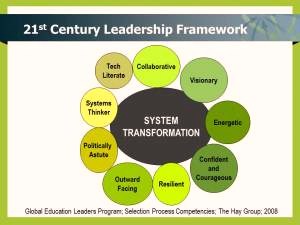
With the backing of research from Hay Group, this excellent article states there are 9 key areas required by systems to assist their schools achieve school transformation. The article can be found at…..
 LEARN AND LEAD