Collaboration and Google Docs

COLLABORATION AND GOOGLE DOCS (2)

At the end of 2015, I completed a Master of Education (Knowledge Networks and Digital Innovation) at Charles Sturt University. As a participant in the capstone subject, Digital Futures Colloquium, I conducted a Case Study.

This Case Study investigated, “In what ways are students using Google Docs for collaboration?” The use of Case Study methodology was relevant for gathering information through the views and interactions of members of the school community, focusing on their engagement with, and various perceptions of, the use of Google Docs for collaboration.

The Case Study “Collaboration and Google Docs” was completed in October 2015. A summary of Findings are as follows:

  • Students were at ease with sharing their document with other students; however, the regularity of commenting on the work of another student work was far less
  • Student ability and/or confidence to ‘comment’ on the work of another student, is not to the same level as their ability to create, use and share Google Docs.
  • Teachers overestimated how often students edited the work of another student.
  • Real time use of Google Docs in the classroom; that is, multi-user editing in real-time to co-construct a document, appeared to be the most enjoyable, comfortable and useful way students engaged with Google Docs.
  • The practices of correction, modification, commenting and editing all constitute collaboration; however, students were largely unable to articulate the connection between these actions and the skill of collaboration.
  • Students collaborated with others to share feedback in constructive ways in the classroom environment. However, this reality was not matched in the areas of students’ willingness (and possibly) their ability to think critically by individually commenting and editing the work of others, especially outside normal classroom hours.
  • When students accessed Google Docs outside of class time, it was primarily for the purposes of creating and sharing documents with the teacher, not with other students.

The recommendations I forwarded to the leaders and teachers of St Hosea’s (not its real name) were as follows: :

  • develop of a school wide rubric which attempts to measure student collaboration;
  • investigate why students use Google Docs more in class than they do outside of class time; and,
  • establish an online space where students and teachers share reflections and post comments about the use of GAFE to support collaboration.

One learning for me….. As part of the work involved with this Case Study, I developed a ‘collaboration rubric‘ particular to the use of Google Docs.  Whilst I will be the first to admit this probably could do with some improvement, it did provide a starting point for me when engaging with classroom observations. I am of the firm belief that schools are now required to engage in the co-construction of such rubrics with students to deepen their understanding of co-constructing such rubrics with students to deepen their understanding of the vital skills required for future work, collaboration being only one of them. If we can at least to being the process of measuring what we value; e.g. collaboration, critical thinking, problem solving etc.; we may start to ‘value’ these skills as much as we do literacy and numeracy, which are far more easily measured.

Any feedback or comments are very welcome.

Regards

Greg

Data and Questions

DeCourcy & Data

Dr John DeCourcy has served as a teacher and principal in Catholic education for over forty years. However, he is probably better known for his ground-breaking work in Higher School Certificate (HSC) Data Analysis for the last fifteen years. Through the provision of quality data, John’s work has enhanced the professional knowledge base of educators by deepening our understanding of the relationship between teacher practice and student performance.

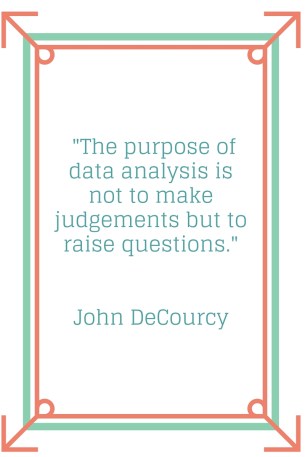
Last Friday, I was fortunate to spend a day with a number of colleagues from across New South Wales at the annual DeCorucy seminar. John reminded us that the purpose of data analysis is not to make judgements but to raise questions. He stated,

“Professionalism is characterised by using data to raise questions. Developing questions supports the search for improvement and for teachers in particular to develop their craft.”

It is, of course, a craft that is primarily focused on learning, not just examination results. On the day, there was a lot of discussion about data but rarely did we look at specific data sets. I suspect John’s learning intention was for participants to leave better informed about the purpose of data and how it can inform quality learning.

The informing happens through questioning. Three great questions to get teachers thinking are:

  • What questions does the data raise?
  • How did you use the data within your school setting?
  • What are the patterns emerging at your school?

It is not just the teachers who must immerse themselves in the the data, school and system leaders must do so as well. It is important for leaders to immerse themselves with teachers in the data because no-one knows it all and,  as John said,

“Leaders engaging as learners with their staff is critical to framing questions which respond to data.”

As we moved throughout the day we were asked to consider the leading indicators of HSC success, “because as we all know the results are the lagging indicator!” Great question right there! The HSC sets high standards for students often demanding high levels of resilience, motivation, drive, self-belief and efficacy, in particular the ability to plan and manage time. For example, the time, effort and energy required for a HSC Major Work or Project requires of students those dispositions more than at any other stage of their school life. Are these dispositions the leading indicators of HSC success?

We have all heard the saying, “We measure what we value and we value what we measure.” At the moment, educators are excellent at extensively measuring literacy and numeracy. Literacy and numeracy are important, but so too are skills such as creativity, critical thinking and collaboration. If we truly valued these skills, rubrics for them would be mainstream in classrooms, but they are not. (BTW – Here is a recent attempt to align Collaboration with Google Docs – any feedback would be greatly appreciated – apologies for digressing).

Just as important as the critical skills of creativity, critical thinking and collaboration, are the dispositions mentioned above, but which dispositions are the most important? A 2015 OECD Report, Skills for Social Progress: The Power of Social and Emotional Skills list perseverance, conscientiousness, self-esteem, socliability and emotional stability as key dispositions required for young people to maximise learning. According to The Gallup Student Poll the key factors that impact student performance are hope, engagement, and well-being, and they measure it! Insight SRC regard well-being, engagement and relationships as critical factors which support student learning. Based on extensive scientific research, they work with schools in the Parramatta Diocese, Lismore Diocese and in Victoria, to provide data sets in these areas.

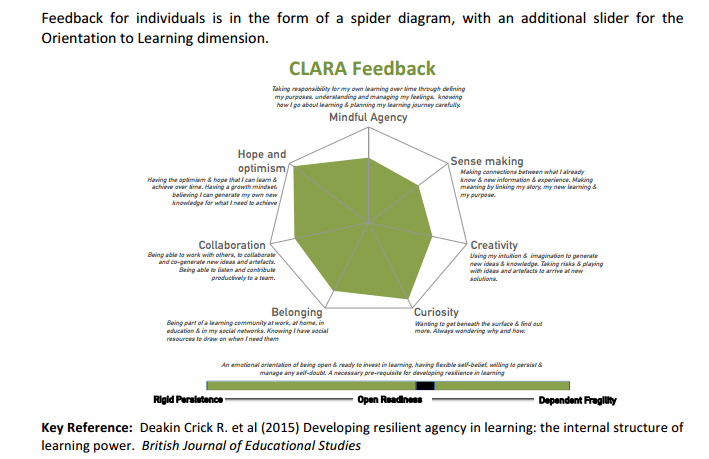
There is also the fifteen years of work by Ruth Crick and others which has resulted in the Crick Learning for Resilient Agency Profile (CLARA)

“CLARA identifies Mindful Agency as a key learning power dimension which predicts the set of active dimensions: Creativity, Curiosity, Sense-Making and Hope & Optimism.  Two distinct Relationship dimensions measure Belonging and Collaboration. Finally, an Orientation to Learning indicator measures a person’s degree of Openness to change — in contrast to either fragile dependency or rigid persistence.”

learningemergence.net (accessed 30 January, 2016).

My understanding is that CLARA surveys students and reports back findings in key areas, putting a face on the data and producing a profile.

Clara

accessed from learningemergence.net30 January, 2016.

CLARA also aggregates individual profiles for school communities. WOW! Considering that the research says these dispositions are foundational for great learning, can you imagine the questions that could be raised with this data?

What are your thoughts?

Creating Time

For those who work in education, and like many other industries, there is just never enough time. A few months back, I was introduced to an article “K-!2 Innovation: It’s About Time“. The author was  2015, Texas Teachers of the Year, Shanna PeeplesAs part of the article she wrote,

“Some of the most innovative, creative and powerful lessons I’ve ever helped to design were created from collaborations with colleagues in a small group given time to really think through a lesson.”

This reminded me of occasions when I have seen teachers provided with time to meet, plan, prepare, deliver and evaluate learning for students. A number of them reflected it was the best professional learning they had undertaken as a teacher, and some commented that it was the most they had grown as an educator.


Finding Time

Image courtesy of Doug Belshaw on Flickr under Creative Commons


So, how can we find time for teachers to meet, plan, prepare, deliver and evaluate learning in the classrooms to produce powerful learning for students AND teachers? Well, I provide a few possibilities….

(Now, there are a lot of numbers about to be thrown at you, and I am not great with  numbers, but please hang in there with me!).

School “A” is a secondary school in New South Wales (NSW), Australia. In NSW, the regulatory authority mandates the minimum delivery of 400 hours of English, Mathematics, Science and HSIE (History, Society and its Environment) to students across Years 7 to 10. However, at School “A”, they deliver 520 Hours of English, Maths, Science and HSIE across Years 7 to 10. (As an aside, can anyone inform me where the ‘value add’ is between hour 401 and hour 520?) Anyway, the end result is a combined surplus of 480 hours (across the four subjects over four years); 120 hours per year. If School “A” was to reduce those 520 hours per subject to 480 hours per subject, still 80 surplus hours over the fours years, then they could ‘find’ 160 hours of ‘time’ per year. Wow!

Now, just to give you an idea of what can be done with 160 hours……. (and please, hang in there with me) School “A” allocates 40 hours less (ie. 120 hours) towards the delivery of an entire subject in Year 7; that being, Languages Other Than English (LOTE). Also, School “A” allocates 240 hours towards Music/Visual Arts in Year 7 & 8 over two school years. As per its timetable, 120 hours per year = 3 x 1 hours lessons per week. 160 hours over the course of a year would compute to 4 x 1 hour lessons per week, or in other terms 4/5ths of one school day per week. School “A” has just ‘created time’.

Maybe, just maybe, School “A” could reduce the mandatory hours for English, Maths, Science and HSIE and redirect that time in the form of 3 or 4 one hour blocks throughout the week where the students are supervised at ‘yard duty ratios’. Students could work on interest projects while the vast majority of teachers could meet, plan, prepare and collaboratively evaluate learning in teams. Students could access open spaces, indoor, outdoor and virtual and collaboratively work on interest projects. Such an idea would require support and guidance for students to ‘self-direct’ their interest projects but c’mon people, stick with me here – I am just throwing up ideas! Again, whilst students engage in these interest projects, the professional learning benefit would be that teachers meet, plan, prepare and collaboratively evaluate together to improve the quality and facilitation of learning throughout the rest of the school week. And what’s more, there is no financial cost to this. NONE! No financial cost for what many teachers consider excellent professional development. However, it does require a new way of thinking about how we use time in a secondary school setting.

School “B” is a two stream primary school. School “B” employs two casual teachers every second Thursday. Those casual teachers are employed to replace 2 x Year 5 teachers for the first half of the day and then replace Year 6 teachers for the second half of the day. This occurs for Term 1 and allows them to meet, plan, prepare and collaboratively evaluate students learning. In Term 2 the same for Year 3 & 4 teachers. In Term 3 for Year 1 & 2 teachers and in Term 4 Kindergarten teachers get a whole day to meet, plan, prepare and collaboratively evaluate together. (Look, my secondary background limits my thinking here, but I am sure the creativity of primary principals and teachers could come up with something a lot better). Cost = employment of 2 casual teachers, 2 x $400 per day ($800) x 4 times per term ($3200)  x 4 terms per year ($12 800) per year. What’s the cost of school based, contextual professional development for teachers when done well?

There is absolutely no doubt these and other similar ideas would require extensive consultation with staff, students and parents. And, I know there will inevitably be people loudly cry out, things like – say, in the case of School “A’”, “We won’t get through the content.” But Puuuhhlllleeeezzzze, when did any student suffer from “not getting through the content” in Year 7, 8, 9 or 10? And, please show me the research which proves this. In the case of School “B”, there may be those who might say, “That won’t work because…..” Well, I ask that we look at how it CAN work.

Looking ahead, I ask those educational leaders who can, to make bold decisions and ‘create time’ by ignoring the chorus of, “That won’t work because……” We need to roll our sleeves up and challenge the thinking as well as overcome obstacles which get in the way of ‘finding time’ or ‘make better use of time’. Shanghai, Singapore, and British Columbia understand the need to create time for teachers to collaborate. Hopefully, Australia will too one day soon. After all, it is in the best interests of student learning.

Regards

Greg

Please note this article “Get Time Right; Don’t settle for Vanilla+”. Maybe the ideas suggested above, and below in the comments section, are “Vanilla+”.

DESIGNING LEARNING SPACES – Part 1

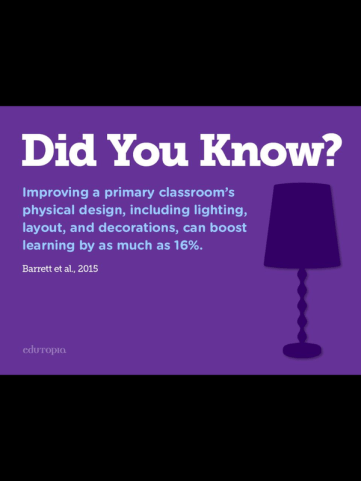
Recently, as part of my work, I have been working with schools who have come into some serious money for new building projects. Architects have already been introduced to those schools; however, it was thought wise to actually see other spaces ‘at work’. Further to this, it was also thought worthwhile to look at what researchers and thought leaders offer about designing learning spaces. For a start, Did You Know?????

Learning Spaces & Primary Classroom

Planning new physical learning spaces or refurbishing spaces requires the effective use of design thinking principles (Kuratko, Goldsworthy et al. 2012; Razzouk and Shute 2012; Hill 2014). Elements of good design include collaboration and prototyping (Brown 2009); collaborative prototyping (Melles 2012); and user centred input (Brown 2009; Kolko 2010).

Learning Spaces can support, enable and positively impact on the learning experience (Thornburg 2007). The communication and collaboration that comes with iterative nature of prototyping is one characteristic that can assist with generating numerous ideas for new learning spaces in schools (Veloso, Marques et al. 2014). Furthermore, the use of design thinking principles for new building spaces, is currently minimal in most schools, and there is little involvement of students or teachers as ‘future users’ of the space.

Input from students is essential when assessing how the use of learning space can support improved learning outcomes for students (Dugdale 2009). Feedback from students as current users of spaces informs the school about future use of space and the placement of furniture within that space (Woolner, Clark et al. 2012). Such participatory design approaches involving users (students and teachers) can provide a springboard that encourages all learners to become more thoughtful and involved users of their environment (McGregor 2004; Woolner 2009).

There is an argument that physical space is one variable, and that it does not have a direct influence on student learning. However, there is literature which suggests there is a strong relationship between learning and physical spaces (Thornburg 2007; Woolner, Clark et al. 2012). McIntosh in (Howarth 2012) is very definitive when he states,

“Spaces should add value to learning and act as a teaching assistant to learning activities. School buildings need to be viewed as influencers of future practice, not responsive to existing practice of teaching and learning” Ewan McIntosh in (Howarth 2012).

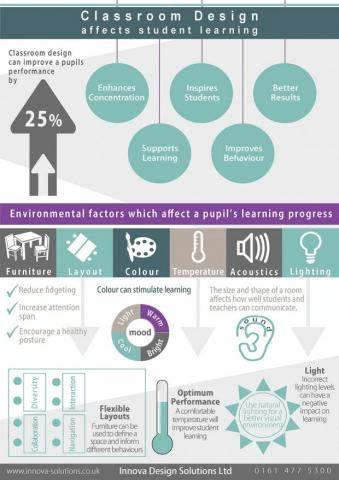
The relationship between learning and physical space is a most important variable which impacts on student learning and can support, stimulate and accelerate learning initiatives grounded in student-centred pedagogy. Innova Design Solutions offer these insights…..

Learning Spaces - Impact on Learning

In the main, schools are (still) designed to support an old factory-style paradigm characterised by mandated school hours which revolve around inflexible timetables to deliver traditional learning (Bellanca and Brandt ; OECD 2006; P21 2009; Rotherham and Willingham 2010; AITSL 2012). Such an environment stifles change and creativity and results with ‘more of the same’. Learning spaces of the future need to start with an approach that is ‘design thinking focused’ with resources which will encourage users to think creatively and re-imagine possibilities by taking into account the future use of space.

REFERENCES

AITSL (2012). “Professional Learning Animation.” 12 April 2014, from http://www.youtube.com/watch?v=nRnstWGJwPU.

Bellanca, J. and R. Brandt 21st Century Skills: Rethinking How Students Learn, Solution Tree Press.

Brown, T. (2009). Change by Design: How Thinking Transforms Organizations and Inspires Innovation. New York, Harper Business.

Dugdale, S. (2009). “Space Strategies for the New Learning Landscape.” Educause Review 44(2): 50.

Hill, A. (2014). Using Design Thinking to Develop Personalized Learning Pilots http://www.blendmylearning.com/. 2014.

Howarth, S. (2012). Pedagogy and People over Places and Spaces. A View from the Middle – Thoughts on Learning with Middle School Studnets, http://edusum.edublogs.org/. 2014.

Kolko, J. (2010). “Abductive thinking and sensemaking: The drivers of design synthesis.” Design Issues 26(1): 15-28.

Kuratko, D., M. Goldsworthy, et al. (2012). “The design-thinking process in Innovation acceleration: transforming organizational thinking.” pp.103-123.

McGregor, J. (2004). “Spatiality and the Place of the Material in Schools Pedagogy, Culture and Society,.” 12(3): 347-372.

OECD (2006). Think Scenarios, Rethink Education.

P21 (2009). “21st Century Learning Environments White Paper.”. from http://www.p21.org/documents/le_white_paper-1.pdf

Razzouk, R. and V. Shute (2012). “What is design thinking and why is it important?” Review of Educational Research 82(3): 330-348.

Rotherham, A. and D. Willingham (2010). “21st-Century” Skills. Not New, but a Worthy Challenge.” American Educator 34(1): 17-20.

Thornburg, D. (2007) Campfires in cyberspace: Primordial metaphors for learning in the 21st century. . Thornburg Center for Professional Development. Retrieved from: http://tcpd.org/Thornburg/Handouts/Campfires.pdf

Veloso, L., J. S. Marques, et al. (2014). “Changing education through learning spaces: impacts of the Portuguese school buildings’ renovation programme.” Cambridge Journal of Education 44(3): 401-423.

Woolner, P. (2009). Building Schools for the Future through a participatory design process: exploring the issues and investigating ways forward. BERA Manchester.

Woolner, P., J. Clark, et al. (2012). “Changing spaces: preparing students and teachers for a new learning environment.” Children Youth and Environments 22(1): 52-74.


A Bold Idea To Better Use Time

In my current role I support and challenge Principals and Leadership Teams to lead their communities to attain improvement through inquiry. I enjoy my visits to schools, discussions with principals and engagement with their learning community. Most particularly, I admire the energy and expertise that these leaders and their teachers dedicate towards the learning agenda of the students who come under their care. They do this despite increasing demands on their time.

For quite a while now, my Twitter PLN, most particularly my #INF537 #dbblearn and @materdeiwagga colleagues, know I have been interested in how schools can use time to accelerate change in their settings. Over the last six months, I have noted “TIME” as being an increasingly precious asset. Over the last three months I started to note more closely note various concerns about “TIME”. Here are some direct quotes……

“We have more teaching face to face hours in Australia than most other countries in the world.”

“We looked into a project but got held up by reports, exams and marking.”

“We need more time to share our experiences of practice with each other.”

“We just don’t get the time to meet and plan.”

“There are competing demands on time.”

“We want to provide more opportunities to share practice which are aligned to the goals of the school.”

The hard nosed people reading this blog will argue, “It’s all about priorities! Just re-organsie your time and do what’s important.” That may be a fair comment; however, others may argue that schools are asked to do more and more without being allowed to let things go.  The reality is that governments and education systems continue to ask more of our schools, placing increased stress on the resource of time.

We need to approach this concept and use of TIME with Carol Dweck’s Growth Mindset by embracing the challenge to use time more wisely! In doing so, and with a solutions focused approach to the challenge, I share one idea with you…. 

School “A” is a secondary school in New South Wales (NSW), Australia. In NSW, the regulatory authority mandates the minimum delivery of 400 hours of English, Mathematics, Science and HSIE (History, Society and its Environment) to students across Years 7 to 10. However, at School “A”, they deliver 520 Hours of English, Maths, Science and HSIE across Years 7 to 10. This is a combine surplus of 480 hours (across the four subjects over four years); 120 hours per year. Just to give you an idea of what can be done with that time, Music/Visual Arts is allocated 240 hours, over two years, for Year 7 & 8. LOTE (Languages Other Than English) is allocated 120 hours in Year 8. As per its timetable, that is 3 x 1 hours lessons per week for four years. WOW! What if?????

What if….. the 120 hours per year could be better used to address our era of rapid change by developing skills of students to use information to co-create knowledge and (hopefully) solve real world problems?

What if….. the 120 hours was used as a three hour block every week? In that three hours students could work on their Genius Hour project that promote the skills of collaboration (teamwork), critical thinking, creativity, innovation & leadership. After that was finished, say after 90 minutes, students could go home early and then teachers could engage in regular weekly professional learning. Teachers could……

  • work together in teams to plan, prepare, review and evaluate learning. WOW!
  • engage in planned, structured action research inquiry on a weekly basis using collaborative technologies which support student learning. 
  • rework a unit of work applying the principles of challenged based learning, project based learning or inquiry learning.
  • produce videos for Flipped Learning approaches.
  • rewrite programs using Learning Design Principles – UBD.
  • develop an online learning course for one of their subjects – did some say “anywhere, any time learning”?
  • work in teams to develop a social and emotional skills continuum.
  • prepare rubrics which attempt to measure collaboration, critical thinking and problem solving in classrooms – what does that look like?
  • reflect on, and engage with, evidence and data sources (quantitative and qualitative) which is focused on student learning. Then the teachers could develop hunches and design rich questions which they interpret from the evidence and data.
  • create “reflection routines” allowing for time at the end of each lesson for students to articualte and synthesize the important points.

Yes, such an idea would require extensive consultation with staff, students and parents. And, I know there will be the inevitable person yell loudly, “We won’t get through the content.” But Puuuhhlllleeeezzzze, when did any student suffer from “not getting through the content” in Year 7, 8, 9 or 10? There will be also those who will say, “That won’t work because…..” However, I ask those who can, to make bold decisions about better use of time by ignoring the choir of

Yes, but

Let’s roll our sleeves up and produce the effort required to overcome obstacles which get in the way of finding time and make decisions which are in the best interests of student learning. I welcome comments from people who want to explore answers to these questions…..

  • How CAN we find the time?
  • How CAN we use it better?

I look forward to reading about your ideas.

Greg

Masters Completed – BAMM. That Just Happened!

Late last week I received feedback for my final assignment for the final subject of a Masters in Knowledge Networks and Digital Innovation hosted by CSU. The Masters course was practical, challenging and certainly developed my ability to identify, use and evaluate digital technologies for learning, teaching and professional practice. Furthermore, I deepened my understanding of the social, cultural and economic dimensions of information use. Most importantly for this day and age, the course greatly enhanced my ability to manage personal and participatory knowledge networks to communicate and work collaboratively and effectively with others.

The final subject was the capstone subject, Digital Futures Colloquium #INF537. INF537 has greatly added to my knowledge and deepened my understanding of the work of an educational professional in digital environments through participatory experiences including, but not limited to:

  • blogging, and the ensuing comments,
  • forum posts, and ensuing responses,
  • Adobe Connect which introduced us to experts, and
  • on Twitter through #INF537

As a member of the INF537 cohort, I was a learner who used, “new technologies to participate in virtual communities where they share ideas, comment on one another’s projects, and plan, design, implement, advance, or simply discuss their practices, goals and ideas together” Davidson and Theo (2010:12). As a part of the Adobe Connect session held Thursday 13 August, Tim Kladpor (2015) highlighted the issue of ‘Data Sovereignty’, encouraged us to dream possibilities of the ‘co-operative’ and challenged the notion of data ownership when authentically engaging in true sense of distributed networks though the Network ‘Common’. As part of my post,Data, Algorithms and Enclosure, I referred to Elizabeth Stark who suggests that people engaged in traditional structures are often threatened by newer paradigms around ownership and control.

Further to the matter of data ownership, on 29 August after hearing Jack Andraka speak at the Melbourne Writer’s festival, I blogged about his frustration accessing research articles from “behind the paywall”. Jack advocates for crowd-sourcing information which is freely accessible to academics and researchers in the hope that it will assist people to answer big questions and solve real word problems in a more expedient manner. The implication here is that, as educational professionals in the school digital environment, teachers are obligated to explore how information can be crowd-sourced to increase knowledge and improve learning outcomes for students.

Jack Andraka

The work of an an educational professional in digital environments requires engagement with co-operative practices. Most particularly, I have been reminded through INF537 discussion forums  that participatory learning experiences can assist people to make meaning through collective engagement. Through the exchange of ideas, I learnt from others and acquired clarity for upcoming assessment tasks.

Increased accessibility to mobile devices and cloud based applications means secondary schools are, by nature, digital environments. Teachers, as the educational professionals within those environments, need to acknowledge and respond to this reality. My involvement with INF537 has impacted on my daily work as a senior leader in a school system. As a person who serves in a position of influence, I am aware of the need for me to facilitate opportunities which enable and encourage teachers as educational professionals when working in digital environments.

As such, INF537 has shaped my thinking when working with the Head of Professional Learning to offer INSPIRE; an initiative which invites schools to engage in a disciplined innovation process which aims to encourage educators to co-design new pedagogical practices which are transferable, sustainable and scalable. Participation requires teachers to engage with digital technologies to regularly reflect and comment on the blogs of other educational professionals, within system and across our globally connected world. The use of cloud based applications to access experts will be particularly encouraged and I am hopeful the connections I have made through INF537 will be useful for variety of projects. Such practices will support collaborative behaviours of working towards a common goal within INSPIRE teams, as well as support cooperative behaviours of sharing freely across system Communities of Practice. Collaborative and co-operative behaviours are encouraged, if not expected of educational professionals in the digital environments of a secondary schools.

Participation in INF537 has confirmed my strong belief that education professionals in digital environments need to develop strong networks, act as connected educators and access opportunities that digital environments offer educational professionals. Completion of this Master Knowledge Networks and Digital Innovation has been as much satisfying as it has been challenging. It is now time to have a break from formal study, but not a time to stop learning!

References

Davidson, C, & Theo, D (2010). The Future of Learning Institutions in a Digital Age  MIT Press Cambridge, Massachusetts London, England.

Klapdor, T. (13 August 2015). You Are Not In Control. CSU INF537 Online Adobe Seminar.

Jack Andraka

Image retrieved from http://melbourne.usconsulate.gov/mobile/

On Saturday 28 August, 2015, I attended the Melbourne Writers Festival to listen to 18 year old, Jack Andraka. As a child he and his brother had an “all things can go” approach to ‘all things scientific’. His parents encouraged this passionate interest in science but asked him just one thing, “Please, don’t blow up the house.”

After losing an uncle to pancreatic cancer, at the age of 15, Jack developed a 30 page procedure for a non invasive method for detecting pancreatic cancer. After being rejected by 199 research companies, Jack overcame the stereotype of being a gay, scientific nerd to have his method supported by a research company. Besides being a great inspirational story, the message for parents and the rest of the village who raise kids……. whether you have kids who live for English, reading, public speaking, sport, dance, surfing, politics, maths, science, technology etc etc., do you best to let them follow their passion. It is a a part of a good education.

As part of the ‘fireside chat’ Jack spoke about the cost of getting research articles from”behind the paywall”. Jack spoke about the frustration of paying $30:00 for an article which may not have contained what it promised, making his crusade to cure pancreatic cancer another step further away. As an aside, he highlighted the irony, “You can pay $1:00 to download a Katy Perry song that you can play over and over, but it costs you $30 to access information which might help you save the world”.

Soon after, Jack highlighted Albert Swartz who, in 2011, devised a method of downloading large numbers of articles from JSTOR, using a computer hidden in a closet at MIT.

JSTOR s a digital library founded in 1995. Originally containing digitized back issues of academic journals, it now also includes books and primary sources, and current issues of journals.[4] It provides full text searches of almost 2,000 journals.[5] More than 8,000 institutions in more than 160 countries have access to JSTOR;[5] most access is by subscription, but some older public domain content is freely available to anyone” Wikipedia https://en.wikipedia.org/wiki/JSTOR

Rightly or wrongly, Swartz was considered by some to be brave enough to challenge the unfairness, hypocrisy and inequality of taypayer-funded scientific research held by publishing firms which then charged outrageous fees to access the resulting academic papers. This is exactly the frustration felt by Jack Andraka, hence why he advocates quite strongly for crowd sourcing information which is freely accessible to academics and researchers. His reason for this is that it will far more quickly enable cures for various diseases, including cancer.

Swartz pushed boundaries. What he did may have been ‘victimless crime’, but the fact is, he did steal. Regardless, the pressure was such that in January 2013 he took his own life.  Is it the case that, “people can say more or less what they like online; but the moment they look like mobilising people, then you come down on them like the ton of bricks”? guardian.com 7/2/2015

Let’s hope that one day we can see the value in the collective sharing of information for the common good of humankind.

Greg

Wrestling with Improvement and Innovation

Two weeks ago I attended the third annual “Leadership for School Improvement Colloquium” held at the Catholic Leadership Centre in Melbourne. I was a first time attendee and felt proud and privileged to be a part of a wider Catholic network of system educational leaders committed to school improvement.

As a participant at the colloquium I left with a number of reflections, most particularly that Catholic School Offices across the country have effectively refined their system-led school improvement (SI) processes through extensive use of quantitative measures and regular ‘check-in’ processes. Most pleasing is that goals of improvement are quite rightly linked to student learning outcomes with some SI processes able to access data dashboards and even put faces on the data. Also pleasing, is the spirit behind the process. Data is being used to promote dialogue and engage in a spiral of inquiry about improved student learning outcomes rather than to offer judgement through inspection. This is very different from the league table approach adopted by headline seeking media outlets!

As a result of my participation at the colloquium, it was obvious to me that Catholic education systems across the country, not unlike Government school systems and Independent school systems, have worked tirelessly, effectively and successfully to implement structures and processes which focus on, support and achieve school improvement. The SI agendas within most systems are usually advanced through timelines, policies, programs and structures as part of a well planned and system-led process, sometimes perceived by some school leaders (rightly or wrongly), to be rich in system accountability and light on school autonomy. I am not suggesting we change SI processes; however, I do ask myself…..

“Do highly effective School Improvement processes stifle innovation in schools?”

The inspirational Martin Luther King had a dream, he did not have a improvement plan. As per Greg Whitby’s latest blog, “Improvement is no longer the Challenge”, Steve Jobs’ dream started with Apple changing focus from ‘manufacturing’ to ‘lifestyle’. What a profound shift this turned out to be! The great companies of the world such as Apple have short, sharp, succinct Vision statements to which all actions, structures and resources strategically align. Bristol-Myers aims “To discover, develop and deliver innovative medicines that help patients prevail over serious diseases”. Amazon strives “To be earth’s most customer centric company; to build a place where people can come to find and discover anything they might want to buy online.” I am unsure if these companies have detailed strategic plans or extensive ‘improvement processes’. If they do, they don’t appear to suggest improvement plans are central to their success.

Education systems, and schools within those systems, need to wrestle with the relationship between ‘improvement’ and ‘innovation’. Do school improvement processes inspire schools and systems to strive for innovation? Can they co-exist? Possibly, but I suggest that innovation in schools not be aligned to system-led School Improvement Processes. I suggest that

“Innovation be linked to a Vision, or even a Dream developed by schools and centred on the development of skills for students of today for when they are employees in 10 years from now.”

The recent Report: The New Work Order, published by Foundation for Young Australians (2015), paints an intriguing picture of work in 2025. There are immediate implications for what schools provide for our current students, and how it is provided. I sense more ‘innovation’, not more ‘improvement’, will be required to respond to the challenges inherent in this report.

In saying this, there are promising signs regarding innovation in schools. Firstly, there have been Schools Rethinking Education with an innovative mindset for quite some time – and they are not seeking forgiveness! Currently, there is a groundswell of schools within the system where I work, who are keen to pursue an ‘innovation agenda’. This is acknowledged and accepted by our system leaders. Some/most schools leaders are seeking permission to ‘think big’, even ‘Do, then Think’; something which may be considered a departure from a deep inquiry of searching for a problem in response to quantitative data. On the other hand, if we need a problem to start an ‘innovation inquiry’ I don’t think we have to look too far. The data, through many reports including OECD reports, project into the future workplaces our students will enter. The New Work Order Report goes some way to explaining that future. The conclusion is that the education being provided in Australian schools needs to be dramatically different, even transformed, if we are to prepare students for very different world of work. There is a clearly defined problem and that problem is,

“schools are not developing and nurturing the skills that students will need when they become future employees.”

A few years back I reflected about what some companies of the world do regarding innovation and tried to link that to Unstructured and Non-Commissioned Time for Teachers. The thinking (and considerable proof) is that unstructured time supports and enables new ideas for innovation. For example, Google 80/20 time is not aligned to any company plan; yet some of their applications, including gmail, have been an outcome of the 20% individual ‘free time’. The 80/20 principle may not be the panacea as articulated in Chris Townsend’s post Innovate or Die but such a strategy does provide a lever to think and act differently. Companies are not schools, but we can learn from them. In his post Townsend writes, “to see the light of day, innovations typically require at least some degree of resources (funding, staffing, specific expertise), and both operational and functional support and buy-in.” I suggest the “operational and functional support” for innovation offered by systems who specialise in school improvement is wedded to tried and true methods of improvement rather than a deeper understanding of how to create sustainable ‘innovation’ discipline across the enterprise.” 

If school systems are looking to facilitate innovation within the community of schools for whom they serve, then we need to offer alternatives to the ‘improvement approach’. This starts with the data we use. Measuring ‘innovation’ may be a lot harder to do than measuring ‘improvement’; however, I suggest we start by valuing innovation as much as we do improvement. It is not an either/or! It is ‘improvement’ AND ‘innovation’ but we must engage with them, and measure them, in different ways but with equal importance.

Where to start? Systems could commence the process by re-calibrating their focus to support teachers to relearn their role by pursuing 8 things every teacher can do to create an innovative classroom. Another option could be to pursue “innovation across the enterprise” by measuring contemporary learning traits and mindsets of students through the use of school developed rubrics which focus on skills such as collaboration, or the Australian Curriculum General Capability of Critical and Creative Thinking. These rubrics would be applicable to all subjects across multiple year levels. Another idea might be to measure how students gain a deeper understanding and appreciation of Aboriginal and Torres Strait Islander histories, cultures, knowledge traditions and holistic world views. In an attempt to measure a school’s ability to develop globally responsible citizens (a buzz phrase some schools use for promotional purposes) there could be an attempt to measure the priority of Australia’s engagement with Asia by measuring students’ ability to celebrate the social, cultural and political links with Asia, and how students apply that knowledge in a globally connected world.Measurement of these priorities may already be happening in some schools, but are they being valued to the extent that they are system embedded?

‘Innovation’ is usually an outcome of iterative, messy, unstructured processes – this is different to the rigorous structures associated with school improvement. I argue

the advancement of the ‘innovation agenda’ requires a new mindset, new structures and maybe even new personnel driving something which is seen to be ‘different’ by the teachers and principals in the schools those systems serve.

This is challenging to those of us ‘in system’ but through conversations at the Leadership for School Improvement Colloquium it pleasing to note some system leaders are facilitating school based innovation initiatives. I am also pleased to say I am working in one of those systems with some of those system leaders. Hopefully, a rich story is yet to be told about that!

Regardless of the individual ‘innovation narrative’, I strongly believe all education systems who oversee a community of schools need to pursue, support and encourage innovation. In doing so, it needs to be done in such a way that is different from well established school improvement structures and processes. If not, we run the risk the ‘innovation agenda’ will be restricted, even negated, from being too tightly aligned to SI processes, indicators and thinking. I am sure no-one wants to see ‘innovation agenda’ be defeated by the well developed ‘school improvement’ agenda. They can co-exist, but through different approaches.

Regards
Greg
Technology and Participatory Learning

As part of recent reading I have been reminded that digital technology is generally being used in schools to repackage learning through a different medium (computers instead of books) for the curriculum which, in NSW, concludes with the Higher School Certificate.  As a system, profession and industry, education, and those involved in it, have not yet maximised nor mastered how technology can best accelerate and amplify learning. As part of the education continuum, students have learnt that assessment ranks are all important going into the concluding examinations and teachers have learnt to often teach to a formula, one that best prepares students to answer questions on an individual basis.

The flow on effect of this approach shapes learning prior to the HSC years, from Years 7 to 10. So too does the competitive nature of NAPLAN and the continued government rhetoric about our nation being “internationally competitive” with tolls such as PISA. Basically, students are encouraged to find the right answer for the test with a ‘yes/no’, ‘either/or’ culture. It may well be that we heed the advice in Teenagers and Technology as referenced in Selwyn (2014); that is, for teachers and parents to acknowledge that young people deserve some support, interest and even guidance from adults in developing uses of digital technology that are genuinely meaningful and empowering rather than an all consuming chase for the best result!

Davidson and Theo (2010) encourage us to ask how this paradigm, a paradigm which values individual (student, schools, national) effort and success, actually supports the learning styles of today’s youth and prepares them for increasingly connected world which awaits them. However, Davidson and Theo (2010) soon answer this question by forthrightly arguing that the days of conventional learning institutions are over, “unless those directing the course of our learning institutions realize, now and urgently, the necessity of fundamental and foundational change.”

Ross (2012) urges educational leaders and decision makers to rearrange the elements of learning and reshape audience expectations about the learning experience when discerning the possibilities afforded by digital technologies. They strongly suggest learning, “should be created in spaces that are not highly structured, the way most e-portfolio environments are” (Ross, 2012:262). Such thinking may even lead to John Spencer’s Ten Alternative Assessment Strategies being undertaken more and more in the school setting.

Participatory Learning acknowledges e-portfolios and other digital learning environments as places where  people can make meaning through collective engagement. Davidson and Theo (2010) articulate participatory learning “begins from the premise that new technologies are changing how people of all ages learn, play, socialize, exercise judgment, and engage in civic life” Davidson and Theo (2010:12). Furthermore, they write,

“Participatory learning includes the many ways that learners (of any age) use new technologies to participate in virtual communities where they share ideas, comment on one another’s projects, and plan, design, implement, advance, or simply discuss their practices, goals, and ideas together” (2010:12).

Ray (2014) highlights clear links between participatory learning and Maker movements. I always (incorrectly) saw Makerspaces as physical places where physical products were produced. In a digital virtual world I now understand that is also about, “students building the next generation of web applications” (Ray; 2014:8) through platforms such as Scratch where students can create and collaborate in building web-based projects and products, all while learning code.

Participatory Learning allows for self-guided informal learning which is recognised, for example, with digital badges through  MacArthur Foundation. Furthermore, games like ‘Quest Atlantis’ are characteristic of participatory learning. Challenges within this game, “require students to make choices that affect how events unfold and impact on other characters” (Ray 2014_a:13). Furthermore, there have been documented learning improvements with greater engagement, higher test scores and “54% play because they want to, not because they have to” (Ray 2014_a:13). There is also Whyville online Civics game where teens and pre-teens learn and play together with their own elected officials, town square and beaches. Such games offer,  “a place where the actions of a 10 year old can have a significant impact on the world” (Sasha Barab in Ray 2014_a:13).

Above all else, what I note regarding participatory learning is that hierarchies are negated and failure is encouraged and seen as part of the learning process. This encouragement, acceptance and acknowledgement of failure as being valued rather than despised, presents a welcomed challenge around the traditional the ‘pass or fail’ syndrome associated with standardised tests and numerous summative assessment tasks. In saying this, there is thinking we may need to ‘reframe’ failure. Our young people associate terms such as ‘Epic Fail’ and ‘Massive Fail’ with people who have fun poked at them through the production of videos such as Top Fails 15 and 12 Funny Massive Fails. Therefore, it may well be that we speak about the “iteration and process of one’s way of making it to the answer through errors and connections” (Ray, 2014:19). Whatever the case, wouldn’t it be great to see Andrew Miller’s Freedom to Fail Rubric, become commonplace in schools.

Your comments are most welcome.

Greg.

REFERENCES

Davidson, C, & Theo, D (2010). The Future of Learning Institutions in a Digital Age  MIT Press Cambridge, Massachusetts London, England.

FW: Thinking. (2013, June 19). Is technology a threat to our education? [Video file]. Retreived from https://youtu.be/nVYwGc8u_c0

Ray, B., Jackson, S. & Cupaiuolo, C. (Eds).(2014). Civics: Participating in a digital world. MacArthur Foundation Digital Media and Learning Initiative.

Ray, B., Jackson, S. & Cupaiuolo, C. (Eds). (2014_a). Participatory learning. MacArthur Foundation Digital Media and Learning Initiative.

Ross, J. (2012). The spectacle and the placeholder: Digital futures for reflective practices in higher education. InProceedings of the 8th International Conference on Networked Learning (pp. 227–244). Retrieved fromhttp://www.lancaster.ac.uk/fss/organisations/netlc/past/nlc2012/abstracts/pdf/ross.pdf

Selwyn, N. (2010). Looking beyond learning: notes towards the critical study of educational technology. Journal of Computer Assisted Learning, 26(1), 65–73. doi: 10.1111/j.1365-2729.2009.00338.x.

Selwyn, N. (2014). Education and ‘the digital’. British Journal of Sociology of Education, 35(1), 155-164. doi: 10.1080/01425692.2013.856668.

My Dream School

Recently, I have engaged with colleagues at my place of work to respond to the question, “What will school look like in 5 years?” We were encouraged to dream about the possibilities of what might be….

Therefore, in the spirit of messiness and complexity, and with the understanding that relational trust is all important, I put together this piece of “My Dream School”.

My dream school is one which strives to develop literate and numerate students who harness the power of digital technology to become ‘self-regulated learners’. Students would do this through learning opportunities which provide them with greater choice of subject matter, learning methods and pace of study. Furthermore, I dream of a school where students are granted the autonomy to challenge themselves and take risks to collaborate, co-create and think critically through learning experiences which are relevant to the real world.

As such, my Dream School acknowledges every student with the dignity and respect they deserve through the provision of student voice and student agency. The school supports of parents as the primary educators, enables children to become young adults who can recognise, have access to, and take up opportunities that will grow them as compassionate people with integrity and moral strength to make right and just decisions.

I dream with the end in mind and use the following questions to provoke thought

  • What will be required of students when they leave school?
  • What will be required of students who started Year 7 this year and leave school in 2020?
  • What will be required of Kindergarten students who leave school in 2027?

Furthermore, this Dream School prepares students for post school life in a world which is increasingly a different one to when their parents left school. In saying that, we must remember, the world will be different for our students in their early years of primary school as compared to our students due to graduate at the end of this year. Principles for Future Employees guides my thinking…..

7_principles_of_the_future_employeehttp://www.forbes.com/sites/jacobmorgan/2014/11/11/the-7-principles-of-the-future-employee/

I dream of a school where we dare attempt to measure ‘hard to measure skills’ of communication, collaboration, critical thinking creativity, innovation and leadership.  Why? because those skills, rather than test scores, will be more important for students in the world that awaits them…..

I dream of a school where we value teamwork as much as individual brilliance. Let me explain…..

American University, Professor Stephen Courtwright argues that organisations, especially in technology, are more than likely to be team based. He cites longitudinal survey of Fortune 1,000 companies which found in 1980 that less than 20 percent of companies had team-based structures; in 1990 that became 50 percent, and by the year 2000, 80. Now, almost all have 100% team-based. He then concludes, “It is more important for children to be taught how to gain the trust of teams, rather than the adoring approval of their manager.”

Martin Luther King said, “I have a Dream!” He did not say, “I have a Strategic Plan”. It is in that spirit, but very much without the charisma and courage, I offer (and in no particular order) …..

I DREAM OF A SCHOOL….

  • Where big, open-ended questions are valued more than answers for closed, state based, mandated tests.

I DREAM OF A SCHOOL….

  • Where Teach Meets and Dream Meets occur more regularly than Staff Meetings.

I DREAM OF A SCHOOL….

  • Where Vision and Trust inform School Annual Plans as much, if not more than data.

I DREAM OF A SCHOOL….

  • Where Digital Literacy and Network Literacy are valued as much, and measured as often, as English Literacy.

I DREAM OF A SCHOOL….

  • Where Maker Spaces are seen as Learning Spaces;
  • Where Coding sits as a subject along-side English and Maths; and,
  • Where students do not ask, “Miss, does this count towards my report?”

I DREAM OF A SCHOOL….

  • Where digital technologies are used for real time reporting and even replace summative semester reports that can be up to five months old.

I DREAM OF A SCHOOL….

  • Where classrooms look like playgrounds and playgrounds are seen as classrooms.

I DREAM OF A SCHOOL….

  • Where BOSTES mandated hours are delivered to their minimum, therefore freeing up time students to engage in self-regulated interest projects where they set the marking criteria and then have peers provide feedback without marks or grades.

I DREAM OF A SCHOOL….

  • Where a teacher is judged as much as the ‘colour’ of their classroom as they are on the ‘content’ they deliver.

I DREAM OF A SCHOOL….

  • Where the timetable serves the needs of learning rather than the delivery of subjects.

I DREAM OF A SCHOOL….

  • Where risk is valued more than compliance!
  • Where questions are followed by more questions rather than the quickest answer we can find; and,
  • Where the process of learning is valued, measured and assessed as much as the end product.

I DREAM OF A SCHOOL….

  • Where teachers work with other teachers and teams of students by planning, preparing and co-creating real world learning experiences .

Finally, I DREAM OF A SCHOOL….where student voice and student agency inform more than strategic plans and annual goals.After all, schools look radically different when we see it through the eyes of children. This requires teachers to unlearn and relearn their role.

WHAT DOES YOUR DREAM SCHOOL LOOK LIKE?