Every so often, someone asks a question that disrupts our assumptions just enough to make us look again at something we have come to regard as immovable.
Phillip Heath, Head of Barker College, did precisely that recently when he suggested that the HSC is overdue for reform. The HSC, first examined in 1967, continues to require students to complete at least 10 units of course study. Phillip recently proposed something different: eight units of traditional HSC study, with the equivalent of two units protected for a special-interest study that develops a young person’s character and potential.
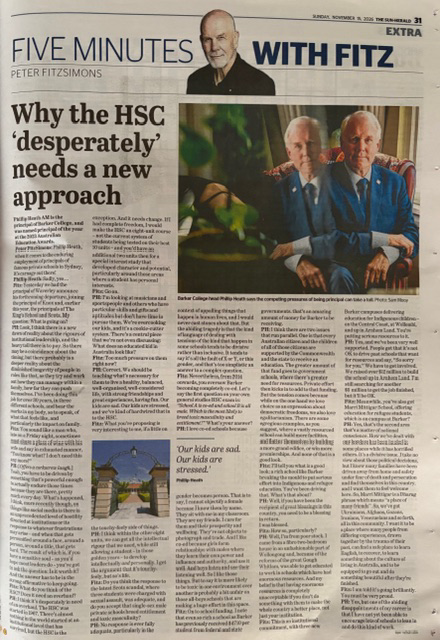
The article above was published in the Sydney Sun Herald on Sunday 15 November, 2026. I share it ‘old style’.
Days later, incoming NSW Education Standards Authority Chair and former NSW Education Minister Carmel Tebbutt rebuffed the push for an overhaul. While acknowledging Phillip Heath’s broader understanding of education, she argued that the HSC continues to play an important role and remains “fit for purpose”. Ms Tebbutt also pointed to the balance between external examinations and school-based assessment and defended the external examination as a fairer form of assessment.
Two things arise for me.
First, I do not see Phillip’s Heath’s proposal as an overhaul of the HSC. It is a small but not insignificant potential iteration. In essence, I interpret it as: Keep the HSC 80 per cent as it is. Let’s change up 20 per cent of it. Eight units would continue to be studied and assessed through the established HSC architecture of external examinations and school-based assessment. The equivalent of two units would be available for students to pursue something substantial that develops their particular interests, character and potential. That is not diminishing the HSC. It retains most of it in its current form while creating some space to do something different.
Second, I would like to better understand what is meant when one says the HSC is “fit for purpose”.
Fit for what purpose? And whose purpose? The important word is purpose. The HSC is extremely effective at measuring disciplinary knowledge and performance within conventional assessment. That does not necessarily mean it captures everything we now understand to be important about an educated young person, particularly in a world being reshaped by artificial intelligence, changing employment patterns and increasingly complex social and environmental challenges.
This is why I think the idea of eight traditionally assessed units rather than ten deserves serious consideration. Not because we need less rigour, but because it creates the opportunity to recognise a different kind of learning, assessment and achievement.
The idea is not as radical as it might initially sound. We already create time within the HSC for major works, performances and projects. Students compose, perform, design, investigate, make and create across a number of courses. Over 12 months they develop a project, product or performance. They receive feedback, revise, practise, encounter setbacks and ultimately produce a folio, an artefact or a performance.
Imagine extending that principle by giving every student protected time to undertake a substantial self-directed project.
For one student, it might involve engineering or designing a product. Another might establish a community initiative, undertake a substantial investigation, develop a business idea, write and direct a short play, curate an art exhibition, pursue environmental action or contribute to a cause that matters deeply to them.
This would not be spare time. Nor would it be an extracurricular add-on or simply two fewer HSC units. It would need to be purposeful, substantial and rigorous, producing credible evidence of what a young person has learned, developed and can actually do. And that brings us to the really interesting question: “How would we assess it?” The answer? Differently.
Enter Melbourne Metrics, capabilities assessment and Matching for Success. Through its New Metrics work, the University of Melbourne is exploring something Australian schools have wrestled with for years; that is, how we might validly assess complex competencies alongside traditional academic knowledge. These include critical thinking, communication, collaboration, active citizenship and agency in learning.
Importantly, this is not simply another list of attractive graduate attributes to place on a poster. The work involves assessment tools, evidence, developmental progressions and credentialling. Schools can use the Ruby assessment platform to make evidence-based judgements about students’ demonstrated capabilities. That changes the conversation from, “Do capabilities matter?“, to, “What would count as credible evidence that a young person can actually demonstrate them?”
A substantial self-directed project could provide precisely that evidence. Students would need to exercise agency, think critically, communicate, plan, respond to feedback and solve problems. Evidence could include artefacts and successive iterations, teacher observations, reflection, presentations and ultimately an exhibition, performance, entrepreneurial pitch or defence of the work. Rather than receiving a conventional examination mark for these two units, students could construct a capability profile derived from evidence accumulated through authentic work. That is not less assessment.
It is assessment of something different, done differently.
The next question, of course, is how we give that evidence credibility and currency beyond the school. This is what makes the Australian Learner Competency Credential particularly interesting. Warranted by Melbourne Metrics at the University of Melbourne, the credential recognises aspects of learning success that are not readily captured through traditional examinations and academic transcripts. Crucially, it is designed to complement rather than replace existing measures such as school reports, HSC certificates and the ATAR.
That distinction matters. This need not become another false argument between knowledge and capabilities, examinations and projects, academic achievement and human development. We can value all. Eight units could continue to provide evidence of disciplinary knowledge and conventional academic achievement specific to the skills of analysis, synthesis, making judgements and evaluations etc. The remaining protected learning time could provide evidence of a student’s capacity to initiate, create, collaborate, communicate, think critically and contribute, especially to the lives of those less fortunate.
The Australian Learner Competency Credential is, albeit slowly, gaining recognition as credible supplementary evidence for tertiary transition within New South Wales and beyond. Work is underway to establish how capability evidence might inform university selection alongside traditional academic measures. Melbourne Metrics describes its Matching for Success research as exploring how such evidence might be used alongside, and where appropriate instead of, the ATAR.
However, Matching for Success need not be limited to matching secondary students with university courses. A rich and credible capability profile could potentially be matched against, for example, the NSW Public Sector Capability Framework, which describes the personal attributes, relationships, results and business capabilities required across public-sector roles. It might also be matched against industry-specific capability frameworks in fields such as health, engineering, technology, community services, construction, business or the creative industries.
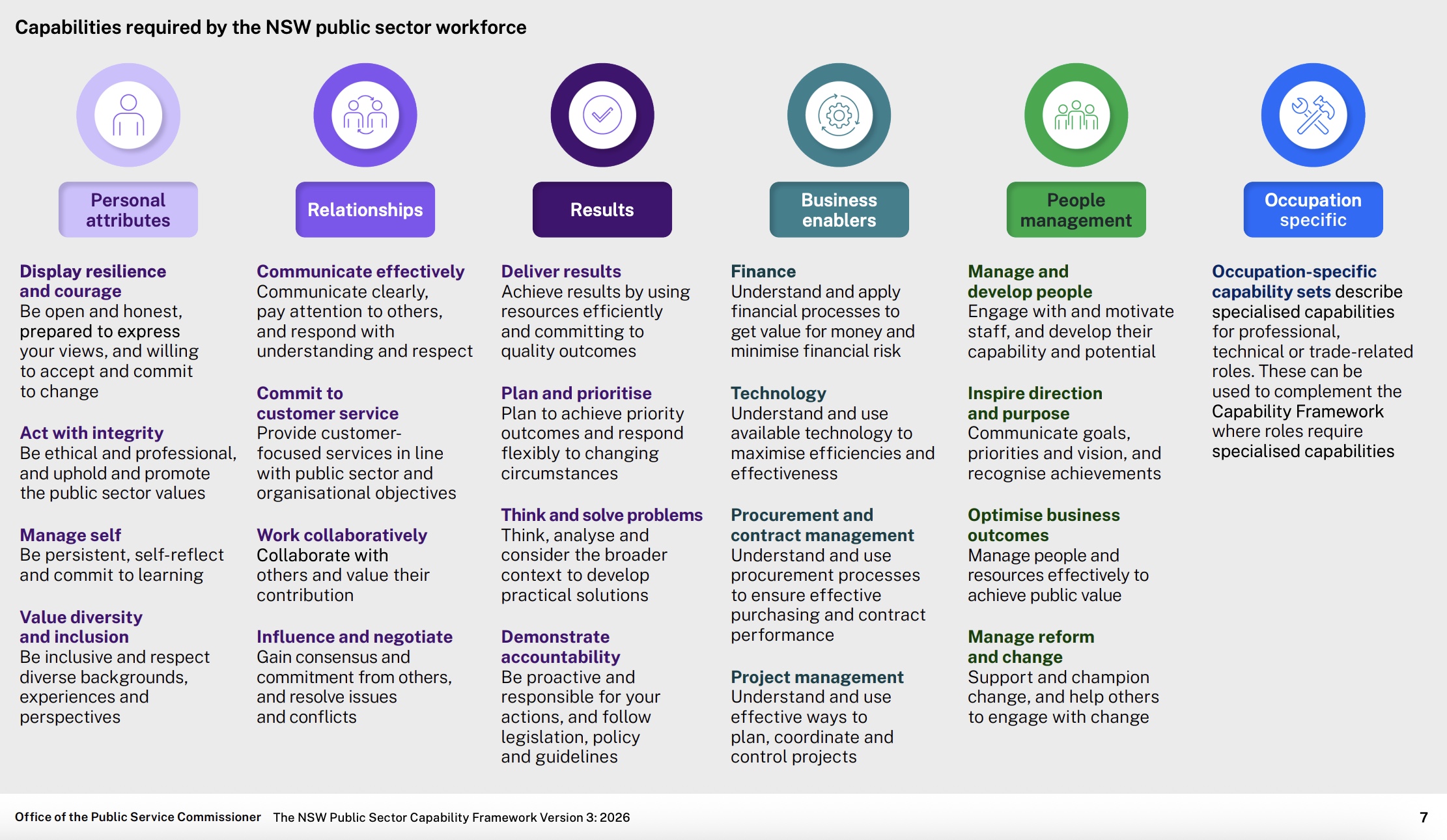
In other words, the credential could help students understand not only what course they might enter, but also where their demonstrated capabilities might be valued.
This would not determine a young person’s future or narrow their choices, nor should a capability profile become another sorting mechanism. Used well, it could broaden the evidence available to students, universities, TAFE providers, employers and industries. It could help each student tell a richer and more credible story about who they are becoming and what they can contribute.
As capability credentials become better understood by universities, TAFE and other tertiary providers, industry and employers, their currency will grow. That will depend, quite rightly, on assessment validity, moderation and the trust others develop in what the credential actually tells them.
That is ultimately how credentials acquire currency: people come to trust what they tell us about a person.
Acknowledging this, a self-directed project cannot become the easy alternative to another HSC subject. Quite the opposite. Students would need to propose something substantial, develop a plan, work with a teacher, document their learning, respond to critique, assemble evidence and ultimately exhibit or defend their work.
In an age of generative AI, a public exhibition or defence becomes even more necessary, perhaps even compelling. Students must stand behind their work, explain their decisions, respond to questions and demonstrate ownership of their learning. That sounds like rigour to me. It is simply a different form of rigour.
Ultimately, I do not think Phillip Heath’s proposition is radical. It is iterative. It preserves the great majority of the HSC while asking whether 20% of it might be used to recognise something we increasingly value but have struggled to formally assess: what young people can actually do with what they know. Carmel Tebbutt and others may well be right that the HSC remains “fit for purpose”. But that phrase should invite rather than close the conversation: fit for what purpose, in what world, and for which dimensions of a young person’s learning?
For the rest of us working in schools, perhaps our responsibility is to keep maintaining the place of knowledge and academic rigour while ensuring that assessment remains in service of learning, rather than allowing learning to become overly shaped by the demands of assessment.
That seems to me a conversation worth continuing.
Greg Miller


