EduTech Asia 2025: AI is Here, But Humanity Must Lead

AI is no longer knocking on the door of education; it’s already inside the classroom. The question is: how do we keep humanity at the heart of learning? 

In early November, I had the privilege of attending and presenting at EduTech Asia in Singapore. The event was a vibrant showcase of innovation, but one reality was impossible to ignore: artificial intelligence (AI) is transforming education at speed. From personalised learning pathways to automated administrative tasks, AI is not just a concept, it’s shaping the future of teaching and learning. 

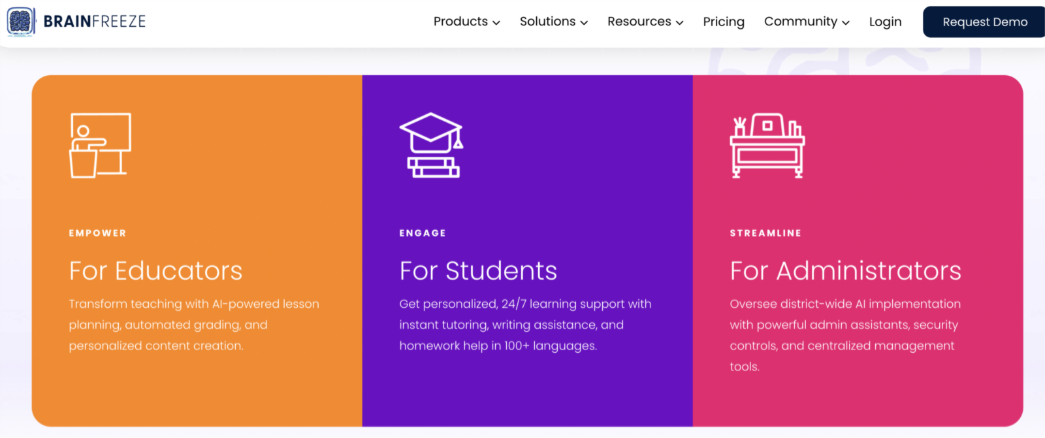
Across multiple sessions, speakers demonstrated how AI can adapt content, automate tasks, and create personalised learning experiences. Exhibitors unveiled AI assistants for teachers, students, and administrators, promising to streamline workflows for staff and enhance engagement for students. Many platforms now blend generative AI with pedagogy, using data analytics to anticipate student needs and tailor learning to individual interests and abilities. 

A few examples that stood out: 

  • FE Tech – A UK-based marketplace helping educators worldwide discover, compare, and implement EdTech and AI tools that drive inclusion and digital confidence. 
  • MeraTutor.AI – A next-generation AI tutor that adapts to every learner’s pace, simplifies complex concepts, and empowers parents with real-time insights. 
  • BrainFreeze offered… 

Importantly, throughout the conference and with the exhibitors, there was a strong emphasis on ethical and practical implementation. Conversations centred on how AI should complement, not replace, teachers, enhancing rather than diminishing the human experience of learning.  

One enduring question I continue to grapple with is the future of leader, teacher and support roles in education. For instance, will we increasingly rely on third-party providers offering platforms that, as one vendor claimed, “do the work for teachers”? Or should we invest in developing internal expertise, techno-pedagogists, who act as coaches and mentors, guiding teachers to adapt, change, unlearn, and relearn their craft by utilising AI as a true assistant to accelerate the work of planning, preparing and delivering personalised and differentiated work for students? 

This raises further questions such as, ‘Will the traditional roles responsible for leading learning and managing curriculum remain the same or similar?  Do we need additional roles, or entirely new ones? If so, what should these roles look like? What responsibilities would they carry, particularly in leading the integration of AI to personalise and learning? 

Equally important is the impact on pastoral care. How will these middle and senior leadership role evolve, change and update if AI can predict a student’s mindset, mood, or emotional state through real-time analysis of data such as attendance, punctuality, work completion, and wellbeing surveys?

Based on what I observed and discussed last week, this is no longer a question of if but when new roles will emerge to harness the power and pace of AI. 

The Human Question 

The conference opened with Atima Joshi, Executive Principal and Head of Pedagogy at Eton House International Group, posing powerful questions: Are we being replaced by AI? Will AI take our jobs? What does it mean to be human? Atima reminded us that cognition, once our greatest superpower, remains vital, but in an age of instant access to information, knowledge alone is no longer king. 

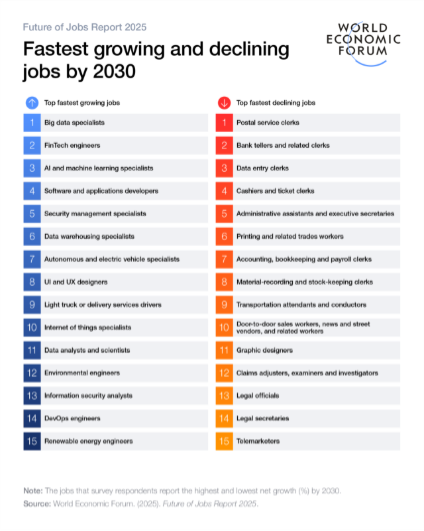
Later, Eddie Ang from Lenovo issued a stark warning: “The people who know AI will be replacing those who don’t.” This echoed recent WEC 2030 jobs outlook data, underscoring the urgency for students to master AI and other advanced technologies. 

Yet, amidst this technological surge, Professor Pasi Sahlberg offered a sobering reminder: The economic purpose of education must never outweigh its human purpose. He urged educators to prioritise student agency, asking: “What do young people want to know?” This question challenges traditional approaches that dictate what students must know, rather than inviting them into authentic learning. 

Chevalier College: Balancing Rigour and Humanity 

At Chevalier, we honour curriculum requirements across eight disciplines, and we also create space for students to explore who they are and what they can do. With a mantra of ‘HSC and capabilities’, ‘ATAR and complex competencies’ we deliver our SIM (Strengths, Interests and Motivations) course; a unique (but not the only) opportunity for students to connect with their human side. Beyond SIM, we offer rich extra-curricular programmes and assess Year 7 students against the University of Melbourne’s New Metrics capabilities, ensuring academic rigour is balanced with personal growth. Most importantly, we educate in the MSC way, a way characterised by kindness, compassion, and respectful relationships. As Professor Sahlberg noted, “Relationships will determine how well students use AI.” 

Guiding Change, Not Resisting It 

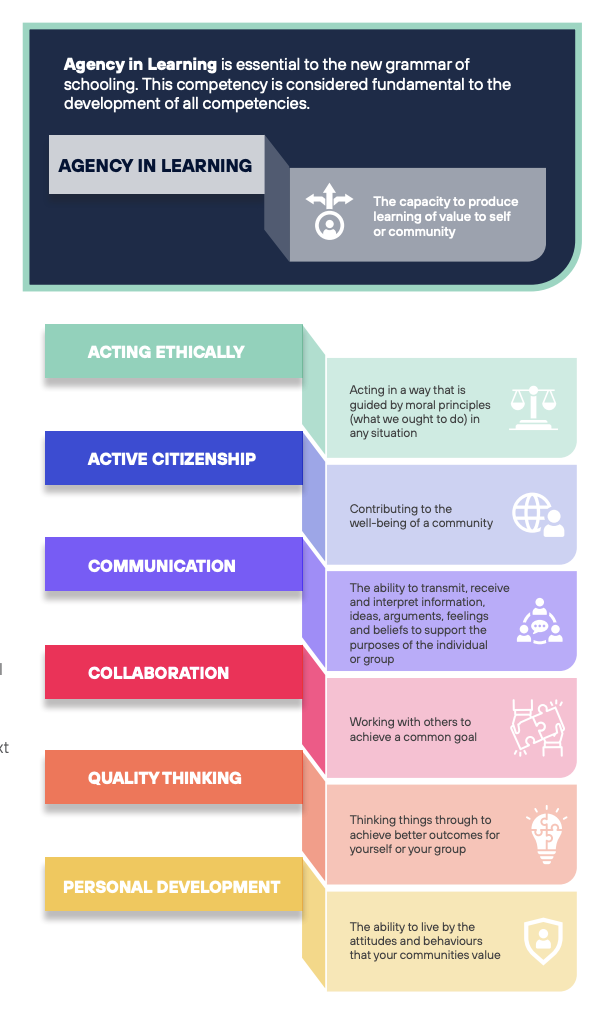
As adults, our role is not to resist change but to guide it responsibly. We must empower students to adopt AI ethically and inspire them to harness its potential to solve real-world problems. The more technology we embrace, we must counter-balance this with nurturing the foundational capabilities that define us and differentiate us from AI. The University of Melbourne’s New Metrics Program identifies these complex competencies as essential for thriving in a future shaped by AI: 

  • Agency in Learning – Autonomy and self-direction. 
  • Acting Ethically – Actions grounded in ethics. 
  • Active Citizenship – Positive contributions to community. 
  • Collaboration – Working towards shared goals. 
  • Communication – Respectful exchange of ideas. 
  • Quality Thinking – Critical thought for a better world. 
  • Personal Development – Understanding oneself as a spiritual, physical, and emotional being. 

These are not mere educational ideals, they are human capabilities our young people at Chevalier need to live lives of contentment and fulfilment. 

In conclusion, EduTech Asia affirmed what we at Chevalier College hold dear: the future belongs to ‘heart-centred, future-facing’ students, who become young adults equipped not only with technological fluency but with the human qualities that sustain and enrich life. 

Onwards and Upwards

Greg

A reflection for the reader… How do you see AI reshaping education in your context? What strategies are you using to keep humanity at the centre of learning? Share your thoughts, I’d love to hear your perspective. 

#EduTechAsia #ArtificialIntelligence #FutureOfLearning #PersonalisedLearning #EducationLeadership #StudentAgency #HumanCentredLearning #ChevalierCollege #MSCValues #NewMetrics 

Curriculum, Capabilities and Complex Competencies 

For much of the past century, the industrial model of education has supported its goals; that being, to equip young individuals with the knowledge and skills necessary for workforce success. However, with the rapid advancement of technology, especially artificial intelligence, the foundations of this ‘knowledge economy’ are nowhere near as strong as they once were. 

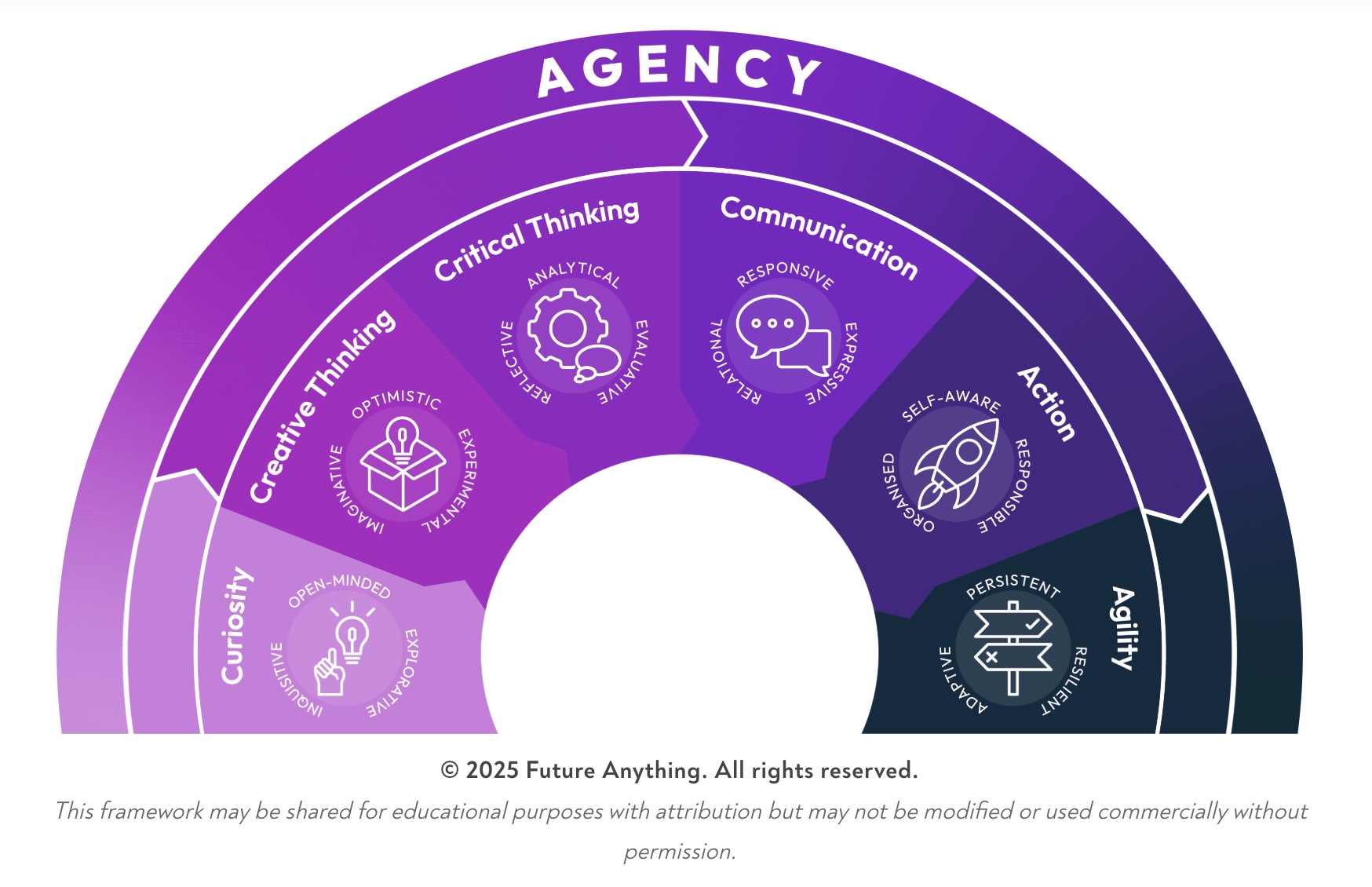
Nicole Dyson from Future Anything introduces us to LinkedIn’s Chief Economic Opportunity Officer, Aneesh Raman, who confirms the world is now transitioning into the era of the innovation economy. In this new world, human capabilities such as curiosity, creativity, communication, critical thinking, leadership and agility are becoming more crucial than simply recalling information or automating tasks. 

The pressing issue now is not whether young people require these capabilities, but to what extent. The implication for schools is to ask how can we effectively ensure the teaching and assessment of such capabilities; after all, we measure what we value!

Recently, Nicole launched Future Anything’s new Capability Framework. As the world shifts to an innovation economy, Nicole and many others would argue that young people need to develop the capabilities such as the ability to think critically, collaborate, and ethically engage with artificial intelligence. 

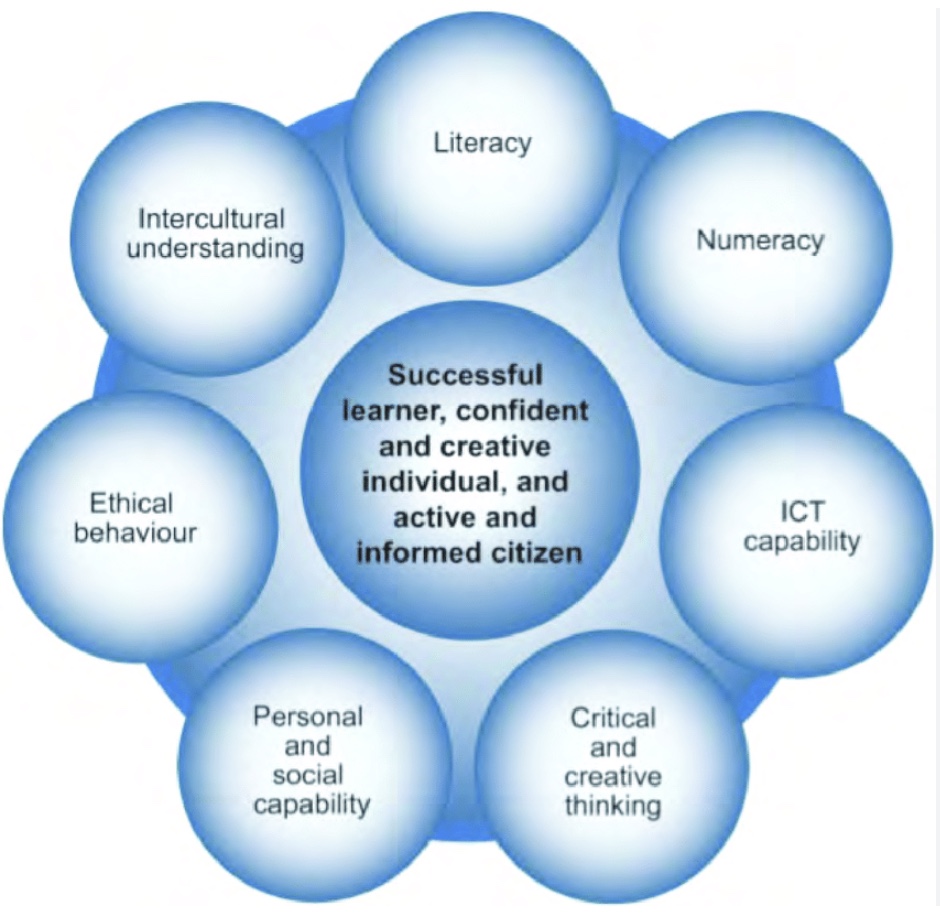
The focus of developing capabilities for school-aged students is not new. The General Capabilities within the Australian Curriculum brought this to the attention of educators some 15 years ago.

ACARA’s General Capabilities Framework

Most notably, for the last 10 years, Professor Sandra Milligan has led a team from the University of Melbourne’s New Metrics Program. The team has partnered with 40 innovative schools to develop and measure the growth of seven ‘complex competencies’ required for further learning and a new world world of work. They appear below.

For more insights about the work of the University of Melbourne’s New Metrics research project, click here (3 minute video). 

As the world of work continues to shift and the requirements of industries shift with it, education, secondary schools in particular, are challenged to adopt a far more explicit focus on capabilities. Employers globally are identifying these essential skills and capabilities as critical for long-term contentment and fulfilment in working lives. Reports which support this include:

  • The World Economic Forum’s “The Future of Jobs Report 2025” (January 2025) underscores the growing importance of soft skills in the workforce. Analytical thinking remains the top core skill for employers, with seven out of ten companies considering it essential. Resilience, flexibility, agility, leadership, and social influence are also highlighted as critical skills, reflecting the need for adaptability and collaboration in the modern economy.
  • The OECD’s “Trends Shaping Education 2025” Report (February 2025) emphasises the necessity of equipping students with skills such as analytical thinking and leadership to navigate and thrive amidst these changes.

These reports collectively advocate for the integration of ‘soft skills’ into educational frameworks, highlighting their significance in equipping students for a rapidly changing world. However, the term ‘soft skills’ undervalues their importance and underestimates the work required to develop them; hence why 40 ‘lead schools’ across the nation follow the example of the University of Melbourne referring to them as, ‘complex competencies’. 

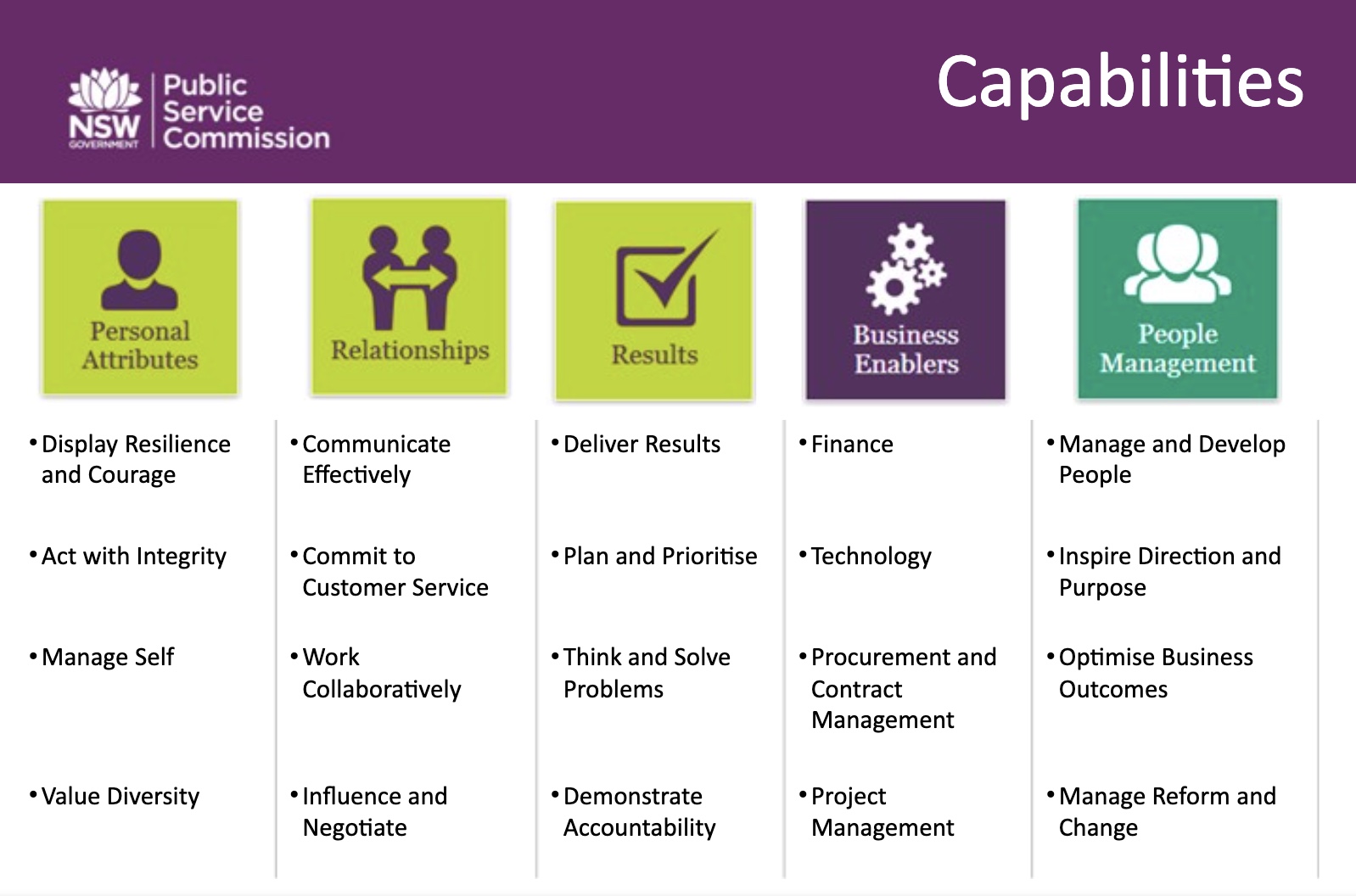
Whether it is complex competencies or capabilities, many companies, businesses and government organisations have adopted frameworks to assist career development. The world of work has moved quicker than the world of education. For example, the NSW Public Sector Capability Framework was first developed in 2008, updated in 2013 and continues to evolve. It is designed to help attract, develop and retain a responsive and capable public sector workforce. 

The Framework is designed to attract, develop, and retain a capable public sector workforce. It includes 20 core capabilities organised into five groups with key capabilities. The framework provides a common language to describe the capabilities and behaviours expected of employees, supporting consistent practices in job design, recruitment, performance development, and career planning.

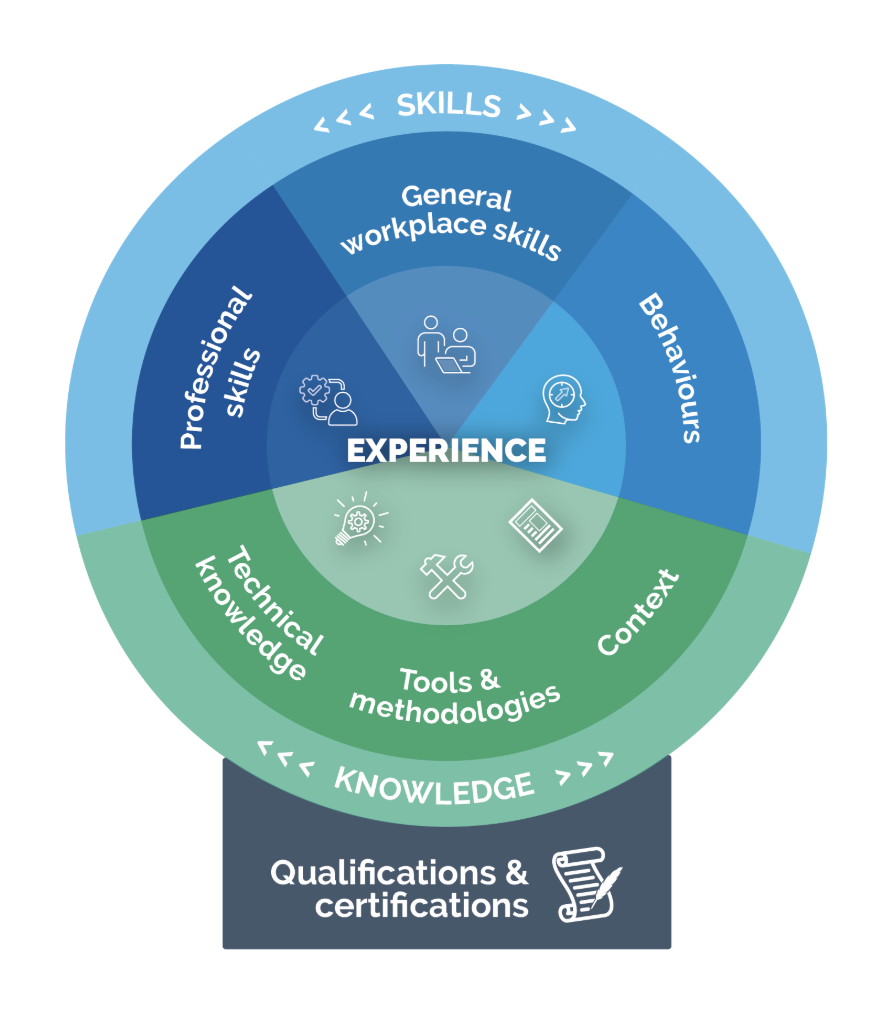
Interestingly, the Australian Public Service (APS) use a capability model to help explain the different skills, knowledge and personal attributes that combine to make up someone’s overall capability as outlined below.

This graphic helps explain the interplay between capabilities, skills, knowledge and dispositions. People still need to have qualifications and experience before they can be considered for a role, especially, professions and trades; however, I wonder if we are getting closer to more companies adopting a, ‘hire for character and teach the skills’ approach to employment.

In conclusion, as the world navigates the transition from a knowledge economy to an innovation economy, and as companies, businesses and organisations increasingly focus of capability frameworks for their employees, it is imperative that schools prioritise the integrate the assessment of complex competencies into their program of teaching. By integrating these competencies into curricula and assessment frameworks, we can ensure that students are not only equipped for the workforce but also empowered to lead and innovate in their future of lives of work and play. The challenge now lies in how effectively schools can implement these changes and measure their impact, ensuring that education remains relevant and responsive to the needs of students in an AI infused and rapidly changing world.

As always, comments and questions are welcome.

Greg

Year 12 leave but the ATAR remains

The festivities associated with Year 12 concluding their secondary schooling has again come and gone for another year. You don’t have to venture far into social media to find the wonderful celebrations and milestone moments which reflect the joyous celebrations which conclude thirteen years of schooling.

The euphoria of concluding school will soon fall away when examinations become front and centre. Not long after the exams conclude, and with post school life looming large, conversation within the community and the wider media, will increasingly focus on the HSC (in New South Wales) and the ATAR Australia wide.

Within each state and territory of Australia there are different end credentials with which students graduate. In New South Wales we have the HSC, in Victoria students complete the VCE, and other states have their own end-of-school credential. The one common feature which binds all state and territory education jurisdictions across Australia is the ATAR – the Australian Tertiary Admissions Rank. Some have labelled this a reductionist approach to education because it reduces thirteen years of formal schooling to one number, on one day.  

About a month ago, Jan Owen posted an article on LinkedIn making the point that #WeAreMore than an ATAR. Jan reminded us that our students leave school without an adequate story which tells of all that they know and can do. Our current education system does not allow for that. A few weeks back, there were more interactions about the value of the ATAR when St Gregory’s College principal, Matthew Brennan announced that almost 40% of their Year 12 students were offered early entry, with other offers to come within the next few weeks. The principal then asked, “If tertiary institutions aren’t requiring it, is the ATAR still relevant?” This question prompted a rather robust discussion among other educational leaders

My thoughts? We owe our students more than an ATAR. As Jan Owen reflects, students are “more than a statistic, a point in time mark or ‘rank’.” Jan is co-chair for Learning Creates Australia, who regularly agitate and lobby state and federal governments to deliver a better, more contemporary and real-world education for all students. They do so by asking many questions, two of which include: 

  • What does success in learning mean and  look like in the 21st century?  
  • How will children and young people gain mastery in their hyper technology world whilst honouring their body, mind and, at Chevalier, their faith? 

Jan’s post mentions a number of design principles in education for schools and communities so they can continue to reimagine education to serve the needs of students in a rapidly changing world. The work of groups such as Learning Creates Australia and the Melbourne Assessment Group led by Sandra Milligan, as well as international research led by Valerie Hannon, informs future facing education. It also informs what is emerging at Chevalier College in 2024 with: 

  1. Increased engagement with more interest electives for Year 7-10 students. 
  1. Early commencement of HSC with Vocational Education & Training (VET) courses for Year 9 students and passion projects as a central focus of Preliminary HSC Design and Technology for students in Year 10. 
  1. The introduction of a dedicated wellbeing curriculum for Years 7-10 students.  
  1. The introduction of ‘SIM’ (Strengths, Interests and Motivations) – a timetabled course created by the team at myDesign Education which enables students to better articulate who they are, what they can do, and more deeply understand their purpose.
     

In 2024, we will, as Jan Owen would say, “give the oxygen to ‘new scenarios’ ” by introducing “initiatives of local significance” at Chevalier. Along with what is mentioned above, we will test and trial ‘Best Use of Time’, an initiative which ‘banks’ whole school events such as pupil-free days, carnivals and celebration days, and year-based activities such as excursions and retreats on one day, a Monday. For the days when we do not have these events/activities, we will provide opportunities to

  • consolidate learning from the previous week
  • prepare learning for the week ahead (flipped learning), and/or
  • arrange time for teacher facilitated Canvas learning so we can maximise the crucial elements of face-to-face teaching each Tuesday to Friday. 

Like any school which strives to reimagine learning by adopting more contemporary approaches to learning and move away from the old grammar of schooling, Chevalier College does so because our students deserve it. 

I welcome any questions, comments and suggestions.

Regards 

Greg

The future of schooling and what might be…

On Wednesday 15 March, Chevalier College hosted a community forum for parents and carers about the future of education and what that might mean for Chevalier in the next 3-5 years. As part of that there was acknowledgement that the current education system was designed for an industrial world, meaning schools were first developed as a response to the demand for a literate and numerate workforce to operate the new machines and factories.  

Schools of a Industrial Age:

  • Emphasise the key features of standardisation and uniformity where students are expected to learn the same material, at the same pace, and in the same way, regardless of their individual needs, interests or abilities.
  • Have the goal of producing a large number of workers with the same basic skills, knowledge and attitudes needed to work in factories and other industrial settings. 
  • Provide a curriculum with core subjects which have few connections between them with little development of collaboration, communication, learner agency, critical thinking and problem-solving skills. 
  • Adopt a classroom setting which replicates the factory setting with rows of desks and where learning occurs in a highly structured and hierarchical manner to follow instructions, work efficiently and conform to rules and regulations. 

We now live in a VUCA (Volatile, Uncertain, Ambiguous and Complex) world. The world has changed and education needs to move with it. As part of a new world which requires agility, flexibility and responsiveness, the post school world of work requires students to provide evidence of more than just a mark or grade to demonstrate how they contribute to a team, a project or a cause.  

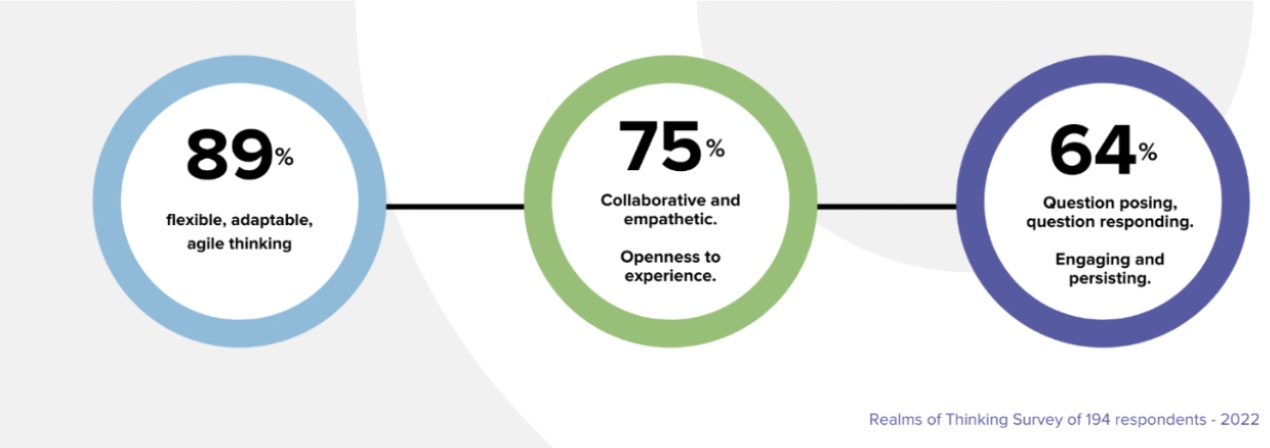
One source of information shown at the forum was a question posed last year by St Paul’s, Brisbane. The question was, “In your workplace/company, what what Realms of Thinking dispositions/skills are you looking for when you employ staff?” 

For schools to be able to provide the space and time for students to nurture and grow such dispositions/skills requires schools to provide a more flexible, adaptable, and personalised approach to learning, one that emphasises capabilities such as creativity, collaboration, problem solving, learner agency and lifelong learning.  

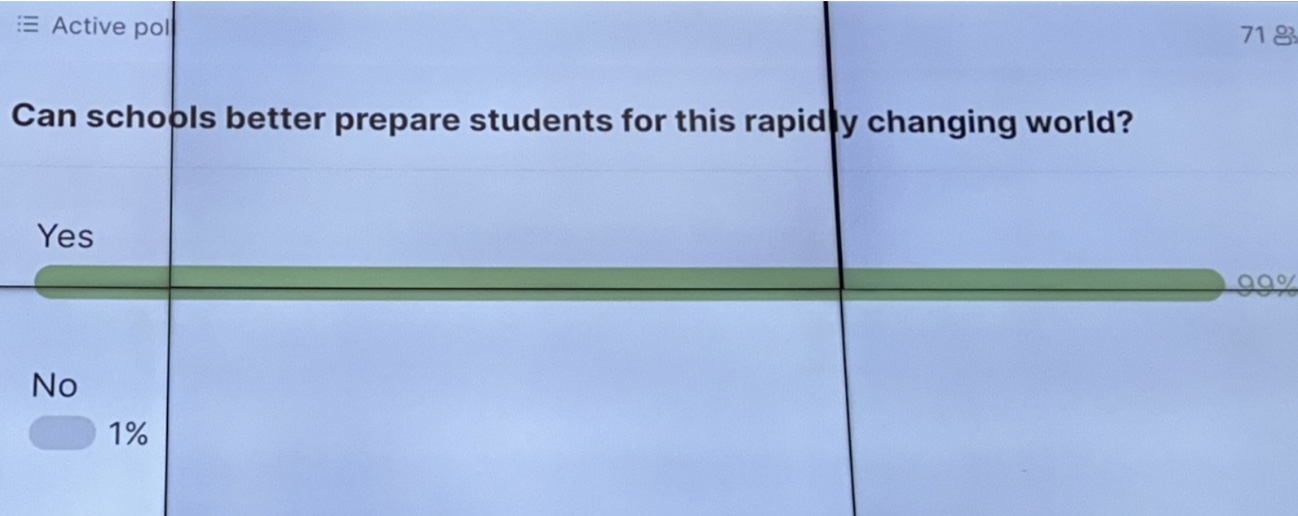
At one stage during the forum, I asked parents, “Can schools better prepare students for this rapidly changing world?” Their response?

The percentage did not change as we reached the near capacity of 108 attendees.

As part of sharing some ideas as to how Chevalier might address the need to better prepare students for a rapidly changing world there was acknowledgment that we may need to provide time for students to understand their S.I.M.; that being their strengths interests and motivations so they can better understand who they are, what they can do and what problems they might want to solve. In other words, interrogate their purpose so they can find their place of meaning in the world. There was also an exploration of how we can better use technology to amplify and even accelerate the learning by embracing the opportunities that come with immersive technologies such as virtual reality as well as generative artificial intelligence including ChatGPT. 

I walked away both enthused and excited by the engagement of parents and carers and was extremely appreciative of the time each gave to participate in the presentation. I also pondered the need to question, even challenge the current paradigm of education – after all, it has well served many generations of Chevalier students. So, I thought I would ask ChatGPT this question, “Is it important for schools to challenge the norm of industrialised education?” Here is its response… 

Yes, it is important for schools to challenge the norm of industrialised education. The industrialised education system, which was developed in the late 19th and early 20th centuries, was designed to prepare students for factory work and to meet the needs of a rapidly industrialising society. This system emphasises standardised testing, strict adherence to schedules, and a one-size-fits-all approach to education. 

However, the world has changed significantly since the industrial revolution, and the needs of society and students have evolved as well. In today’s knowledge-based economy, creativity, critical thinking, problem-solving, and adaptability are essential skills that students need to succeed. Thus, schools must adapt teaching methods to meet the changing needs of students and society. 

Challenging the norm of industrialised education means embracing new and innovative approaches to teaching and learning. This might include personalised learning, project-based learning and interdisciplinary approaches to education. It also means focusing on the individual needs and interests of students, rather than trying to fit them into a standardised model. 

By challenging the norm of industrialised education, schools can better prepare students for success in the 21st century. They can foster creativity, critical thinking, and problem-solving skills that will enable students to adapt to the rapidly changing world around them. 

Not too bad for a first draft? 

I can see a day when an adaptive curriculum, scaffolded and supported by machine learning, artificial intelligence and virtual reality, acknowledges students not by age but by ability. I imagine a time when learning is assessed a surface, deep and transfer rather than reduced to just grades, marks or an ATAR – one mark on one day!

Such respect given to students may lead us to explore new models of learning and new structures for schooling which use time wisely and facilitate learning which is relevant and real-world.

Greg Miller  

Learning recognition beyond an ATAR

Recently, Dr Peter Webster, Principal Leader of John XXIII Stanhope Gardens, shared his latest blog The NSW Higher School Certificate – Looking Back to Look Forward. Peter’s piece was a detailed reflection about the current three-way relationship between the New South Wales Higher School Certificate (HSC), the Australian Tertiary Admissions Rank (ATAR) and university pathways. In ‘Looking Back’, Peter provided an insight into the history of the graduating credential in New South Wales dating back to the 1960s.

Through his historical reflection, Peter raised credible provocations including the long term future of the HSC. In summary he noted:

  • Qualifying Certificate – redundant 1967
  • Intermediate Certificate – redundant 1967
  • Leaving Certificate – redundant 1967
  • School Certificate – redundant 2012
  • The Higher School Certificate – REDUNDANT ???

Furthermore, as part of his reflection Peter also wrote:

  • Tertiary Entry Score – redundant
  • Tertiary Entry Rank – redundant
  • Australian Tertiary Admission Rank – REDUNDANT ???

There was even the suggestion that the ATAR may already be redundant. As Peter wrote, “except for intense competition between applicants in a small number of courses and universities, most people who want to attend university can do so.”

Before the Covid-19 pandemic, universities had been looking at more than the ATAR when considering admissions to their courses. Since the pandemic universities have increasingly bypassed the ATAR by offering a record number of early offers. In fact, the escalating prominence of early offers over the last few years would indicate that the need for an ATAR is even less that what appears in the diagram above as reflected by my recent tweet.

Of course, state and territory educational jurisdictions offer more than the ranking reflected by one mark on one day. In News South Wales each student receives a certificate upon completion of secondary school. The Higher School Certificate (HSC) comprises a compilation of marks and ‘bands’, reflecting the standard achieved within each course. Schools often take the time to complement the HSC by offering awards, prizes and references which reflect the personal and holistic uniqueness of each individual student. 

However, we need to go further, much further.

Recently, Professor Sandra Milligan, Enterprise Professor & Director ARC, Melbourne Graduate School of Education, stated, 

We should be able to put in place a system that enables every kid to show where they’re strong, what they can do and be able to use that to go where is best for them. And at the moment, we don’t have that system; we’ve got an examination and an ATAR system.”

Professor Sandra Milligan, Enterprise Professor & Director ARC, Melbourne Graduate School of Education.

The changes required for a new, ‘fit for purpose’ education system will require great courage from educational system leaders. It will also require governments to trust those trained in education and action research – teachers and contemporary academics. More likely, the transformation of education will come from within, from innovative schools and individual change agents who collectively reveal new ways of learning. Such a reality will ensure each child becomes a young adult who knows themselves and their skills well enough to find a meaningful place in their world.

In their most recent report, Report 3: Framing success for allLearning Creates Australia identifies changes required for senior secondary certificates to support the new definitions of success that learners, teachers and employers want and need. As a way forward we could take seriously the ‘Shergold Review’ – Looking to the Future – The Review of Senior Secondary Pathways. The Review made 20 recommendations to the Australian Government to facilitate important changes to the design and management of secondary schools pathways. Most notably, Recommendation 4 called for the creation of learner profiles in Australia by stating,

Students should leave school with a Learner Profile that incorporates not only their ATAR score (where relevant) together with their individual subject results, but that also captures the broader range of evidenced capabilities necessary for employment and active citizenship that they have acquired in senior secondary schooling”

Looking to the Future Shergold et al., 2020, p. 20.

In a positive development, the New South Wales government appears to be taking seriously the need for a Learner Profile. Although labelled a Digital Wallet (the differences between a wallet and a profile need to be clearly understood when moving forward), the NSW Education Minister, Sarah Mitchell confirms “Students, industry and universities have been sharing with us what they want included in the learner profile,” Ms Mitchell said. 

Along with Tracey Breese (quoted in the above hyperlinked article), other principals and other key leaders in half a dozen NSW schools, I was fortunate to attend a NSW Learner Profile Workshop day earlier this year with Eric Land and his Education Wallet Team at the NSW Department of Education. The work done to that point in time by Eric and his team was extremely impressive. The wallet/profile will enable students to showcase the very best of who they are and what they can by bringing together in one virtual place formal academic attainment, micro-credentials, VET certification, work-related courses, performing arts and sporting progress, formal examination results, and the list goes on.  The information shared at any given point in time can flex up and flex down depending upon purpose and audience – think closed job application as compared to open public profile.

For the sake of each and every student, the development of a Learner Profile needs to remain an ongoing and top priority. Each student needs to receive equitable access to a Learner Profile which expresses the very best of who they are, what they can do and what problems they want to solve, and from as early as Kindergarten, if not before. South Australia is leading the way with its Capabilities & Learner Profile Project. The project is working with 30 pilot schools who include assessment of capabilities alongside academic achievement (grades) to provide a more holistic view of graduates’ achievements. Pleasingly, the work is not just focused on senior secondary students.  This project is central to the SACE Board’s commitment to enable all students to thrive through provision of a connected, future-focused, and internationally sought-after qualification. The aspiration is for the SACE (South Australian Certificate of Education) Learner Profile to demonstrate a student’s capabilities, showcasing their achievements following 13 years of schooling and to enable them to make better decisions about their post-school pathways that match with potential employers and further education providers.

As South Australia has concluded, the real key to a profile of national significance requires regular, reliable and trustworthy assessment of a broader range of evidenced capabilities (Shergold, Recommendation 4) with reference to a yet to be developed national capability framework for all. A national framework would ensure consistency across states and territories for both school and post school learning. The framework will need to be a continuum, accessible for students in early years of learning right up to and including adults in a post school world; after all, we all know that learning is lifelong!

Work on assessing and reporting on ‘evidenced capabilities’ continues to be the main focus of The New Metrics Project. For two years a coalition of First Mover Schools from across all Australian states and education sectors has engaged in rigorous collaborative research led by the University of Melbourne. The project continues to produce work which sees a movement away from the traditional ‘grammar of schooling’ most notably through the development of assessment tools for complex competencies. A recent development has been the generation of sample profiles that recognise a broader range of what a learner knows and can do.

The work of The New Metrics Project will contribute to a national capabilities framework which would also be advantageous for universities as it would add more value than one mark on one day. More importantly, the expression of evidenced capabilities as part of a greater Learner Profile will offer an opportunity for better, more rounded educational outcomes for the greatest number of students. 

Despite the need to engage in rigorous processes to develop Learner Profiles for students, in mid December when HSC/VCE/SACE etc., and ATAR results are released, we will still see the media bombard us with league style comparisons of schools and their end of year results. There will also be many schools, promoting enviable ATAR results of students suited to an examination approach to learning. However, I remain positive that one day, and one day soon, each one of our students will leave each one of our schools with more than one number on one day and a certificate filled with only marks and bands. I look forward to the day, hopefully one day soon, where we will have a Learner Profile which showcases the very best of who a young adult is and what they can do so they can find their place of meaning in this rapidly changing world. 

Who knows, when this becomes a reality the ATAR may become redundant.

As always, comments, questions and provocations are welcome.

Greg

References and Hyperlinks

 “Your ATAR isn’t the only thing universities are looking at.” 20 Mar. 2018, https://theconversation.com/your-atar-isnt-the-only-thing-universities-are-looking-at-93353.

“HSC 2022: ATARs bypassed by universities; students receive early ….” 13 Sep. 2022, https://www.smh.com.au/national/nsw/universities-bypass-atars-as-record-number-of-students-receive-early-offers-20220906-p5bfvf.html

 “Is it time to rethink year 12 exams? – ABC News.” 5 Nov. 2022, https://www.abc.net.au/news/2022-11-06/atar-year-12-exams-time-for-rethink/101599868.

“Framing success for all – Learning Creates Australia.” https://www.learningcreates.org.au/media/attachments/2022/04/01/learningcreates_framingsuccessreport_march2022.pdf

“Looking to the Future: Report of the Review of senior secondary ….” 23 Jul. 2020, https://www.education.gov.au/quality-schools-package/resources/looking-future-report-review-senior-secondary-pathways-work-further-education-and-training.

“Capabilities & Learner Profile – SACE Board.” https://www.sace.sa.edu.au/innovating/capabilities-learner-profile. Accessed 5 Dec. 2022.

“An equity perspective on the development of student learner profiles.” 5 Jul. 2021, https://www.ncsehe.edu.au/research-database/equity-perspective-student-learner-profiles/.

Farewell to designing and establishing a ‘new normal’.

I go back to March 2016 when a member of my online network connected me to an advertisement for a principal in a new Catholic school in Sydney’s West. There was a fair bit of hype around this new ‘super school’ as to what it was known by some at the time. Part of the excitement and anticipation was driven by Executive Director of Catholic Education Diocese of Parramatta (CEDP), Mr Greg Whitby, who challenged the paradigm of what principalship may look like. Greg’s thinking at the time was, “the principal of its newest school would not necessarily be a career teacher, but rather someone who was a ‘bit of an entrepreneur’ who will make connections and manage relationships”. He went on to say, “We are not talking about someone like the CFO of BHP, but it could be someone from the tertiary sector, private education providers, the coaching industry.” 

As a ‘career teacher’ I thought my chances of appointment were limited; however, I felt my personal vision for education strongly aligned with CEDP’s vision for St Luke’s to design and establish a ‘new normal’ for preschool to post school education. This was to be no ordinary school, but more so a learning community, one which combined the 5 services of pre-school, primary school, secondary school, out of hours school care and a High Needs Studio for students with special gifts. After a video application, a presentation to 60 people made up of clergy, teachers, parents and students from various CEDP settings, and then a final interview, I was offered and accepted the privileged role of principal at St Luke’s.

On February 3, 2017 the College opened with 14 staff entrusted by true believing parents to serve the needs of 86 students, and there has been much achieved since! Since Day One, and as part of the commitment to designing and establishing a new normal for preschool to post school learning, the staff of St Luke’s adopted a curious approach by questioning everything about ‘the what’, ‘the how’ and most importantly, ‘the why’ of education. In our early days this saw St Luke’s:

  • Adhere to the deep belief in the power of intrinsic motivation by only offering stickers, stamps, rewards or awards to students who, on very few occasions, go above and beyond school expectations. 
  • Maintain a minimum indicative hours approach to face to face learning.
  • Stage based (not year based) learning with 2 teachers for each class of 60 students.
  • Maximise the power of Social Media through Facebook, Twitter, LinkedIn and Instagram to actively share the learning narrative of St Luke’s in real time.
  • Provide learning schedules without bells. Six years later there are no bells with 1440 students on site.
  • Sport uniform all day every day for Kindergarten to Year 4 students. 
  • A cashless college since Day One.

This has all been supported through CEDP’s generous provision of expansive and purposeful learning spaces that are comfortable, modern, contemporary, flexible and agile.

Staff in our early days quickly learnt that when you question everything as part of a commitment to designing and establishing a ‘new normal’, before Covid owned that terminology, a school starts to develop emergent mainstream practices which reflect a change from the old grammar of schooling. However, in doing that we met with opposition. Early on, this was from some parents who signed up to something new but still yearned for the past – thankfully, they were very few and far between. Occasionally, St Luke’s met with the ire of so-called and often self anointed educational authorities, most of whom had never worked in a classroom nor held an education qualification. Even after an invitation to view our work, most never set foot on site. However, St Luke’s has always welcomed feedback from wide and far including the 800 educational leaders and additional community visitors who have engaged in our professional learning tours and parent learning walks. In the context that all feedback needs to be considered, I found that whilst the messages of detractors need to be considered, their observations and feedback need to be constructive; if not, they are ultimately best forgotten.

For some aspects of the work at St Luke’s there has been an approach to ‘Do then Think’, also known as ‘Ready, Fire, Aim’. Sometimes this has been seen as cavalier; however, it has complemented the ‘question everything’ stance adopted since Day One. Since we opened in 2017, St Luke’s has adopted ‘best practice’ in a number of areas. These include:

  • The explicit and rigorous teaching of the foundations of literacy and numeracy for 160 minutes each and every day for Kindergarten to Year 6 students. Extensive and numerous professional learning opportunities have ensured our teachers are continually updated on the learning strategies which enable learning growth for students in these key foundational areas.
  • Teachers work in pairs and teams to plan, prepare, deliver and evaluate learning together. As part of the evaluation, teachers review data, determine the ‘next steps’ for each child and adapt their programs, sometimes on a daily basis.
  • Fidelity towards ‘surface, deep and transfer learning’ using a rigorous inquiry framework adapted for local context. This translates into a pursuit of play and inquiry learning with a balance of direct teacher instruction, self directed learning, learning workshops, teams of students collaboratively working together to drive the inquiry with the teacher closely and regularly monitoring the progress of individuals and teams.
  • Play based learning in our CELC and Kindergarten which assists students to explore, discover and learn about their immediate world.
  • A coaching approach to building teacher capacity to impact student learning where our school leaders work with teachers to co-plan, co-teach and co-evaluate aspects of their teaching so there is constant reflection about how we teach. After all, teachers are learners too!
  • Encouraging students to exercise choice and voice through inquiry learning, because we know through research that the more students can combine curriculum requirements with their interests, the more engaged and empowered they become as learners.
  • When needed and necessary, there has been the explicit teaching of social skills and the publication of stage appropriate student independence progressions which have assisted many students to become more confident and resilient.

Complementing our ‘best practice’, St Luke’s has pushed the boundaries with ‘next practice’. This includes:

  • Partnering with Become.Me with a research based approach to careers education for Stage 3 students (Years 5 & 6) which aligns with the curriculum and engages students in the possibilities of ‘what might be’ for post school life. Why Stage 3? Because the research says that 83% of 10 year olds think about their future once a week yet only 10% of them actually get to speak with an adult about those aspirations.
  • Using ‘Scribo’ in 2019 & 2020 to assist leaders and teachers in Stage 3 and 4 to far more quickly provide students with feedback to improve their writing. 
  • A strong priority for each student to develop the capabilities required for a changing world as expressed through our 6 Pillars of Learning. Our 2022 student dashboard and student-led conferences since 2017  reflect our commitment to this priority.
  • As part of our Life Design course for Year 7-10 we partner with life coaches from Innerzone to ensure students can more accurately learn about their Strengths, Interests and Motivations – SIM, so that they can more deeply understand who they are, what they can do and what problems they want to solve.
  • Teachers who provide engaging and purposeful masterclass learning activities as part of an extended school day to 6pm, Monday to Friday.
  • Partnerships with Universities including:
    • University of Sydney (2019) for an integrated approach to Science, Technology, Engineering and Maths (STEM) in Stage 2. This program utilises the expertise of university based research to benefit our teachers and students.
    • A three way partnership between Stage 4 Maths teachers, CEDP Mathematics experts and Emeritus Professor, Peter Sullivan from the University of Melbourne (2020). This action research team investigated how artificial intelligence through ‘Maths Pathways’ can support self paced learning for Stage 4 Mathematics.
    • University of Technology, Sydney (2020) to reimagine preferable futures post COVID-19. 
    • University of Wollongong (2021) Oracy Project for Kindergarten students.
    • University of Western Sydney (2021) to action research our coaching approach to teacher development.
    • University of Melbourne New Metrics for Success Project (2021-2023) to assess capabilities and complex competencies for a changing world.
    • School-led action research projects for:
      • Play in the Infants’ Years;
      • Coaching to support teacher learning; and,
      • Next Practice Wellbeing in the secondary years.
    • Formal learning concludes each Friday at midday for Kindergarten to Year 6 students with teachers receiving increased release from face to face teaching to now self direct their learning by engaging in professional learning offered by College leaders.
    • A learning cycle which encapsulates hybrid learning and sees Year 9-12 students start formal learning at 10:00am (instead of 8:30am) three days a week. This accommodates teenage brain science requirements for more sleep, provides more choice for senior learners and improves well being.

The above by no means covers all that is done at St Luke’s. Students in all years follow the mandated curriculum set by the NSW Education Authority (NESA) adhering to mandated requirements for all Key Learning Areas (KLAs). All outcomes are addressed to a deep level through students reflecting on their learning and applying their knowledge rather than just rote learning. St Luke’s is committed to addressing all aspects of the core curriculum, but offers students choice and flexibility in achieving the required learning outcomes.

In a place where “Learning = Infinite Possibilities”, we now know Best Practice + Next Practice = the ‘New Normal’. This ‘new normal’ at St Luke’s combines the five educational services of Early Learning, Primary, Secondary, Out of School Hours Care and High Needs School into the one Catholic Learning Community which nurtures faith filled curious children to become creative contributors and innovative problem solvers for a changing world.

Having commenced in 2017 with 86 students in 2017, St Luke’s at Marsden Park is a next generation learning community within the Catholic Education Diocese of Parramatta (CEDP). As a ‘next generation Catholic Learning Community’ we continue to design and establish a ‘new normal’ for preschool to post school learning in an environment characterised by a flexible, stage based curriculum which nurtures and grows faith-filled, curious children to become creative contributors and innovative problem solvers for a changing world. In 2023, the College will enrol over 1600 students from Kindergarten to Year 10 in addition to the 77 place long day centre and 60 students in a high needs special school. The work will evolve and continue to be complex; it will continue to be exhausting yet satisfying work for those who continue to heed the call to design and establish a new normal.

What a privilege it has been to be the Foundation Principal of St Luke’s! I have appreciated playing a small part in a big team. I will be forever thankful for the staff who trusted me and I leave being in awe of their work.

May St Luke’s continue its trail blazing work, work which positively contributes to the greater good of designing and establishing a new normal for preschool to post school learning.

Farewell St Luke’s.

Greg.

The challenge – a contemporary, cutting-edge curriculum!

2022 sees a convergence of challenges in the world of primary and secondary education. For me, the greatest challenge is developing an engaging curriculum which empowers students to fulfil their potential by acknowledging that young people can learn anywhere, at any time and not just within the time-bound hours of 8:30am – 3:00pm, Monday to Friday.

Students are increasingly falling short of achieving their full learning potential. A comprehensive review of the New South Wales Curriculum found that the overcrowded nature of many syllabuses, the undervaluing of skills in the curriculum and constraints on teachers’ abilities to address individual learning needs, contributes to many students becoming disengaged from school.

The Australian curriculum lacks flexibility. It is anchored in one year blocks of time. We group students by age to learn the same things with the same amount of time, regardless of each student’s learning achievement. It is not surprising that some students struggle whilst others disengage and withdraw. According to the OECD’s Programme for International Student Assessment (PISA), by 15 years of age, one in five Australian students fails to achieve a proficient standard in the fundamental foundations of literacy and numeracy. Year-level curricula contribute much to this reality. However, despite our knowledge of this, schools persist with what Ira Socol calls a, “nonsensical calendar system in which the clock overrules the idea of doing what you do well.” 

At St Luke’s Marsden Park, we have combined academic research and local data accumulated prior to, and during the Covid disruption period, to use time differently and better. This includes, but is not limited to:

  1. Friday Half-day; an initiative which sees formal learning conclude at 12 noon each Friday for students in Kindergarten to Year 6. At midday students are either picked up by their parents or remain at school to be cared for by reduced staffing. The additional release time allows teachers to provide an explicit piece of feedback about each child’s learning which can be accessed by their parents via an online learning platform.
  2. As part of the the St Luke’s Learning Cycle, which can be seen here

we can provide Late starts for Years 9-12 students three days per week where students can choose…

Each of these two initiatives have resulted in benefits such as increased time release for teachers and increased choice for students and parents. There is increased agency for all; however, we are only scratching the surface at St Luke’s. We need to press on and continue to explore how we can dismantle the rigid foundations of 20th Century education and liberate learning from its industrial straitjacket.

Education the world over needs to adopt what Saul Kaplan calls a ‘Best Practices and Next Practices’ approach. Kaplan explains that in this rapidly changing world, best practices are necessary but not sufficient. Kaplan challenges leaders to explore, identify, develop and experiment with next practices. One such next practice needs to enable the development of an adaptive curriculum, scaffolded and supported by immersive technologies such as machine learning, artificial intelligence, augmented and virtual realities, which acknowledges students not by age but by ability. Such respect given to students may lead us to explore models such as the one driven by Dwayne Matthews at Ontario Virtual School (OVS). 

Implementing the principle of ‘Time Shift Accreditation’ with integrity, sees OVS enable 10,000 students to learn virtually, usually through time chunked videos of 2 to 4 minutes. These videos provide content and concepts accredited specifically to the core curriculum. If a student hits a hurdle, they seek support from their immediate network, usually other students, for assistance. If they meet another hurdle they go to an expert, usually a teacher, who assists the student to progress. The majority of students accelerate their way through the curriculum in less time than indicative hours, as usually provided through face-to-face teaching in mainstream schools. This approach leaves more time for self-directed learning in areas of interest and passion. Not only does this reality see increasing engagement, it empowers students to make a real difference in their world!

It goes without saying that responding to the challenge of providing all students with a contemporary, cutting-edge curriculum which empowers them as a learner, presents us with an opportunity to ‘design the next’ by exploring best use of time for student learning. New ways of learning may also result in more enriching ways of working for teachers. The two are not mutually exclusive! Who knows, we might even equip every child to be a creative, connected and engaged learner in a rapidly changing world whilst cultivating an adaptive, innovative and continuously improving education system; two priorities of ‘Growth Through Achievement’

As usual, comments, repsonse and questions are most welcome.

Greg

P.S. For the referenced paper, please click here.

The future of learning – success for all

Recognition of learning success for all​“​ issued by Learning Creates Australia is worth reading.

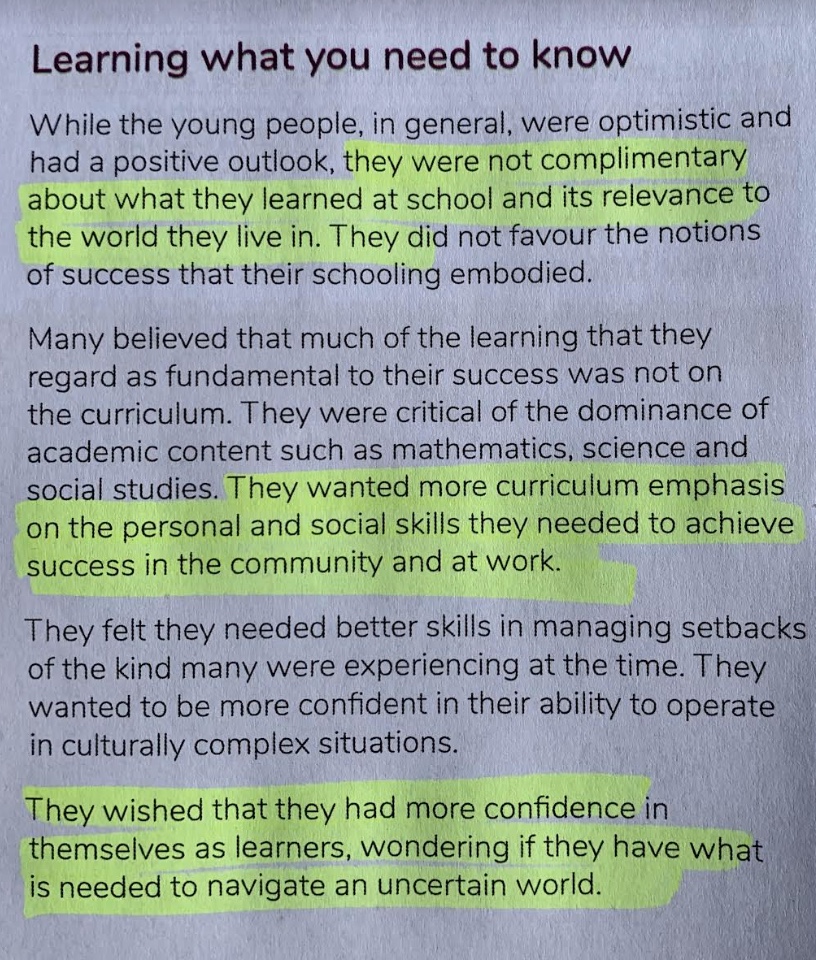
As part of the research underpinning the report professionals from Learning Creates Australia conducted a series of sessions with young Australians. Diverse groups of young adults were asked to reflect on their primary and secondary years of schooling. This occurred in early 2020, at a time when the impact of the bushfires was still raw and the challenges of managing Covid-19 were emerging. Here are some of their reflections.

These snippets resonate with the vision and actions at St Luke’s. When I read comments highlighted above, I am pleased that we, at St Luke’s, continue to deepen our knowledge and understanding of how to teach and assess the capabilities required for a changing world as expressed through our 6 Pillars of Learning. This focus starts in our Early Learning Centre, continues into Kindergarten, and is prominent for all stages of learning including Stage 6.

Also, pondering the reflections above reminds me why Stage 3 teachers and students engage with Become. Our students deserve to feel confident and positive about the future. Our teachers work with Liv Pennie from Become, to broaden the personal awareness and aspirations of Stage 3 students so they ‘become’ more optimistic and inspired to take action on their own future.

Furthermore, recognition of learning success for all affirms why we offer Life Design as a rigorous and challenging course at St Luke’s. By exploring their SIM (strengths, interests and motivations) as well as engaging in concepts such as purpose, Life Design provides time for students answer three questions:

  • Who am I?
  • What can I do?
  • What problems do I want to solve?

Students won’t read these questions in NAPLAN over the next few weeks, nor will they ever see them in an exam such as the HSC. However, young people will need to be able to answer these profound questions when pursuing a post-school life of contentment and fulfilment.

We could do worse than suggest that every legislator read Recognition of learning success for all​, and I recommend it to all those in education.

Greg.

“Time is the First Technology” – Ira David Socol

A few weeks back, I had the great fortune to meet (Zoom) with Dwayne Matthews. Early on in our conversation, I shared a little bit about what we are doing at St Luke’s Marsden Park. He was most interested in how we used time. I explained how we are trying to push the boundaries of a traditional 9-3 school day through:

  • Friday Half-day for K-6;
  • late starts three days a week for Years 9-12; and,
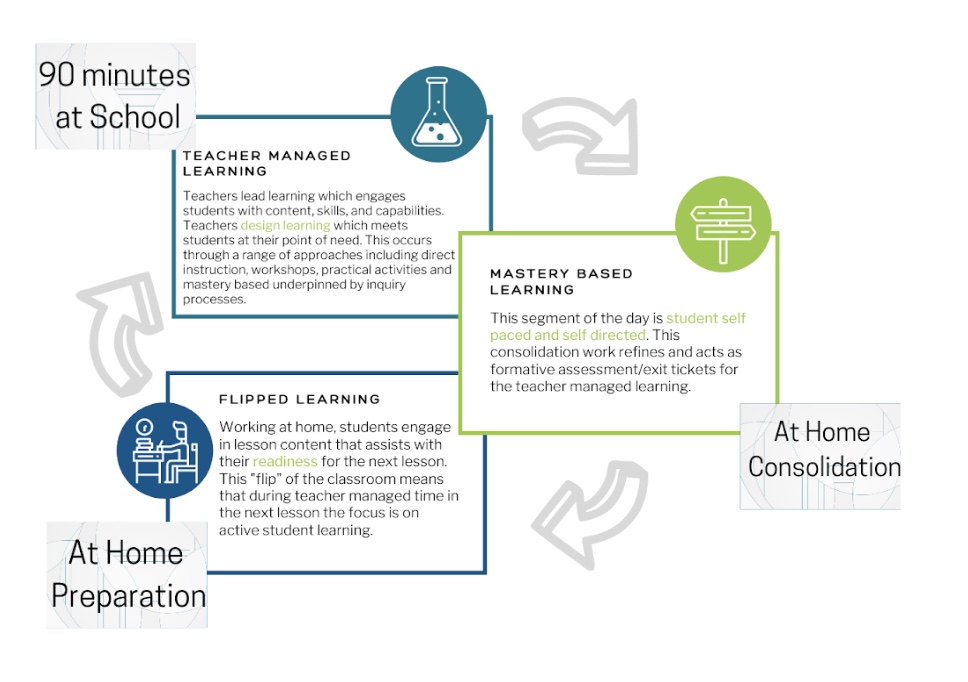
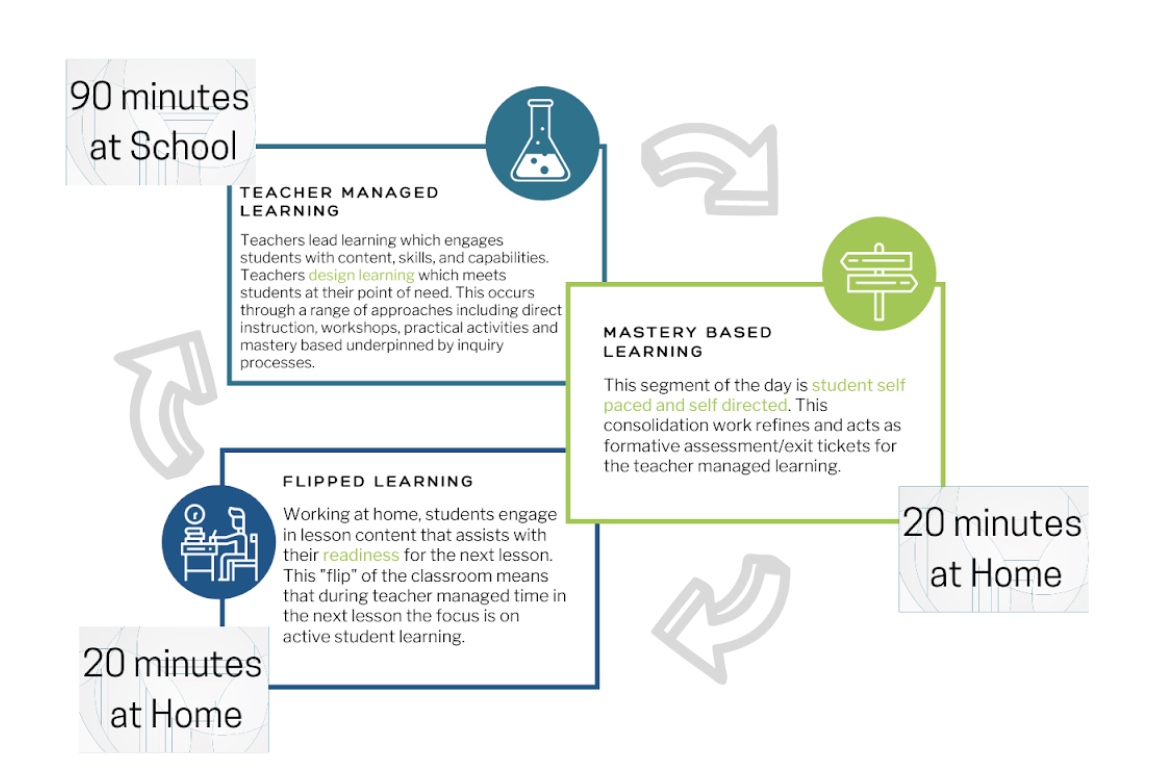
  • how we are establishing a learning cycle in Years 7-11 of face to face, consolidation (from the previous lesson) and preparation (for the next lesson).
Image developed by Kelly Bauer – Head of School of Entrepreneurs – St Luke’s, Marsden Park.

Dwayne was affirming of the work we are doing at St Luke’s by reflecting, “You are way ahead of most people I speak with.” 

Further on in our conversation, Dwayne mentioned how his school, the Ontario Virtual School (OVS) offers the Ontario High School Diploma (NSW HSC equivalent) to anyone anywhere in the world. They have 100,000 students who learn virtually, usually through “time chunked videos” (2-3mins) where they learn content and concepts accredited to the Ontario core curriculum. If students hit a hurdle they seek out support for their immediate network, usually other students, for assistance. If they then stall, they go to an expert – the teacher – who usually assists the student to access the success they have not had achieved to that point. One unintended outcome of this approach has been ‘time shift accreditation’, a reality where students make their way through the curriculum in less time than the ‘indicative hours’ of the core curriculum.

If we do what Dwayne and others do at OVS, we will reflect that a school day lasts 6 hours. What could we do if it took only 2 or 3 hours for students to satisfactorily cover accredited content? What creative models could we create with the additional 3 or 4 hours? Asking such as question might see a deep dive into which artificial intelligence can provide accelerated feedback for students or which sophisticated technologies can support teachers to more effectively track student progress and achievement at different rates and levels. Locally, it might provoke St Luke’s and other Catholic Education Diocese of Parramatta (CEDP) schools to consider a mainstream version of CEDP’s School of Now for the majority of students able to utilise a device, possibly as young as Stage 2, 8 years of age.

School of Now Learning Model

Elsewhere, but still related to the concept of time, I read, The New Zealander trying to revolutionise the working week: ‘It’s a rational business decision’. Andrew Barnes raises the concept of a 4 day working week which is getting traction through 4 Day Week Global, a non-profit group expecting to run trials with 300-500 companies internationally this year. Barnes himself, in 2018 trialled an 80-100-100 rule: 80% hours, to accomplish 100% of the work, for 100% pay. The experiment worked. Productivity rose, staff were happier. He made the change permanent.

Will something like this get traction in school settings? As I wrote on Twitter, “For the fire brigade, police, some health services, 4 day weeks (sometimes across a weekend) have been a reality for a while. Methinks schools will be the last place a 4 day week will occur even though curriculum can be covered in 4 x 6 hour days.”

The above reading and conversation was complemented by Undoing Academic Time, a rather forthright blog written by Ira David Socol. Ira’s blog contains many many challenging statements including those listed below…

Time is the ‘first technology’ because it is the most controlling of all the structures which define ‘school’. Learning is, of course, timeless. It exists in its own temporal zone, unique to each individual, and different for each thing ‘learned’. But school is all about the clock.

And of course, a mediocre work turned in “on time” trumps a great work that’s ‘late’.”

… within schools, we must stop dividing time between ‘play’ and ‘learning‘. “

Assignments need to stop having dates on them.

” ‘School work’ needs to stop being separated from life by the hard line of ‘school time’ and ‘non-school time‘.”

If a student comes to class ‘late’ or leaves early the question is not one of ‘bell compliance‘ but of how to do that politely and without disrupting others.

If a student chooses an extended lunch (usually ‘extended’ from something obscenely short) over class attendance, this needs to be viewed as a micro-economic decision, and not a behaviour issue.

When reflecting on Ira’s blog, the 4 day working week and my conversation with Dwayne, I have no idea what the implications will be for schools. After staff, TIME is the greatest resource in a school setting. I am hope-filled that schools will move into the future continually learning how to best use time as we seek new (and better) ways of learning as well as new ways (and better) ways of working.

Greg Miller

Exams and contemporary learning – it’s all upside down!

The original image was accessed from article “Trainees granted exemption to sit RACGP exams” written by Francine Crimmins and published 4/2/2021

Among all the volatility, uncertainty, complexity and ambiguity since June of this year, I have been thankful that we did not have students sitting the HSC in 2021. Those completing the HSC have been put under unnecessary pressure to undertake examinations when many, possibly the majority of students have already established their post school pathway. Those leading education in this state had a wonderful opportunity to reimagine a far more contemporary approach to the New South Wales Higher School Certificate as an exit credential. Unfortunately, under the influence of 20th century thinkers, they let that opportunity slip by.

School exams don’t prepare teens for the real world. As Jehan Casinader writes, the sad truth is students were forced to participate in a ritual that has become meaningless”. 24/7 access to information via the internet means the need to memorise information for exam conditions is no longer required. Our most necessary skill when accessing information from the world wide web is to ensure information is from a valid and trusted source.

When considering the place of exams in the context of contemporary learning, it is all upside down. Education change agent, Ted Dintersmith regularly asks, ‘Are our children prepared for the future of work?’ (3 mins). Ted Dintersmith continually reminds schools that employers no longer require employees to know or memorise information. Robots are increasingly doing the jobs which require rote memory. The need for workers today and tomorrow will be to ‘apply information in context’ in responding to challenges, develop improvements, and even transform services or products. This will be done by collaboratively working with a team, or teams of people across disciplines. The reality is, end of school examinations are taken in single subject disciplines and are a very individual pursuit with no collaboration allowed!

Please do not mistake my comments to mean subject disciplines are no longer necessary. They are. The message is that we no longer need to memorise long lists of subject facts or knowledge. Much more important is the ability to apply subject knowledge by trialling and testing new projects and processes in real world situations in addressing real world challenges.

As principal of St Luke’s, I challenge students to answer three questions:

  • Who am I?
  • What can I do?
  • What problems do I want to solve?

You won’t find any one of these three questions on a HSC paper. I dare say that none of those questions appear in any examinations for school systems across the world. However, in answering these three questions throughout their time at St Luke’s, students are more able to understand their SIM (strengths, interests and motivations), engage with concepts such as ‘flow’ and ‘purpose’, and therefore enter a post school world with confidence by knowing where they can contribute. This allows them to do more than just work; in fact, it enables them to lead a lifestyle of fulfilment and contentment because they…

  • Deeply know who they are;
  • Are confident in what they can do; and,
  • And are enthusiastic to solve problems and respond to challenges.

By ensuring the teaching and reliable assessment of our 6 Pillars of Learning remain at the forefront of what we do, and by maintaining a commitment to work with students through their Careers Expo in Stage 3 and Life Design in Years 7-10, St Luke’s will continue to nurture faith filled curious students to become creative contributors and innovative problems solvers for a changing world.

Comments, questions and feedback are all very welcome.

Greg