Author: gregmiller68
CHOICE, CHOICE, CHOICE! At a Staff Meeting?
Yesterday I spoke with teachers @materdeiwagga. I informed them I would (later that day) send them an email which would have the ‘agenda’ for our Staff Meeting early next week. Below, is the email…
Dear Teachers,
The ‘agenda’ of our meeting next meeting is about giving teachers the opportunity to set their own agenda regarding their priorities for professional learning by giving teachers choice about what work they do and with whom. Teachers can choose from the following…..
OPTION 1
JOIN A GROUP which…. Explores the possibilities of a Term 4 “Learning Day” opportunity. Considering every day is a day of learning, what is a better title? I don’t think “Activities Day” as that come with preconceptions and misconceptions about what this day (and future days) could bring. Some ideas for that day could see groups of students……
-
Design and Build a Vege Garden.
-
Explore ecologically responsible school based actions. Go to Catholic Earth Care, Australia. This is endorsed by the Bishops of Australia. Of course, we also have Erin Earth.
-
For more ideas you can go to… http://bit.ly/19FpDwC
-
What can we do to assist students to immerse students in a global challenge? What initiatives, what programs, what activities can we introduce to help students play their role as active and responsible global citizens?
-
Have a “Maker Day”. For more ideas go to https://docs.google.com/a/ww.catholic.edu.au/document/d/1GrPHmytAmBL2ZrXrbz4CDVCaxjpLEpmEA6GdhGZS14I/edit
OPTION 2
JOIN A GROUP which…. Discusses/Debates….. “All Mater Dei Classrooms should look like the Glasshouse.”
OPTION 3
JOIN A GROUP which….Updates the Staff Charter with reference to staff feedback from earlier in the year.
OPTION 4
JOIN A GROUP which…. Reduces the eLearning Plan to an succinct summary.
OPTION 5
INDIVIDUALLY, you can engage in “NON-COMMISSIONED” work. Using your imagination and creativity, a teacher can explore their own area of interest which will ‘value-add’ to the (classroom, KLA or the school) learning environment at the College. A teacher can use this time to do anything as long as it is not related to your “commissioned work” such as preparation, programming and marking. Some examples could include…
-
Taking time to explore Apps that will assist learning in your classrooms.
-
Searching for research about student-centred learning, flipped classroom etc.
-
Developing your awareness of the power of Twitter as a PLN.
-
Exploring the possibilities of Pinterest for your classrooms.
-
Starting a class blog. An example could be….
http://foodtechnologylearningjourney.blogspot.com.au/2013/07/whats-to-come-by-year-712-food.html#com
-
OR, Anything else that may ‘value-add’ to the (classroom, KLA or the school) learning environment at the College.
OPTION 6
CREATE A PAIR OR GROUP to explore “NON-COMMISSIONED” work. Using your imagination and creativity, teachers can work with others on a mutual area of interest which will ‘value-add’ to the (classroom, KLA or the school) learning environment at the College. A teacher can use this time to do anything as long as it is not related to your “commissioned work” such as preparation, programming, summative assessment and/or marking. For example, pairs/groups of teachers could develop activities which would see….
-
15 students from 3 different Wagga schools creating ?????
-
Peer writing with students from other schools across the state to create a story book, creative writing essay, persuasive speech etc….
-
Mater Dei students working with students from schools across the nation to solve a local problem.
-
Mater Dei students working with students/teachers from outside Australia develop a “cross-cultural App”.
OPTION 7
Teachers can individually engage in SELF-DIRECTED RESEARCH. Teachers are offered the opportunity to research an area of interest as long as it is not related to your “commissioned work” such as preparation, programming, summative assessment and/or marking. For example, individual teachers can…
-
Explore the AITSL Website developing a greater knowledge of emerging teacher standards.
-
View 3 x 5 minute YouTube clips which looks at transforming classrooms for collaborative learning
http://www.youtube.com/watch?v=4y2IaAC5vj4
-
Read one research article about education in Finland.
-
Read research articles about the relationship between agile spaces and learning.
-
Read an article about Critical and Creative Thinking as a “General Capability”.
-
Read articles from one the Educational Journals supplied.
-
Read a joint discussion paper published by Microsoft and Pearson Education titled 21st Century Skills and the Workplace.
OPTION 8
INDIVIDUALLY, you can engage in “NON-COMMISSIONED” work. Using your imagination and creativity, you can explore your own area of interest which will ‘value-add’ to the (classroom, KLA or the school) learning environment at the College. You can use this time to do anything as long as it is NOT related to your “commissioned work” such as preparation, programming, summative assessment and/or marking.
REALLY, THE CHOICE IS YOURS.
There will be a brief survey which all teachers will be required to complete from 4:50 pm until 5:00 pm.
What are your thoughts?
Regards,
Greg.
BYOD – the first steps
Another great piece from Alice Leung.

So my school has decided to journey down the BYOD path. This is for several reasons, including students already bringing in their own devices (not just their own smartphones but quite a few students bring in their own laptops and tablets) and asking for them to be connected to the school WiFi and wanting to continue technology-rich learning post DER (DER stands for Digital Education Revolution, an Australian government initiative that gave Year 9 students their own laptops. The funding for this has ended.)
Several teachers have asked for a blog post on our BYOD journey so far so here it is …
Before we jumped on the BYOD bandwagon, we wanted to know what students thought of this. This involved chatting to students to explain what BYOD is and whether they would bring the devices they already at home to school. We put the feelers out to see what…
View original post 511 more words
Assessment Tasks and the use of Technology
On two occasions within the last few months @materdeiwagga has been fortunate to have @aussietony, Tony Ryan, as a keynote presenter and small group facilitator working with teachers about contemporary learning. Teachers positively commented about Tony’s ability to identify with their challenges in the classroom and then provide practical strategies that were student-centred and inquiry focused.
Tony has worked with schools in Australia and overseas. He has a wealth of knowledge and knows what can be achieved when teachers make the conscious decision to work in new paradigms. As part of his commitment to work with us, Tony had numerous conversations with me as principal both before and after his visits. He also had two conversations with the Leadership Tam and sent various emails to ensure he was working with us to serve our needs. Throughout all those times, the understanding between us was that we had to be honest with each other.
A part of his presentation on day one, Tony was asked to critique two assessment tasks. He stated the quality was there and that they would definitely ‘cut muster’ with NSW Board of Studies requirements. However, “they are very 2007ish.” His point was that there was little choice for students to be creative and innovative with the use of technology.
About a week later I had another conversation with Tony. He again made the point that technology should not come before student centred pedagogy, and challenged me to encourage teachers to ensure that technology was “core” to tasks. To be fair, there are many @materdeiwagga examples of assessment tasks and other related learning activities where students creatively use technology to demonstrate their knowledge and understanding. However, based on what was presented to Tony before his visits, and at the time of his visits, there is still some way to go before it becomes ‘whole school’.
When setting an Assessment Task, in fact any learning activity for that matter, we need to ask ourselves….
1. Can the task done without technology? If so, it is not a valid task for the learning of today. 2013 learning requires technology to be used for more than just research. It needs the technology to be indispensable!
2. Is the task asking students to be collaborative and work in teams? If so, does it extend them further to act as “co-creators”? Working in teams and ‘co-creation’ will be essential requirements for most workers in 2020, if they aren’t already now.
3. With collaboration and co-creation, is it just within the school? If so, why? Why can’t the task or learning activity involve students working with others outside of school? For example,
i) 15 students from 3 different Wagga schools creating ?????
ii) Peer writing with students from other schools across the state to create a story book, creative writing essay, persuasive speech etc….
iii) Working with students from schools across the nation to solve a local problem.
iv) Working with students/teachers from outside Australia develop a “cross-cultural App”.
3. How can Social Media assist? How could teachers see students using Twitter/Facebook/Pinterest to assist with their learning?
4. What about the creation of an iPhone/Android App.? What about the creation of a website? I know Weebly is one helpful tool that some teachers @materdeiwagga have introduced to students. WordPress is another tool that three Leaders of Learning use as part of the leadership of their area of responsibility. Also, many teachers have asked students to create videos about a concept to demonstrate understanding and then these videos have been used to teach the rest of the class. An excellent use of digital technology for the purposes of learning!
5. What about publication? It is a tremendously positive comment on any learning community when they have confidence to publish student work on public websites. Some schools have been doing this for sometime.
In totality, it seems overwhelming to be doing all of the above. However, if we continue to take things one step at a time, then in three years time, our use of technology to support quality learning will have grown exponentially.
Our school, any school can take one unit at a time and reframe the task so that it couldn’t be done without the technology. At the moment, based on the nine pieces of evidence cited by Tony, almost all of the tasks could be done without the technology.
The fact is, I am very pleased with the progress of teachers and their use of their technology @matredeiwagga. We have done the right thing in the past two years to concentrate more on how technology can support student-centred pedagogy. We simply cannot and should not, put the technology before the the pedagogy. Our progress with eFolios, Moodle, all things Google, iPads, KLA blogs & websites, and many other technology initiatives, especially over the last six months, has been a privilege to witness. The challenge is for us to now, with significant student input, discover the best ways to use technology for the purposes of student learning.
Any school(s) out there interested in co-creating with @materdiewagga students?
Any school(s) out there interested in co-creating students across the state to………
Any school(s) out there interested in working with students from schools across the nation?
Any school(s) out there interested in working with students/teachers from outside Australia develop a “cross-cultural App”?
If not, do you have any ideas how we can?
I would appreciate hearing from you.
Regards,
Greg.
Feedback Feedback Feedback
Like most teachers across Australia, I have just come off two weeks holiday. In that time I had the good fortune to visit a few different places for a mixture of work and pleasure. It started with a conference in the warmer climate of Cairns, a social weekend in Sydney before spending the second week on the sideline of a court being a netball dad. All three were enjoyable experiences with the third one being the most important and most pleasurable.
When I returned home to Wagga Wagga, I was still in holiday mode and lounging by the television when I noticed a television commercial which, in part, stated, “Get paid to give feedback” and go to http://www.sponsoredreviews.com/page/get-paid-to-blog.html.) This was after recent emails which requested (in some cases almost ‘pleaded’) for me to provide feedback of my recent experience. In fact, I was asked to provide feedback to Virgin Blue regarding my flights to and from Cairns, the Ibis Hotel in Cairns and Mecure Rutherford asked for feedback. Wotif asked for feedback. Each time I go banking online I am asked to provided feedback. Each time I telephone an organisation such as Telstra or Country Energy, I am asked to engage in 30 seconds of feedback at the end of the telephone call. These organisations obviously see “feedback as a gift”.
In teaching we often hear about the power of feedback. Hattie’s studies indicate time and time again that feedback impacts most positively on student learning outcomes. Taking this on board, teachers have worked hard on improving the quantity and quality of feedback for the students whom they teach. But, how often do principals and teachers actively seek feedback about their own practice? And, do they seek the right type of feedback?
The answers to these questions are not fixed and are impacted on any one school’s/teacher’s context and resources. Review of data for external examinations, and internal action research, often provides ‘food for thought’ to teachers about their practice. Well-being surveys and classroom surveys also provide invaluable insights for teachers looking to improve their vocation.
In 2013 @matredeiwagga, the Assistant Principal (AP) has led a process which has real value. Starting at the beginning of this year, he asked staff about the possibility of each teacher surveying their students about the learning experience in their classroom. In doing so, the teaching staff revisited previous documents used for such a purpose, looked at student-centred pedagogy, the role of digital technology and examined latest research including the Gates Foundation Measuring Effective Teachers (MET) program. From these different perspectives we developed a draft classroom survey to give to students.
There were another two opportunities for teachers to comment on the survey. Each time, it was updated until it was finalised in early Term 2 and then the AP asked for teachers to volunteer for the survey experience. Well, he cannot keep up with the demand! It is a wonderful comment on our teachers and their willingness to embrace the importance of ‘student voice’. After a request from the teacher, the AP speaks with a class of the teacher’s choosing. He administers the survey to the class and reviews the feedback before passing it onto the teacher. (The reason he reviews it before the teacher is to identify any personal comments which have no place in a professional conversation. To this point in time, after some 14 surveys, there has been no need for the AP to delete a comment.) Once the teacher has had an opportunity to review the survey feedback, the AP meets with the teacher and has a coaching conversation with them. The findings of the survey are discussed confidentially between the AP and teacher. Without breaching any confidences, the AP reports that each discussion is a humbling experience where he witnesses teachers ‘taking on board the student voice’ about the learning experience as facilitated by the teacher.
The @materdiewagga experience reflects my strong feeling that feedback will always be valued by teachers when they have shared ownership of a feedback process which is focused on professional dialogue rather than judgement.
What does your school do to enable teachers to access worthwhile feedback about their practice?
Please let me know.
Greg.
Non-Commissioned Time for Teachers – An Update
A few weeks back I published the following blog “Non-Commissioned Time for Teachers” http://wp.me/p393nc-bRWm5 It was exciting to get so many responses, with many of them adding to the original idea. Ah, you gotta luv the online PLN!
The week before last, I tabled an “Ideas Paper” with the wonderful staff @materdeiwagga. The “Ideas Paper” has four “BIG Ideas”. All were represented on a shared Google document, allowing for some ‘on the spot’ collaboration. One of the four ideas was “Unstructured and Non-Commissioned Time for Teachers”. 26 teachers reflected and responded to this idea. Their thoughts, feelings, concerns, excitement and overall reflections can be found at http://bit.ly/19RDwsx
I would appreciate your comments below, or on the Doc itself, if you get a chance.
Regards and Thanks,
Greg.
Unstructured & Non-Commissioned Time for Teachers
Time is valuable. For teachers, there is never enough time, not unlike many other professions. Considering the need to deliver a contemporary education in an engaging manner, I ask the question….. are we using our time in the best way possible?
For over 12 months now I have heard about different companies giving time to employees to “do whatever they want.” Well, not really, but some companies provide ‘unstructured’ or ‘non-commissioned’ time for their employees. Some examples are:
- Apple who provide a “Blue Sky” program which allows employees to take two weeks to work on projects outside their normal responsibilities.
- Twitter have “hack weeks” once a year where employees focus for a week on their own ideas.
- Intuit gives employees 10% of their hours as unstructured time.
- Google allows employees to use up to 20 percent of their time to work on a project unrelated to their normal workload.
- LinkedIn have “InCubator”. This is where engineers can get 30 to 90 days away from their regular work to develop ideas of their own into products.
The benefits which flow from such initiatives include the following:
- Intuit say their legal department created a tool kit that lets product managers try new business ideas without needing to talk to the legal team. Also, the IT department accelerated the time it took to set up test environments for new Web products from two months to two hours.
- Google claims that many of their products in Google Labs started out as pet projects in the 20 percent time program.
- For LinkedIn, many ideas submitted to InCubator come from LinkedIn’s monthly “hack days,” in which workers can win awards for small bits of quickly written software.
There are a number of theories about why such a concepts work. According to James Lawther via http://www.squawkpoint.com/2012/08/hack-days/ reasons include:
- Staff are close to the daily work, so they know what the real issues are and how they could be fixed.
- There is no downside if a project is a flop. After all you can work on whatever you like, so staff take bigger leaps of faith, bigger risks, they will try things that they wouldn’t normally dare.
- Employees are more engaged if they can work on what they think is important. They will work harder and longer if they can set their own agendas.
- Employees will collaborate more, share ideas and solutions. They are all in it together and they don’t have their own targets to meet.
Whilst not as well-known as other companies, Atlassian is a company which gives employees the chance to work on anything that relates to their products, and deliver it during “Ship It Day”. When reading http://www.atlassian.com/company/about/shipit they strongly believe in a concept of self-directed, unstructured and non-commissioned time, because it can:
– Foster creativity – When there’s no rules, anything’s possible.
– Scratch itches – Every employee has something that bugs them about our products, and ShipIt is the time to tackle it.
– Get radical, dude – ShipIt gives a spotlight and traction to radical ideas that might not normally be prioritzed.
– Be fun! – Traditions like ShipIt Day help make Atlassian a more fun place to work.
In the interests of using our imagination, in an attempt to be creative, in an effort to be innovative, why wouldn’t we investigate such a concept for teachers? We could give teachers “Choice Days!” That is, they choose what the focus of their work. This is time where teachers can work on anything as long as it is linked to their work at school and so that it ‘value-adds’ to the learning environment. It is not a time for the ‘commissioned work’ of marking, reporting, programming etc. It is time for imagination and the creativity which can lead to innovation at the local school level and beyond!
What could come from this? Are you excited about such an idea? How could this work at your school? Your ideas?
“THE WHAT” of IMAGINATION, CREATIVITY AND INNOVATION.
Unless we have had our head under a rock for the last 5 years, all teachers, principals and education system leaders are acutely aware of the current movement to transform schools from 19th century to 21st century hothouses of innovation. Yes, I know, we are already 1/8th into it!
The ‘school transformation movement’ requires students to use their imagination and creativity to become more and more innovative. But, if “teachers make the difference”, I have some questions????
- Do teachers know what imagination is?
- Do schools, systems have a shared understanding of what creativity is?
- Are education systems open to the concept of innovation?
Through the glorious Twitter network, I was introduced to a website which contained a fantastic 8 minute video featuring Sir Ken Robinson exploring each of these terms. It can be found at…. http://www.wobi.com/wbftv/ken-robinson-creativity-and-imagination
In short….
IMAGINATION is….
- The “Well Spring” in all of us.
- the extraordinary power, to bring to mind things that are not yet created or developed.
- Possibilities for the future.
Sir Ken warns, “You can imagine all day but if you don’t DO anything with it, it (imagination) is useless.”
CREATIVITY is….
- Putting your imagination to work.
- Informally… it is “applied imagination”
- Formally, “It is the process of having original ideas that have value.”
- Creativity can occur anywhere; work, home, family and of, course, subjects/learning at school.
INNOVATION is….
- Simply “putting good ideas into practise.
- “To innovate, you have to have a process of creativity and to have that you have to foster and encourage imagination.”
- But, “You can’t go straight to it.”
Sir Ken also states, “A lot of companies are interested in innovation, and they are right to be because the world’s is changing so quickly.” Essentially, this is why innovation in schools is so important. Firstly, the companies, businesses and organisations that our students/your children will join tomorrow, will need to be innovative or they won’t be around. Secondly, “the world is changing so quickly.”
In summary, if schools can foster the process of imagination leading to creativity which results in innovation, then schools are making the transformation required to properly prepare students for the world which awaits them. BUT HOW????? That is a blog post of the future.
Inquiry and Reflections of a Professional Learning Day
Monday 29 April was a pupil free day where teachers @materdeiwagga enjoyed a Professional Learning Day with @aussietony, Mr Tony Ryan. Tony Ryan is a consultant who offers professional support to schools both within and outside of Australia. Tony has presented over 1500 keynotes and workshops at state, national and international conferences in the past 15 years. He is and was quality!
On Monday, Tony reminded teachers of the world which awaits our students and affirmed that student-centred learning will assist students to prepare for that world. From there we explored more/other/new ways to support and promote meaningful learning which will value-add to the very good work already being done. Furthermore, we deepened our understanding of inquiry learning.
There were many powerful messages that came from the presentation and workshops which Tony delivered throughout the day. Tony reminded us of the need to “future-proof” our students for the world in which they will have to work. We can essentially do this by:
- increasing student skills and knowledge as prescribed by curriculum;
- developing student capability to use digital technology for both critical and creative thinking;
- supporting the development of student personal and social capabilities; and, last but not least,
- ensuring students become authentic, lifelong inquirers; that is, to constantly ask discerning questions about life and work.
As we already know, our students of today, the adults and leaders of tomorrow, will not need to remember facts because they will be accessible at the touch of a button on a smartphone or other device. Rote learning and recall will not be as necessary as it has been to date. In fact, the more and more I read (and stated by Tony on Monday) reaffirms that adults of tomorrow will increasingly work in jobs (most of them not yet known) where organisations will require new and expansive thinking from employees who continually work in teams to solve real world problems. Schools of today and tomorrow are obligated to balance the need for curriculum compliance with the obligation to nurture the creativity and imagination required to address such real world problems.
The best schools will re-design their learning. Re-designing learning does not mean ‘changing everything’; however, it does mean implementing new strategies to complement the (right percentage of) direct instruction required to develop the essential building blocks of literacy and numeracy. It is NOT a case of “either/or”; it IS indeed a case of “both/and”. That is, schools of today and tomorrow are obligated to balance the need for curriculum compliance with the obligation to nurture the creativity and imagination required to address such real world problems. The best way to nurture creativity and imagination is to continually inquire by asking questions.
For a long time now, some say since the days of Socrates, asking questions to assess student understanding has been a core component of teaching and learning. So, asking questions is not something that is new to today’s classroom learning. In fact, it’s difficult to picture a classroom in which a teacher isn’t asking questions. The ability of teachers to ask good questions is critical to success, not only for our students but for our own growth as learners. As teachers, we need to model for our students the need to ask important questions, positive questions reflective questions by starting with “why?” “how?” “what if?” Developing our ability to questions is at the heart of cultivating the creativity and innovation required to address future real world problems.
Greg.
“TED” – A Term One Reflection
I am fortunate to work with teachers who continually challenge themselves to facilitate learning which has the interests of students at the forefront of their considerations. One concrete example is the “TED” learning initiative for Year 7 students in 2013. “TED” is the integrated approach to learning for Religion, English and Human Society and its Environment (HSIE) for Year 7 students in 2013 @materdeiwagga. “TED” is short for ConnecTED Learning and “connects” both subjects and learners, and also provides students with CHOICE of:
- Technology which will best support their learning;
- Area(s) of interest they may wish to Explore; and,
- How (in pairs or groups?) and with whom (teachers or students?) they Discover new knowledge and understanding.
Early signs are very promising indeed! Since the start of the year we have had Prime News produce a story for their nightly news. Also, we have had two visiting principals as well as two visiting academics, one of them a visiting educational professor from Finland. In both instances, students were chosen without notice to answer their questions about “TED”. I listened to these students speak about the program. In summary, they:
- Identified they were offered opportunities to choose their subject matter;
- Developed their ability to determine their own pace of study (within reason);
- Welcomed the opportunity to make decisions about who they work with and when;
- Were empowered to use available Web 2.0 technologies to demonstrate their learning; and,
- Enjoyed the agile learning space known as “The Glasshouse”.



Reflecting upon the above, at this stage they are qualitative reflections of just one individual, me. Within the next few weeks, the “TED” team of teachers will evaluate the first term of work with a specific focus about how students experienced the unit of work called “Dig Deeply”. I have little doubt that the feedback gained from the evaluation will inform teachers how to improve delivery of the unit of work, but is that all we are looking for?
To complement the evaluation of the “Dig Deeply” unit of work, there will also be the implementation of an action research process. This will take place in Term 2. The reason for this will be to commence a valid and trustworthy process that provides information about student learning gain. It may take months or even years to effectively measure the worth of TED and its impact on learning gain for students; however, the commitment to action research will provide data that will assist the College to make informed decisions about the validity of TED and its contribution to student learning gain. With that said, it may or may not use data associated with traditional measures of learning gain; that being HSC achievements, DeCourcy reviews, NAPLAN analysis, or feedback from ICAS tests. It may be that we explore learning gain in areas that will assist students to live and work in the world which awaits them; that is, explore the learning gain of students with the General Capabilities in the emerging Australian Curriculum.
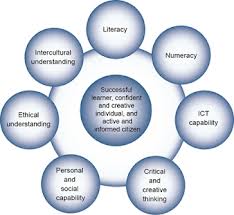
“General capabilities are a key dimension of the Australian Curriculum. They encompass the knowledge, skills, behaviours and dispositions that, together with curriculum content in each learning area and the cross-curriculum priorities, will assist students to live and work successfully in the twenty-first century” (ACARA 2013).
“They play a significant role in realising the goals set out in the Melbourne Declaration on Educational Goals for Young Australians (MCEECDYA 2008) that all young people in Australia should be supported to become successful learners, confident and creative individuals, and active and informed citizens” (ACARA 2013).
The action research process will be a trustworthy approach which ensures the data is primarily about student learning gain not just the pedagogy adopted by teachers. Furthermore, it may inform us about our stated aim of developing self-directed learners, by having students reflect on questions such as:
- What do I know? How do I know it?
- What do I need to know?
- How do I learn best?
Regards,
Greg Miller
5 April, 2013.
REFERENCES
ACARA (2013). “Australian National Curriculum.” Retrieved 5 April 2013, 2013, from http://www.acara.edu.au/curriculum/general_capabilities.html
MCEECDYA (2008). National Declaration on the Educational Goals for Young Australians.
 LEARN AND LEAD