I am fortunate to work with teachers who continually challenge themselves to facilitate learning which has the interests of students at the forefront of their considerations. One concrete example is the “TED” learning initiative for Year 7 students in 2013. “TED” is the integrated approach to learning for Religion, English and Human Society and its Environment (HSIE) for Year 7 students in 2013 @materdeiwagga. “TED” is short for ConnecTED Learning and “connects” both subjects and learners, and also provides students with CHOICE of:
Technology which will best support their learning;
Area(s) of interest they may wish to Explore; and,
How (in pairs or groups?) and with whom (teachers or students?) they Discover new knowledge and understanding.
Early signs are very promising indeed! Since the start of the year we have had Prime News produce a story for their nightly news. Also, we have had two visiting principals as well as two visiting academics, one of them a visiting educational professor from Finland. In both instances, students were chosen without notice to answer their questions about “TED”. I listened to these students speak about the program. In summary, they:
Identified they were offered opportunities to choose their subject matter;
Developed their ability to determine their own pace of study (within reason);
Welcomed the opportunity to make decisions about who they work with and when;
Were empowered to use available Web 2.0 technologies to demonstrate their learning; and,
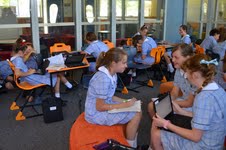
Enjoyed the agile learning space known as “The Glasshouse”.
Reflecting upon the above, at this stage they are qualitative reflections of just one individual, me. Within the next few weeks, the “TED” team of teachers will evaluate the first term of work with a specific focus about how students experienced the unit of work called “Dig Deeply”. I have little doubt that the feedback gained from the evaluation will inform teachers how to improve delivery of the unit of work, but is that all we are looking for?
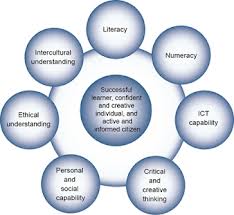
To complement the evaluation of the “Dig Deeply” unit of work, there will also be the implementation of an action research process. This will take place in Term 2. The reason for this will be to commence a valid and trustworthy process that provides information about student learning gain. It may take months or even years to effectively measure the worth of TED and its impact on learning gain for students; however, the commitment to action research will provide data that will assist the College to make informed decisions about the validity of TED and its contribution to student learning gain. With that said, it may or may not use data associated with traditional measures of learning gain; that being HSC achievements, DeCourcy reviews, NAPLAN analysis, or feedback from ICAS tests. It may be that we explore learning gain in areas that will assist students to live and work in the world which awaits them; that is, explore the learning gain of students with the General Capabilities in the emerging Australian Curriculum.
“General capabilities are a key dimension of the Australian Curriculum. They encompass the knowledge, skills, behaviours and dispositions that, together with curriculum content in each learning area and the cross-curriculum priorities, will assist students to live and work successfully in the twenty-first century” (ACARA 2013).
“They play a significant role in realising the goals set out in the Melbourne Declaration on Educational Goals for Young Australians (MCEECDYA 2008) that all young people in Australia should be supported to become successful learners, confident and creative individuals, and active and informed citizens” (ACARA 2013).
The action research process will be a trustworthy approach which ensures the data is primarily about student learning gain not just the pedagogy adopted by teachers. Furthermore, it may inform us about our stated aim of developing self-directed learners, by having students reflect on questions such as:
On Saturday February 9, 2013, I posted the question, “Has Twitter assisted your professional learning? If so, how?”
Two days later, there were 67 responses.
·14 teachers from @materdeiwagga (the place where I work) posted 15 responses.
·Another 44 colleagues from across Australia and a few from overseas, posted another 52 responses.
Throughout the following week there were another 13 responses for a total 80 responses. You can read them below.
I firmly believe each and every one of those who replied to my question, is worth a follow on Twitter. Each one contributes to an extensive professional learning network that ensures we are well connected and informed.
If you want to leave your thoughts at the end, please feel free to do so.
On Saturday February 9, 2013, I posted the question, “Has Twitter assisted your professional learning? If so, how?”
Two days later, there were 67 responses.
·14 teachers from @materdeiwagga (the place where I work) posted 15 responses.
·Another 44 colleagues from across Australia and a few from overseas, posted another 52 responses. You can read them below.
I firmly believe each and every one of those who replied to my question, is worth a follow on Twitter. Each one contributes to an extensive professional learning network that ensures we are well connected and informed.
If you want to leave your thoughts at the end, please feel free to do so.
In 2010, I was a participant at the Leading Australia Schools Program (AITSiL) overseen by Hay Group and University of Melbourne. As part of the program I was presented with substantial data about my social motives, leadership styles and organisational climate of the workplace. This information assisted me to work with others in developing a three year eLearning Plan for the College in July 2011. The ultimate objective of the plan is to transform learning and teaching by establishing a contemporary educational environment which sees teachers develop pedagogies which capitalize upon the relative advantage of using technology to enhance content.
With reference to feedback from the Leading Australia’s Schools Program in 2010, as well as data obtained from my Principal Renewal and Development Process completed in November 2011, I reflected that I needed to adopt strategies which:
Enable Teacher Autonomy; that is, develop the feeling among staff that they can decide how to do their jobs without constantly consulting their immediate ‘up-line’ Co-ordinator.
Encourage Risk Taking among teachers; and,
Promote Innovation by encouraging people to develop new ideas and approaches.
To do this, throughout 2012, I was more conscious to:
Delegate authority to the lowest appropriate level and set a minimum number of check-offs (depending on capability) in order to empower people.
Encourage teachers to exercise individual judgement, take reasonable and calculated risks, and use their time well.
Encourage creativity, experimentation, and original, independent thinking in designing new systems, solving complex problems, exploring alternatives, and pursing new opportunities.
Be flexible and help put new ideas into practice.
How am I going? I might need to ask teachers; so, I might just do that.
At our home of learning, student centred learning which
– provides students with greater autonomy and choice of subject matter and pace of study:
– involves students in more decision‐making processes
– requires extensive use of digital technologies; and,
– results in memorable experiences where students ‘learn by doing’ with relevance to the real world.
The above should then translate into core questions you ask yourself and others when trying to measure the worth and value of a learning activity. Questions such as:
–Does this activity provide greater choice of subject matter?
–Does this activity provide a choice of the pace of their study?
–How are you (the teacher) involving students in more decision‐making processes?
–Have you pursued the extensive use of digital technologies for this task?
–Will this be a ‘memorable experience’ for the students?
More and more I am questioning the value of examinations, most especially for Year 7 & 8 students. This questioning stems from the fact that our school is moving towards “connected learning approaches” in Year 7 next year. Furthermore, our teachers are pursuing and embracing an inquiry based approach to learning which will increasingly result in students taking more responsibility for their learning. In 2012, we adopted mixed ability classes in Year 7, a decision based on research, and we are now asking should this be the case for both Year 7 and Year 8 for 2013?
Last week, we had exams in the areas of English, Maths, Science and HSIE for year 7 to 10. (As an aside, why was it that only 4 of the 8 KLAs had examinations? Hhhmmm!). As a result of “Exam Week”, the day to day of schooling changed in the following ways:
·Bell times had to be altered so specifically timed exams could be implemented for the week.
·The Hall became a revolving examination centre with different year groups sitting different exams at different times for different subjects.
·When not sitting exams, during ‘normal class time’ students were given “study time” teachers. I must admit, I have done exactly the same in the past!
·Teachers were seen to be marking while the students were studying for their next exam. Again, I have done exactly the same in the past!
·14 students went home sick from school during the week. This is an abnormally high number.
It probably changes in a whole lot of others ways for many, the above is just a snapshot. The above reflects the reality of many schools, but does is reflect a sound learning environment? I understand a sound learning environment to be one which:
·provides students with greater autonomy and choice of subject matter and pace of study;
·involves students in more decision‐making processes;
·requires extensive use of digital technologies; and,
·results in memorable experiences where students ‘learn by doing’ with relevance to the real world.
Are these characteristics associated with examinations blocks? I think not!
I know some people will push the line that students need to start early to prepare for the HSC (which not all students will do), to get an ATAR (not all those who sit the HSC will pursue an ATAR), to go to university (not all students who attain an ATAR will commence university). So, how important is it for students to sit exams?
Over the next week, I am sure that, on more than one occasion a student will say, “We’ve done the exams, why do we have to do this work?” This thinking probably explains why some schools ‘make them work right up until the end’ and have students sit exams at the very end of the semester/year. (Again, I have worked in one school which does this, and know other schools who continue to do this). Students finish a semester/year with the examination block as their last learning experience for the year. Then, when they drift off into holidays, teachers mark exams, collate the marks with others assessments, write reports and then send the reports home. Where was the feedback for students? Doesn’t Hattie say something about the importance of feedback? If there is no feedback to students, why was it important for students to sit the exam in the first place?
With my unsettledness about exams resonating loudly within, I was pleased to read these minutes from a recent faulty meeting which read, “Discussion on the future value of end-of-year exams. Do they still serve a purpose? We have used assessment marks to grade students into classes but is that still valid if classes are becoming more mixed ability (Year 7/8)? What is the purpose of exams from the student’s point of view i.e. do they prepare for it; what is the point of school after the exams are over in week 6? Are there other ways to assess?”
I leave you with those questions and seek answers from you, or more questions of course!
With the understanding that “Ideas take time to incubate”, the video talks about the “slow hunch” combining with other hunches to form great ideas. The four and half minute video can be found at
As a result of viewing the the video I have the following questions…..
Next year at the school of which I am privileged to call myself Principal, the College will implement two initiatives in 2013. They are:
1.For Year 7, an inquiry based approach to cross curricular projects which result in richer, deeper learning; and,
2.For Year 11 SOR, a blended approach to learning which results in acceleration of the cohort to sit the HSC at the end of Year 11.
These initiatives will need to be supported with:
1.A group of teachers who are flexible, innovative and understand their role as one of coach and facilitator;
2.Student centred pedagogy within a guided inquiry framework;
3.Access to a reliable Learning Management System; and,
4.Effective and efficient timetabling.
Yesterday, I sent an email to teachers. Attached to that email were plans for agile, flexible and contemporary learning spaces. The email read as follows…..
Hello All,
Following on from our Briefing this morning, please find attached plans for G2.
At this stage…..
For 6 lessons per fortnight, Rooms 4,5,17 & 18 will be used for Year 11 SOR 1.
For 12 lessons per fortnight Rooms 4, 5, 6, 16, 17 & 18 will be used for 12 lessons of Year 7 (4 x Eng. 4 x RE & 4 x HSIE) per fortnight
For 6 lessons (3 doubles) per fortnight All G2, that is rooms 4,5,6,7,15,16,17,18, will be used for Connected Learning.
A total of 24 lessons. Hhhmmm, what to do with the other 26 lessons per fortnight?
For the remaing 26 lessons, who gets first choice to use those rooms? Will everybody want to use those rooms? What happened to the teacher’s desk? Will any teacher want to use these rooms, now? What if students want to use those rooms but the teacher doesn’t? What if the teacher wants to “go in there” but their class doesn’t? What does “in there” mean? What is “in there”? And before you say, “It doesn’t worry me because that’s not my room”, should there be questions about “room ownership”? Is it more about the room or about the Learning Space? How will this Learning Space change the way I teach? If there is no teacher’s desk, am I really the teacher, or am I just another learner?
Dear Sir and Miss,
Can you please guide me as to whether or not I am asking the right questions?
In 2009, Mark Treadwell ignited a passion to learn about a new paradigm of learning. This started my learning journey and shortly afterwards the College of which I am Principal. I really like two of your lines…
“To progress we must provide learning environments that challenge students thinking, ask more questions and not provide as many answers, listen more and talk less, don’t accept, be open to curiosity, explore more, fail forward and negotiate.”
Your call for new educators. “Educators who are willing to say “I don’t know; but boy, do I wanna learn!” Educators that are willing to take risks, to call out for help, to share resources, to support your learning as well as their own, educators who are personable and capable, persistent and innovative.”
For the College of which I am privileged to be Principal, our objective is to enable learning opportunities which:
·provide students with greater autonomy and choice of
osubject matter
olearning methods and
opace of study.
·involve students in more decision‐making processes.
·require extensive use of digital technologies.
·result in memorable experiences where students ‘learn by doing’ with relevance to the real world.
New Educators challenging student thinking will help this to be achieved. PLANE may assist some teachers in their journey to become “new educators”.
@7Mrsjames, “Thanks” for the post and “thank you” for the reflection it prompted.